Atlas Air to buy 2 new Boeing 777 freighters

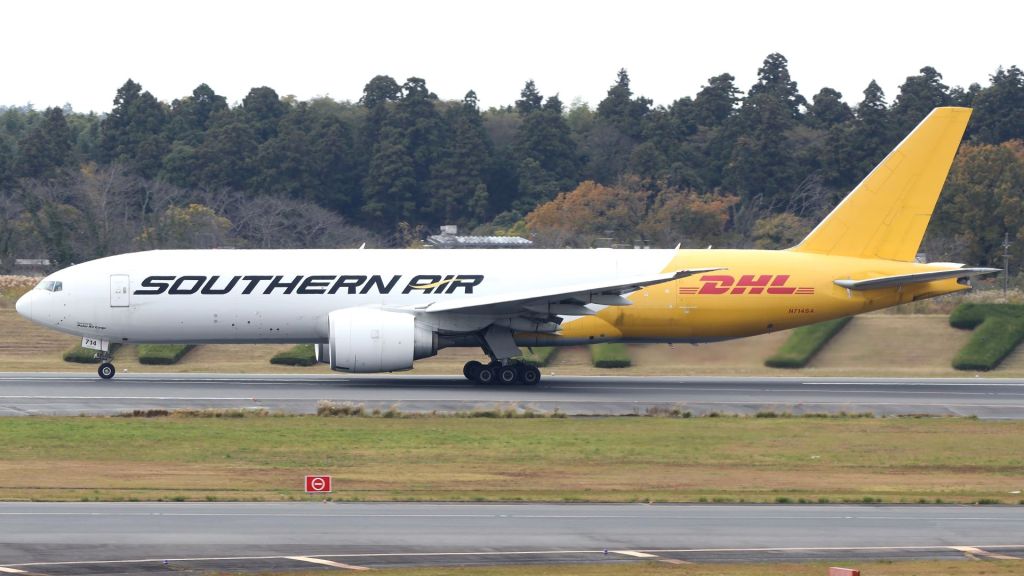
A yellow-tailed Southern Air/DHL freighter jet on the runway with evergreen trees in the background.

Atlas Air Worldwide on Tuesday announced the order of two 777 freighters from Boeing in response to strong demand for international e-commerce shipping, one of the few areas of strength in a freight market that has bottomed out after 18 months of decline and led airlines to reel in expansion plans.

The two new 777 cargo jets, which were booked in October, are expected to be delivered in the second half of 2024. Atlas Air and joint venture Polar Air Cargo operate 116 aircraft, including the largest fleet of Boeing 747 jumbo freighters in the world as well as about a dozen 777s, according to the company. Atlas has a handful of passenger aircraft used for charter customers.

Top customers include Amazon, DHL Express, the U.S. Department of Defense, Alibaba’s logistics arm Cainiao and global logistics giant Kuehne+Nagel.

Atlas Air also flies four 777 freighters for MSC Air Cargo, the startup airline from Mediterranean Shipping Co. that entered the market in late 2022. Atlas Air ordered the aircraft, which are painted in the MSC brand, from Boeing in 2021. Three aircraft have been delivered so far, with the fourth long-range freighter scheduled for delivery in December.

“We are excited to add these aircraft to our leading world-class fleet. These come at a time when retirements of older widebody freighters will significantly increase and when the introduction of new widebody freighter capacity will be limited. We have a deep pipeline of prospective customers interested in these 777 freighters, and we’re confident in our ability to place them under long-term agreements,” said Atlas Air CEO Michael Steen.

Atlas became privately held earlier this year when investors led by Apollo Global Management bought the company for $3.2 billion plus debt.

Airfreight volumes are about 6% lower than 2022, year to date, after being down more than that  most of the year and about 3% below levels in 2019, a weak year for cargo demand.

The downturn has taken the wind out of factory manufacturing and passenger-to-freighter conversions, with Boeing only notching eight orders for freighters — all 777s — so far this year, including the two from Atlas. Last year, airlines ordered 35 freighters from Boeing, including 10 medium widebody 767-300s. Boeing recorded 42 freighter orders in 2021 and 17 in 2019, a slow year for the cargo industry, according to the company’s online database.

Aftermarket overhaul specialists have also seen a sharp drop in new orders, and many all-cargo operators have paused plans to add aircraft. This year Canada’s Cargojet stopped pursuit of four 777 converted freighters, Air Canada dumped an order for two 777 production freighters, bankrupt Western Global Airlines backed out of a similar order and lessor Air Transport Services Group said it will postpone sending six 767s to specialty shops for conversion as more of its customers get cold feet.

 Click here for more FreightWaves/American Shipper articles by Eric Kulisch.

Contact Reporter: ekulisch@www.freightwaves.com 

Orders for freighter aircraft slow ‘to a trickle’

Atlas Air snags ex-Etihad cargo chief for C-suite role

Check Call: The Supreme Court and broker liability 

people gathered around a desk of computers. Check Call news and analysis for 3pls and brokers

Welcome to Check Call, our corner of the internet for all things 3PL, freight broker and supply chain. Check Call the podcast comes out every Tuesday at 12:30 p.m. EST. Catch up on previous episodes here. If this was forwarded to you, sign up for Check Call the newsletter here.

In this edition: The Supreme Court is petitioned to rule on freight brokers and F4A, and it’s been a rough year for brokerages. 

(Gif: giphy)

Broker liability, it’s something that haunts every broker’s nightmares. What happens when something tragic happens on the road as a result of the load you’ve booked? Who is at fault? 

What is F4A, officially known as the Federal Aviation Administration Authorization Act, and why does it apply to freight brokers? F4A was created in 1994 to forbid states from enacting or enforcing a law related to the price, route or service of any motor carrier. This act has given freight brokers substantial protections over the years because even though brokers have MCs (motor carrier numbers), it’s not the same type of MC as a carrier because a broker doesn’t physically move the freight. 

Bringing it forward to current events, there have been three major court cases over the last few years that have brought F4A to the Supreme Court for ruling, as there now are conflicting rulings at the circuit level.  

Of the aforementioned cases, two support the broker exemption for F4A and one doesn’t : 

  1. Ye v. GlobalTranz: According to FreightWaves’ John Kingston’s article, “The 7th U.S. Circuit Court of Appeals ruled in July that … F4A blocked GlobalTranz from being held liable for the death of Shawn Lin, [Ying] Ye’s husband. Lin was riding a motorcycle in November 2017 when he collided with a truck driven by a driver for a company named Global Sunrise, which had been hired by Arizona-based GlobalTranz to move freight.”
  1. Kingston also brings up in his article, the“guy named James’ case. “When the 7th Circuit decision was handed down, it created a split in the federal circuit court system over whether a broker could be held liable for such an accident, or whether the F4A blocked that finding. In both the Ye case and the ‘guy named James’ case involving Landstar in the 11th Circuit, the F4A was invoked by the ruling appellate panels to hold brokerages not liable.”
  1. In Miller v. C.H. Robinson, the 9th Circuit in 2020 held C.H. Robinson liable for injuries suffered by Allen Miller in an accident involving a truck booked by Robinson. The giant brokerage company asked the Supreme Court for review of the decision, but the court denied that request in June 2022.

Where that leaves us now is waiting. There is no guarantee that the Supreme Court will even hear the case, but we are left to wait while the court reviews the petition. Hopefully it puts an end to this debate once and for all. 

 SONAR TRAC Market Dashboard

Trac Tuesday. This week’s TRAC lane is Jacksonville, Florida, to Atlanta. This short jaunt of 309 miles is running 67 cents per mile lower than the National Truckload Index. Given that the load is headed into Atlanta, one of the largest freight markets in the country, the below average spot rates aren’t terribly surprising. On the flip side, getting a carrier a load out of Atlanta shouldn’t be too difficult. Rate coverage for this load should be about $516 all-in, before margin. Both outbound tender volumes and rejections have fallen in Jacksonville, which has to be one of the driving factors of the low spot rates. 

(Gif: Tenor)

Who’s with whom? 2023 has proved to be a tough year for freight brokers and carriers alike. While most of us this time last year knew there would be some losses, no one predicted the amount of loss the industry has faced this year. 

There have been no less than 12 layoffs at major freight companies this year. Undoubtedly there are more but at smaller companies and progressively as the year went on opposed to the one fell swoop approach some of the other companies had. 

First Surge filed for Chapter 11 bankruptcy and then the year was capped with Convoy’s demise and finally bankruptcy filing. While Surge attempts to battle back to operating in the black, Flexport has bought Convoy’s technology stack and nothing else from the company. 

Almost all of the companies that had mass layoffs credited the turn in the market for the need to lay people off. Spot rates have somewhat bounced back but not in a significant way that has those hunting for margin breathing a sigh of relief. 

Unfortunately, the trend doesn’t seem to be slowing down as we head into 2024. Best of luck and may the odds be ever in your favor come 2024. Also, if anyone has the secret to making the market turn faster, I’m pretty sure everyone would love for that to happen. 

The more you know 

Supply chain ‘forever about cost, quality and service’

Borderlands: Eternity Group Mexico unveils tool for shippers to monitor carbon footprint 

Biden administration announces massive logistics plan 

More parcel shippers likely to get caught in delivery surcharge net

See you on the internet.

Mary

Join the community in freight and subscribe for more at www.freightwaves.com/subscribe.

Bestpass acquires compliance platform Fleetworthy Solutions

Bestpass announced Tuesday that it has acquired truck safety and risk management platform Fleetworthy Solutions, intending to create a one-stop shop for truck toll payments, compliance and safety needs. 

Albany, New York-based Bestpass is a technology company that provides toll management services to more than 30,000 owner-operators and commercial fleet customers. The company, founded in 2001, processes over $1.5 billion in toll transactions annually, according to a news release.

“We know fleet and driver safety is a top priority with our customers. … It’s why we sought collaboration with a premier provider to incorporate safety and compliance solutions into our comprehensive range of services,” Tom Fogarty, CEO of Bestpass, said in a statement. “Fleetworthy emerged as the ideal partner, and we eagerly anticipate the valuable contributions this integrated offering will make for our customers.”

Fogarty said the Fleetworthy Solutions acquisition also allows Bestpass to expand its customer base and geographic reach by offering Fleetworthy’s solutions to its existing and new clients.

Madison, Wisconsin-based Fleetworthy Solutions was founded in 1983 and provides Department of Transportation safety and regulatory compliance services for the transportation industry. The company offers services such as vehicle and driver safety compliance and audit support.

Michael Precia, president and CEO of Fleetworthy, said he has been impressed with Bestpass’ growth and success.

“By combining our complementary strengths and capabilities, we will be able to offer a unique and powerful solution that will help our customers go beyond compliance and achieve optimal outcomes for their fleets,” Precia said in a statement. “We look forward to working with the Bestpass team to create an industry leader and more powerful and comprehensive solution set.”

The terms of the acquisition were not disclosed. Both companies will continue to operate under their respective brands. Raymond James and DC Advisory acted as financial advisers to Fleetworthy.

In June, Bestpass received a $100 million minority investment from Insight Partners to expand its toll solutions for commercial fleets and owner-operators. Last year, Bestpass also acquired ExpressTruckTax, an e-filing system for truckers, fleet owners and tax preparers.

Bestpass was also recently named to the 2024 FreightTech 100 by FreightWaves, which recognizes the most innovative companies in the commercial transportation industry. 

Click for more FreightWaves articles by Noi Mahoney.

More articles by Noi Mahoney

Eternity Group Mexico unveils tools for shippers to monitor carbon footprints

Mexico orders railroads to prioritize passenger service over freight operations

Houston may restrict cargo truck movements inside city limits

Zipline flies without ground observers: ‘Holy grail’ of drone approvals

This story originally appeared on flyingmag.com

If a delivery drone flies and nobody is there to see it, did it really fly?

Trick question — the Federal Aviation Administration requires commercial drone operators to station humans on the ground, called visual observers (VOs), to keep an eye on every flight. So, the aircraft technically aren’t allowed to fly where no one sees them.

That is, unless you have a waiver, like the one drone delivery provider Zipline secured in September. On Friday, Zipline, which primarily delivers medical cargo such as blood, vaccines and prescriptions in the U.S. and abroad, used that approval to complete what it says was the first beyond visual line of sight (BVLOS) drone flight in the U.S. without VOs.

The company had already flown BVLOS under prior FAA exemptions. But last week was the first time it — or any firm in the U.S. — had flown without VOs along the route. There is no video of the flight, since no one was there to see it.

“This is widely considered the holy grail of approvals for scaling drone delivery operations,” said Okeoma Moronu, head of global aviation regulatory affairs at Zipline.

BVLOS refers to flight beyond the view of the pilot or operator. But in the U.S., the FAA requires VOs to keep an eye on BVLOS drone flights. In other words, these flights are not truly beyond the visual line of sight, and they’re often limited to small service areas as a result.

Removing the VOs, therefore, can greatly expand the scope of a drone delivery provider’s operations beyond where it’s able to station humans on the ground.

“This exemption from the FAA represents a monumental shift for logistics and equitable access in the U.S.,” Liam O’Connor, chief operating officer of Zipline, said in a blog post. “It builds the foundation for Zipline to scale to deliver food, medicine, consumer goods and other supplies to millions of Americans on demand, and to do so in an environmentally conscious way, resulting in 97 percent fewer emissions per delivery than a gas-powered vehicle.”

Zipline flew its Platform 1 (P1) drone without VOs in Salt Lake City within an hour of receiving the all-clear from the FAA. Ground-based personnel were replaced by onboard perception technology, including the company’s patented detect and avoid (DAA) system. DAA functions like a bat’s echolocation, detecting aircraft as far as 2 miles away using acoustics.

“This system has been tested by flying tens of thousands of real-world miles around the globe and through tens of thousands of test encounters with aircraft,” said O’Connor. “It has been designed to operate with the highest level of safety regardless of visual observers along flight routes.”

The FAA in September deemed Zipline’s onboard perception system, combined with a hefty helping of operational restrictions, to be just as safe as placing VOs along the company’s routes. Those limitations require Zipline to fly below 400 feet, maintain a list of aircraft components, submit a collision and avoidance plan for all operational locations and steer its drones well clear of other aircraft.

The regulator’s approval allows Zipline to fly without VOs in Bentonville, Arkansas, and Salt Lake City, where the company is now delivering to customers without the requirement. It plans to expand the approach across its U.S. operations.

“Earlier this year, Zipline became the first company in U.S. history to receive approval from the FAA to leverage an onboard perception system to enable autonomous long-distance drone delivery flights, and [Friday], we made history doing just that,” said Moronu. “This means that Zipline can now go from serving a few thousand homes to serving hundreds of thousands of homes within the U.S.”

What it means

The removal of VOs should have a significant effect on Zipline’s operations.

Its drones are capable of flying nearly twice as far as previous approvals permitted. And without the need for VOs, the door is open for the company to operate much longer routes in the U.S., similar to those it flies in Africa. The reduced reliance on human capital also figures to decrease operating costs.

Other companies should be excited about Zipline’s new permissions, too.

In lieu of a permanent rule for BVLOS operations, the FAA awards temporary waivers on certain regulations. In September, the agency gave BVLOS permissions to four firms, including Zipline.

Another recipient, UPS Flight Forward, was permitted to replace VOs on BVLOS routes with remote operations centers, which could be tens or even hundreds of miles from its actual operations. Phoenix Air Unmanned was also authorized for BVLOS operations without VOs.

However, the permissions are not permanent. The FAA uses waivers to collect data on BVLOS flights, which it hopes will inform its proposed rule on BVLOS regulations, published in the Federal Register in May. The proposal is based on recommendations from the agency’s BVLOS Advisory Rulemaking Committee, a coalition of industry stakeholders tasked with building the framework for a final rule.

The waivers are rare — only a handful of drone operators have obtained them — and nearly all come with significant restrictions. But the FAA expects September’s round of approvals will open things up.

“Our goal is to work towards summary grants as we continue towards rulemaking,” said David Boulter, FAA associate administrator for aviation safety, at the Commercial UAV Expo in Las Vegas that month.

Summary grants are essentially streamlined authorizations for “copycat” companies with similar infrastructure, aircraft and technology to those that have already been approved.

The FAA intentionally picked applicants with four different use cases to simplify the waiver process for a wide spectrum of operators. A medical drone delivery provider, for example, could look to Zipline’s approval as a blueprint for the operational requirements needed to secure its own BVLOS permissions.

For now, though, only a handful of operators can routinely fly commercial BVLOS drone flights, and many of them are using waivers that are several years old.

Of the five companies that have been awarded FAA standard Part 135 air carrier certificates, Zipline and UPS Flight Forward now have the longest wait before their BVLOS permissions expire. Amazon Prime Air, Alphabet’s Wing, and Flytrex partner Causey Aviation Unmanned are the other three firms authorized for commercial operations under Part 135.

Those companies certainly have a leg up on the competition. But with the removal of VOs, Zipline may have the entire field beat. The company says it makes about 10,000 commercial deliveries per week, equating to about one every 70 seconds. Already, it’s completed more than 815,000 deliveries across seven countries, dwarfing all other competitors — Wing is the next closest with about 350,000 as of October.

“Zipline can now have the kind of positive impact in the U.S. that we’ve had in other countries where we can fly more than 140 miles round trip, beyond the visual line of sight of any observer, all day every day,” said O’Connor. “We have flown over 50 million commercial autonomous miles around the world, carrying everything from blood, pharmaceuticals, vaccines, educational materials, food and convenience items to tens of millions of people.”

The next step for Zipline will be the introduction of its Platform 2 (P2) system, which it says will make 10-mile deliveries in as little as 10 minutes. P2 will introduce several new pieces of tech, including a delivery droid that will replace P1’s parachute delivery system; easily installable docking and charging stations; and what is essentially a drone drive-thru window.

P2 emphasizes automation, with the only human involvement coming from the employees loading orders and remote pilots overseeing each flight. The system is expected to debut next year, though the company plans to continue P1 operations in certain markets.

It’s unclear, however, whether Zipline’s VO permissions extend beyond P1 operations. The FAA identified the company’s Sparrow drone, or P1 Zip, which it uses to conduct P1 flights, as the approved model. The new system will rely on a slightly different model, the P2 Zip.

Petroleum hauler Patriot being sold to United at solid premium

The acquisition of publicly held tanker carrier Patriot Transportation Holding by privately held United Petroleum Transports gave a substantial boost to Patriot shareholders whose stock prior to the merger announcement was not even at the company’s book value. 

In its second-quarter earnings call in May, Patriot CFO Matt McNulty said the book value of tanker carrier Patriot was $9.70. He and CEO Rob Sandlin then corrected that figure to $9.58.

But on Oct. 31, the day before the deal was announced, Patriot Transportation closed at $7.63. It shot up to $15.81 a day later when the deal was announced that United would acquire Patriot at $16.26 per share. The price of Patriot on the Nasdaq has not yet reached that level since the deal was announced.

The United Petroleum prepared statement on the deal said it is expected to close in early 2024. 

According to the 8-K report filed by Patriot (NASDAQ: PATI) in connection with the acquisition by United, Patriot management has the ability to seek a better deal through Friday. However, there is a $1.86 million termination fee.

Patriot conducts its business through a wholly owned subsidiary, Florida Rock & Tank Lines. Hauling petroleum is its primary business and it mostly uses company drivers, according to the 8-K.  

According to Patriot’s third-quarter earnings report, it drove 5.71 million revenue miles in the third quarter ended June 30, up from 5.33 million miles in the third quarter of 2022. It had revenues of $24.5 million for the quarter compared to $23.5 million a year earlier. 

Net income in the third quarter was 33 cents per share, up from 22 cents per share in the corresponding quarter a year earlier. It has not paid a dividend since 2020.

One notable quarter-to-quarter change in Patriot’s earnings report was that compensation costs climbed on an outright basis and significantly in terms of a percent of revenue. Third-quarter 2022 compensation costs of $9.77 million were 41.6% of revenues, but in the third quarter of 2023, the $11.26 million in compensation costs was 46.4% of costs. 

The compensation costs caught the eye of analysts on the third-quarter earnings call in May. In response to one question, CEO Sandlin said Patriot’s driver count was almost 400. “We haven’t quite made it to 400, but we’re 390,” he said, adding that Patriot had “pulled back” in some markets because “we’ve saturated the market with the amount of business that we have there.

“But we still see some opportunity to move that number up to 400, and that’s what we’re trying to do,” Sandlin said.

In its earnings statement, Patriot did not break out income net of fuel surcharge revenues. But fuel costs in the third quarter fell to $2.72 million from $3.97 million in the corresponding quarter a year earlier.

In the release published by United Petroleum about the acquisition, United said the deal would “create a top ten bulk tank carrier by revenue, with operations stretching from Arizona to Florida.” It also said the combined companies would have more than 1,000 professional drivers. 

“This acquisition marks a significant milestone for UPT, furthering UPT’s and Florida Rock’s shared mission to become a top five bulk tank carrier by revenue,” United said in its prepared statement announcing the acquisition. 

In a common theme heard in the trucking sector of late, McNulty said there had not been a significant reduction in capacity through petroleum haulers exiting the market. 

“We haven’t seen any kind of run or rash of closures of our competitors,” he said on the call. “We’ve seen people moving out of markets like we had done in certain places.”

Ironically, Sandlin was asked on that third-quarter earnings call about merger-and-acquisition activity in the tank transportation sector. But it was from the perspective of Patriot buying a company, not being the acquired company. 

“So we’re not shying away from acquisition opportunities,” he said, according to a transcript of the call. “We’ve looked at a couple of things, but we just haven’t seen anything that was the right fit for the right amount of money at this point.”

The possibility of Patriot being the acquiring company appears to have been spurred in part by the fact that it’s got a lot of cash on the balance sheet relative to its revenues. Full-year revenues of $87.8 million for the year ended Sept. 30 are relatively low for a company with cash of more than $7 million.  

Sandlin was asked about distributing the cash to shareholders if a good merger partner couldn’t be found. “I wouldn’t anticipate that,” he said. “We want to run our business and just keep doing what we’re doing. And hopefully, there’s an opportunity down the road for us. And we’ve distributed a lot of our cash already.”

More articles by John Kingston

STB’s Oberman rips into Union Pacific CEO Vena

Estes execs recap hack experience in unusual video presentation 

Freight rail execs seeing some green shoots for beleaguered sector

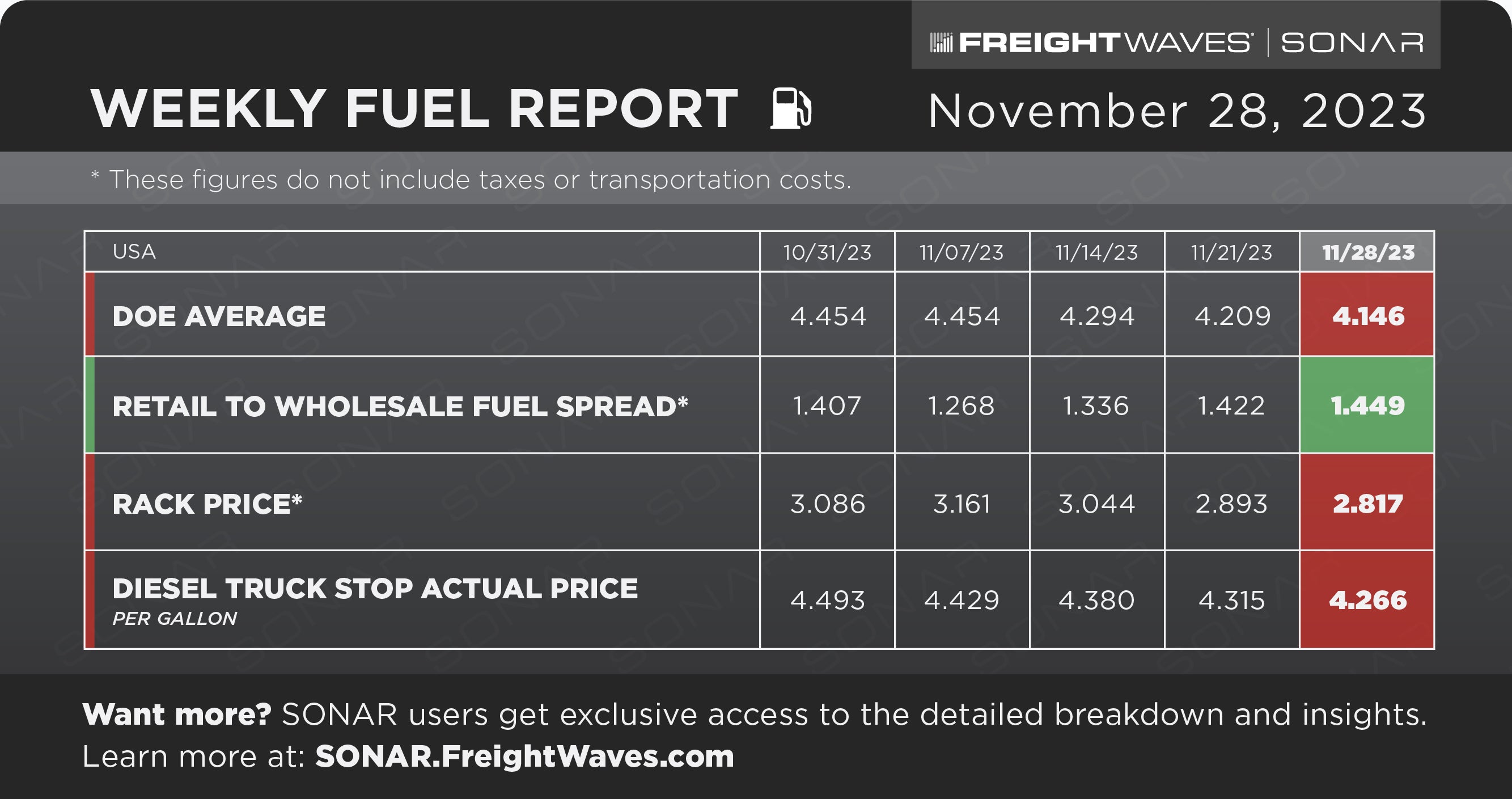
Weekly Fuel Report: November 28, 2023


Learn more at SONAR.FreightWaves.com

Show up for yourself to show up for others – Taking the Hire Road

On this week’s episode of Taking the Hire Road, guest host Leah Shaver, president and CEO of the National Transportation Institute, is joined by Eileen Dabrowski, director of learning, development and marketing at ReedTMS Logistics.

Like many within the industry, Dabrowski came to trucking with no prior experience with the work. “All I knew about trucks,” she says, “was that they are bigger than me and that they’re on the road.”

But a phone call from Jason Reed, CEO of ReedTMS, pulled Dabrowski out of higher education in 2016. During her time in academia, where she wore the hats of crisis counselor, victim advocate and emergency responder, to name but a few, Dabrowski developed skills that were readily transferable to the trucking industry.

At ReedTMS, Dabrowski built the company’s training program from the ground up, onboarding every new employee — no matter the role. Coming into contact with such a diverse set of people and their many responsibilities inspired her to gain a deeper understanding of the different positions in the industry.

It was a popular misconception, Dabrowski found, to “treat recruitment and working with truck drivers as totally different tasks.”

“I’m a firm believer that a recruiter should know exactly what it is to be a truck driver.” Without this firsthand experience, she argues, recruiters are unable to understand the unique pressures that drivers often face.

Yet, even though drivers face a common set of challenges, there is no one-size-fits-all approach to self-care. 

“Self-care is designed to be personal and subjective,” Dabrowski maintains, and so it “should be defined by the person themselves — not by their company or the truck they drive or the job they have.”

To begin sketching the outline of one’s self-care habits, one should first reflect on the identities they bear, be it one’s cultural upbringing or interpersonal relationships and the responsibilities they entail.

These aspects that define an individual are not often apparent to others, however. Open and free communication among employees and employers is therefore a necessity for putting self-care into practice.

“Growing up, I was taught that you don’t show vulnerability because it makes you weak,” Dabrowski said. “I have since learned to completely but respectfully disagree with that sentiment.

“If we don’t talk about the things that make us human, how can we be stronger together and support one another?”

Both Shaver and Dabrowski note the pervasiveness of mistaking such self-care for selfishness. “In an industry that runs 24/7/365,” Shaver stresses, implementing and encouraging self-care is something that takes “not only self-awareness but also empathy.”

People in leadership positions, Dabrowski asserts, should be acutely aware of their own reserves of empathy. “Try not to schedule all of your one-on-one meetings on the same day,” because it is important “to give everyone who asks to meet with you your full attention.”

If these precepts are followed by managerial staff, it reflects well on the business. “We live in a world of referrals,” Dabrowski notes. “If people are happy at a company, they’re going to tell everyone about it.”

Click here to learn more about ReedTMS.

More from Taking The Hire Road:

Leveraging associations and networking in tough economy

DriverReach rolls out driver qualification checklist

How PSPs lead to better data-driven decisions

Daily Infographic: DHL Express upsizes Hong Kong air hub


To view more FreightWaves infographics, click here

More parcel shippers likely to get caught in delivery surcharge net

Every year, UPS Inc., FedEx Corp. and some regional parcel delivery carriers adjust the number of U.S. ZIP codes subject to a relatively common yet costly per-package levy known as a delivery area surcharge (DAS). Based on two outside estimates, UPS’ 2024 changes will add the equivalent of 2.75 million to nearly 3 million Americans to the DAS list, even though the carrier plans to remove more ZIP codes than it will add.

The estimates from consultancies Shippingwise and Shipware LLC were based on UPS’ (NYSE: UPS) internal data and population data from the U.S. Census Bureau. According to Shippingwise, the UPS changes will add the equivalent of about 2.9 million people to the DAS rolls, while 15,000 would be removed. Shipware’s estimates weren’t much different, with the equal of 2.73 million people being added and 15,873 people being removed. 

The estimates indicate that the ZIP codes being added for 2024 cover a much larger population compared to the ZIP codes being removed, said Matt Sumowski, senior manager of client success at Shipware.

This means, in theory and likely in practice, that UPS merchants will have to pay a per-package delivery area fee for more of their transactions. UPS said in a statement that its surcharges provide “appropriate compensation” for additional costs that it bears.

FedEx (NYSE: FDX) has not made its 2024 data available to analysts, though the consultancies said that it’s a safe bet that it will make similar changes. Nicholas Fanelli, founder of Shippingwise, has estimated that the 2024 changes at both carriers will result in 29% of the U.S. population that will be covered by a DAS.

A DAS is divided into three categories. The first is a standard surcharge. A second is an “extended” area surcharge and a third, which applies to deliveries to specific ZIP codes within Alaska and Hawaii, is known as a “remote” area surcharge. Standard surcharges generally apply to relatively close-in suburban areas where the cost to serve isn’t as burdensome for the carriers. Extended area surcharges, which run higher than standard levies, cover regions that lack the delivery density of suburban neighborhoods and where the travel costs are higher. Remote area surcharges to less-acceptable delivery areas run still higher. Commercial surcharges are lower than residential levies.

DASes traditionally cover destination locations and are not applied at a delivery’s origin point. However, a returned item picked up at a DAS-eligible ZIP code would be charged a levy, according to Fanelli.

FedEx and UPS’ DAS tables are effectively the same. For example, in 2024 both will levy a $5.85 charge on each eligible residential delivery made by air. In addition, each will impose a $5.70 fee for eligible ground residential deliveries. For deliveries covered by an extended DAS, a $7.70 charge will be applied by both carriers. Each will raise their respective DAS’ in 2024 by between 25 cents to $2.50 per package, depending on the service.

Fanelli estimates that DAS accounts for about 20% of a shipper’s average total surcharge levy. 

OnTrac, the largest regional carrier that has expanded into what has become a transcontinental network, applies a DAS. So does LSO, which operates across seven Southern states including all of Texas. The U.S. Postal Service does not levy a surcharge. Amazon.com Inc. (NASDAQ: AMZN), which recently launched a stand-alone parcel delivery service known as Amazon Shipping, levies a $3.70 per package on all eligible shipments.

DAS, like the other and myriad delivery surcharges imposed by the national carriers, are designed to offset their higher costs to serve. In the case of the extended and remote area surcharges, the carriers do incur higher than normal costs. However, in more high-density suburban areas where the carriers have well-established routes, the per-package cost is significantly lower, according to Fanelli, who said in the latter scenario, a higher portion of those levies will flow to the bottom line.

Sumowski of Shipware said the ZIP code shifts are an “example of how the carriers hide additional increases separate from the increase in surcharge dollar amount. The overall impact comes from the change in the rate itself, but also from the frequency with which the charge will apply.” DAS, like other surcharges such as fuel, apply to a broad range of the carriers’ services. Fanelli added that many shippers might not even notice the ZIP code changes and their potential impact on their shipping budgets.

It is also a way for the carriers to boost their top and bottom lines within a multiyear contract period, and especially during a cycle of carrier overcapacity and slow demand.

Still, a DAS can be negotiated down (though likely not out) depending on a shipper’s volume and how much density it adds to a carrier’s network. Brian C. Gibbs, president of Refund Retriever LLC, a shipment auditing firm, said in a website post earlier this year that a 25% to 50% discount off of a shipper’s published rates “is an excellent goal.” 

Gibbs advised shippers to review the charges being assessed before asking for the concession and said one question that a shipper should ask is how many packages are slapped with a DAS.

Despite that, many merchants tend to accept these changes each year, and absorb any additional cost if they offer free shipping, Gibbs said. 

Fanelli echoed those sentiments, saying that although they may want to pass on the DAS, they won’t risk alienating their customers to do so.

(Note: An earlier version said that Amazon Shipping does not impose DAS. Though Amazon Shipping states that it does not impose delivery surcharges, a notice in its terms and conditions shows that. it does. The story’s updated version also includes comments from UPS).

Lion Electric lays off 150 employees

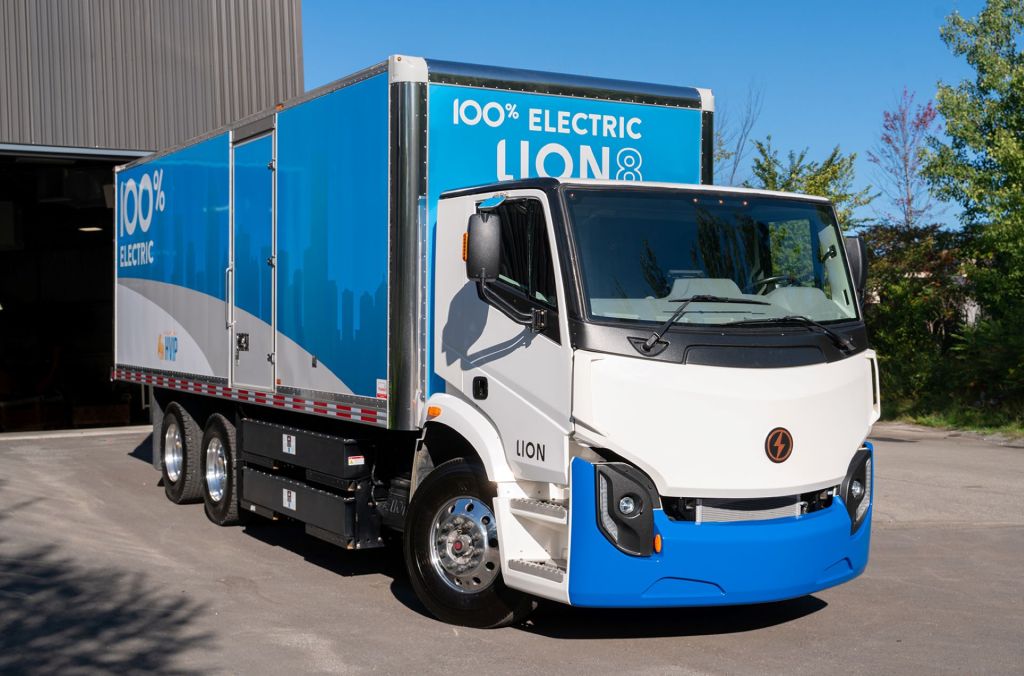
Lion Class 8 truck image from 2021

Canadian electric truck and bus startup Lion Electric is cutting 150 jobs, about 10% of its head count, in the U.S. and Canada as it seeks to reach profitability.

“Although this was a very difficult decision and we are sad to part ways with valued employees, this initiative was the right thing to do for the business at this point in time,” Marc Bedard, CEO and founder of Lion, said in a news release.

Lion is far from alone in making hard decisions around electrification. Several electric vehicle startups have filed for bankruptcy reorganization, executed reverse stock splits to prop up their share prices and cut jobs over the past year. 

Job cuts across all areas of Lion’s business

Lion’s job cuts affected production overhead, manufacturing, product development and administrative functions. The company creates, designs and manufactures all-electric Class 5 to Class 8 commercial urban trucks and all-electric school buses. 

“I am confident that the workforce remaining in place is more than capable to continue growing Lion’s leadership,” Bedard said.

The Montreal-based company posted record third-quarter revenue of $80.3 million, up $39.4 million, from $41 million in Q3 2022. It recorded record gross profit of $5.4 million compared to a gross loss of $3.8 million a year earlier. But its net loss of $19.9 million was greater than the net loss of $17.2 million a year ago.

Lion delivered 245 vehicles in Q3, 89 more than the 156 delivered in the same period last year.

Lion shares closed down 10 cents, or 5.9%, Monday at $1.59. The company has a market value of $359.6 million.

Lion Electric sues Nikola over canceling Romeo battery contract

Newly public Lion Electric will build electric trucks in Illinois

Lion Electric SPAC wins shareholder approval

Click for more FreightWaves articles by Alan Adler.