China and global trade: Why stimulus is MIA and risks are rising

a photo of Shanghai, China

NEW YORK — China’s economy has played a central role in ocean shipping for two decades, driving goods exports aboard container ships, fuel imports aboard tankers, and imports of iron ore, coal and grain aboard bulkers. Whenever the global economy flagged over the years, there was China, jumping in with stimulus, saving the day for shipowners.

Now, the era of rapid Chinese economic growth and large-scale government intervention is over, according to Leland Miller, founder and CEO of China Beige Book, a provider of independent data on China.

During a presentation at the Marine Money Ship Finance Forum in New York City on Thursday, and in a subsequent interview with FreightWaves, Miller explained why shipping’s owners, investors and analysts need to recalibrate their thinking on China.

He further predicted that relations between China and the U.S. will continue to deteriorate.

“You can have a Xi-Biden summit and you can have a bunch of pandas come back this way from China, but that’s not going to stop what is happening,” he warned the day after America’s and China’s presidents met in San Francisco.

Miller told FreightWaves that he believes markets are heavily underpricing the risk of an eventual war between the U.S. and China, a scenario with enormous consequences for ocean shipping.

Sentiment missed the mark in both directions

“The markets are notoriously bipolar on China. Just look at 2023,” said Miller.

“At the beginning of the year, coming out of COVID, everybody was absolutely sure there was going to be a rally and huge economic growth, and of course that didn’t happen. Then the markets flipped in the other direction and by this summer, we were dealing with questions on whether China was collapsing and whether the property market could create a ‘Lehman moment’ for China. Of course China is not collapsing.

“It is amazing how sentiment went from extreme optimism to extreme pessimism and none of it was based on what was actually happening in the economy,” he said.

What was actually happening in the economy was much more nuanced. “There was a sequential recovery in everything but the property — it was better than 2022,” and that economic activity was much weaker than expected but not cataclysmic. “The markets are just getting around to this conclusion months later,” he said.

Numerous shipping stocks have followed the same basic pattern as China sentiment this year: rising sharply in January and February on expectations of a post-COVID reopening boost from China, then falling back starting in March after it became clear that the China boost wasn’t coming.

‘They are not going to push the stimulus button’

China’s much-weaker-than-expected recovery has fueled months of speculation that the central government will pull the trigger on large-scale stimulus, spending its way out of low growth as it has in the past and indirectly subsidizing shipowners yet again.

Shipping analysts continue to highlight stimulus potential. “We are optimistic that Chinese infrastructure stimulus spending and further efforts to stabilize the property market will result in stable Chinese iron ore demand in the coming quarters,” wrote Deutsche Bank analyst Amit Mehrotra on Wednesday.

According to Miller, “There seems to be this belief that Xi Jinping sits in a room and there’s a button that says ‘stimulus’ on it and he’s just sort of circling around that button. And maybe he doesn’t do it today or tomorrow but it’s only a matter of time before he hits that button. Because for the last 20 years, what has China taught us? That they like high levels of growth and they’re eventually going to jam that button down and everything’s going to be OK.

“They are not going to push that stimulus button,” asserted Miller.

“Xi Jinping is no longer worried about high levels of growth. The Chinese economic growth model we were taught to track for the past 20 years is over.”

Lower structural demand for dry bulk commodities

The old model was for high growth, juiced by credit-fueled development in the property sector — “growth for growth’s sake.” The new model, he said, focuses on “slower but healthier growth, making China stronger from within, and distributing wealth more broadly.

“It’s not that growth is suddenly going to die, but it does mean that the economic growth model we grew up with is over. Analysts of China have been much too bearish cyclically [i.e., recent fears of a collapse] but far, far too bullish structurally.”

The Communist Party realizes it can’t take non-productive property development down too quickly, as property traditionally accounts for 25% of the economy. Therefore, it is culling weaker developers by allowing them to fail, then intervening with new credit before a contagion effect ensues. It is a gradual “cull the herd and ventilate” process to reduce property’s importance to the economy, which Miller believes will take over a decade to complete.

“What this means for commodities and metals is that China’s model focused on ‘build, build, build’ is gone, but that doesn’t mean the property sector is going to disappear and a country with 1.4 billion people doesn’t need to build stuff.”

Container exports, auto exports, crude imports

Meanwhile, containerized goods export data tracked by China Beige Book “have gotten really weak to the U.S. and pretty weak to Europe, but exports to Asia have held up quite well. China’s ability to export a lot to its Asian neighbors has continued to ramp up but its ability to keep up high levels of exports to the West is greatly diminished.

“When you look at the political environment, U.S.-China relations are getting uglier and uglier,” Miller added.

“I think the trajectory of the relationship does not just get worse but much worse in the coming years. I would expect more tensions and more export controls. A lot of the companies we work with are diversifying away from a complete reliance on Chinese markets and supply chains.”

Miller told FreightWaves that China’s now-booming automotive exports will be the next big trade flash point.

“The car exports are going to be the story of the next five years, the next chapter that is about to begin, because the EU and U.S. are going to move to ring-fence their markets from the Chinese. It’s going to become another trade war,” he opined.

FreightWaves also asked Miller about the surprisingly high volumes of crude oil China has imported this year, seemingly at odds with its weak post-COVID economic recovery.

“Why are crude imports so much higher if the economy is doing this? First of all, the economy was never as bad as people thought it was. It’s not collapsing. The property sector is not doing well but the rest of the economy is doing better, so you should expect more crude oil [imports],” he said.

“The second thing is that China has done a lot of strategic buying — crude bought at discounts, filling up inventories because they’re worried in terms of the Taiwan stuff. Is this sort of the end of that and will it be tapering off now? Maybe. If this continues for another six to 12 months, then we’ll be scratching our heads.”

War odds ‘much, much higher’ than markets imply

FreightWaves also spoke with Miller about the risk of a future war between China and the U.S. over Taiwan.

A common perspective from shipowners speaking at conferences is that such an event would be so calamitous that they can’t plan for it. There is also the view that fallout for both China and the U.S, would be so severe that it would be a case of “mutually assured economic destruction,” and thus, a deterrent to war.

“I do not agree with that,” said Miller.

“I think the odds of something happening before the end of the decade are much, much higher than the markets are giving credit for. The market understanding of this — that it’s way too damaging so it’s not going to happen — is just wrong.

“If you play economist war games, you can come to the conclusion that it would cost too much financially and there’s no way they’ll do it [invade Taiwan]. One problem with that conclusion is that Xi Jinping does not play economic game theory, and we don’t know what he’s going through domestically and with his military.

“The other problem is that to China, Taiwan is like Texas is to the U.S. If Texas was being pulled by somebody else, we would go to war, the consequences be damned.”

Click for more articles by Greg Miller 

STB chairman will not seek reappointment to agency

Surface Transportation Board Chairman Marty Oberman will not seek reappointment to the agency, the STB confirmed late Thursday.

STB spokesman Michael Booth said Oberman announced at the RailTrends conference in New York that he had decided against seeking reappointment, according to a news release from the board. The release said Oberman will continue to serve several months into next year, which is within his one-year holdover period. His current term is set to expire on Dec. 31 of this year.

STB gave no further details. Oberman was confirmed by the U.S. Senate on Jan. 2, 2019, to serve a five-year term.

He was often outspoken in criticism of the railroads’ handling of service issues, particularly during the COVID-19 pandemic. His critiques, which at times seemed to put him at odds with the railroads, earned kudos from both shippers and unions because he sought to call hearings and establish proceedings on rail service and publicly linked subpar service with declining head count at the U.S. Class I railroads. 

Oberman’s pending departure will raise speculation not only about who will replace him as chairman of STB, but also whom Congress might designate as his replacement so that the board can have its full complement of five members. Fewer than five members — a situation that the board has encountered in the past — could result in a board with two Republican appointees and two Democratic appointees.

Although Oberman was nominated by former President Donald Trump to be on the board, he has been affiliated with the Democratic Party. President Joe Biden later named him as chairman. 

Subscribe to FreightWaves’ e-newsletters and get the latest insights on freight right in your inbox.

Click here for more FreightWaves articles by Joanna Marsh.

How Macy’s Thanksgiving Day Parade logistics has worked for almost 100 years

Tracks Through Time

FreightWaves Classics is sponsored by Old Dominion Freight Line — Helping the World Keep Promises. Learn more here.

The logistics of the Macy’s Thanksgiving Day Parade is a massive undertaking and takes all year long. Interested in learning how it works? In this week’s episode of Tracks Through Time, Deputy Editor Brielle Jaekel and 3PL expert Mary O’Connell explain it all and also reveal some really interesting facts about the parade. 

FreightWaves Classics articles look at various aspects of the transportation industry’s history. Click here to subscribe to our newsletter!

Have a topic you want us to cover? Email bjaekel@www.freightwaves.com.

Petitions for meal, rest break waivers dispute parking shortage claims

Parked trucks

WASHINGTON — Claims that giving truck drivers more time for meals and rest will worsen parking shortages in California and Washington are baseless, according to two groups seeking federal preemption waivers.

The Teamsters and the Truck Safety Coalition (TSC) have petitioned the Federal Motor Carrier Safety Administration for the waivers in response to FMCSA’s notice published in August announcing it would consider rolling back its 2018 and 2020 decisions finding that meal and rest break rules in California and Washington are preempted by federal hours-of-service rules.

In California, truck drivers and other employees must be given a 30-minute meal break if they work more than five hours in a day, and drivers who work a shift of 10 hours or more are entitled to a second 30-minute meal break. Employees are also entitled to a 10-minute rest period for each four hours that they work in a day. Washington’s rules are similar.

Federal hours-of-service rules — which were revamped in September 2020 — require only that drivers be provided a 30-minute break after eight hours of driving time (instead of on-duty time) and allow an on-duty/not driving period to qualify as the required break.

However, FMCSA indicated in its August notice that any federal preemption waiver would focus on how petitioners address truck parking, and whether — as the trucking lobby asserts — allowing California’s and Washington’s stricter meal and rest break (MRB) laws would exacerbate parking shortages, result in more trucks parked on the side of the road and “create additional dangers to drivers and the public.”

But claims that the state MRB laws create safety issues by exacerbating parking shortages are unfounded, according to attorneys representing the Teamsters in their waiver request.

“Any parking shortages that do exist primarily impact one segment of commercial drivers — long-haul property drivers — and do not impact short-haul drivers who have many more opportunities throughout their day to stop and take breaks,” the attorneys stated.

Even for long-haul drivers, there is no persuasive evidence that there is a direct connection between the California and Washington MRB laws and truck parking or that the laws encourage drivers to park in unsafe places, the Teamsters claimed.

“Moreover, and perhaps most importantly, it is completely illogical for the agency to attempt to address parking concerns by depriving drivers of breaks which have been shown to increase drivers’ and public safety,” the labor group stated.

“If a lack of parking really does have the negative effect on safety that the agency and industry players claim, the agency should take steps to directly address that issue through its rulemaking powers, or by supporting separate efforts at the state and federal level to legislatively address these parking issues. The agency should not place the burden of that issue on drivers, who are not the ones that created or have control over any parking issue that does exist.”

TSC, a crash victim advocacy group, acknowledged “the very real and legitimate concerns” regarding truck parking shortages and safety as it pertains to drivers who approach their hours-of-service cap. Many such drivers, who also risk driving fatigued, end up parking on the road shoulder or on exit ramps due to a lack of legitimate parking.

However, “it is very unclear what, if any, documented negative safety impacts result from 30-minute rest breaks, whereby very few vehicles may pass by in that short time,” TSC contended in its petition. “Additionally, federal research indicates truck parking shortages are far more likely to occur in the evenings and overnight.”

In addition, “the premise that 30-minute driving breaks could create ‘additional danger to the public’ is absurd,” TSC stated. “In fact, 30-minute rest breaks have undisputed safety benefits, something FMCSA affirmed” in proposed hours-of-service rule changes in 2010.

Union, advocates dismiss supply chain concerns

The Teamsters and TSC pushed back on other factors FMCSA said it will use to decide whether to grant a waiver: extra burdens on interstate commerce and dissuading carriers from operating in California and Washington — both of which have been cited by the trucking industry in supporting the current federal preemptions in those states.

Regarding burdens on commerce, “TSC respectfully points out this framing is offensive to truck crash victims and anyone who cares about roadway safety,” the group stated, maintaining that FMCSA was relying on a perspective from the American Trucking Associations, which believes regulations should impose a minimal burden on commerce.

“Paying [the cost that] safety requires necessarily reintroduces a previously externalized cost back into supply chain stakeholders, where it always belonged,” TSC stated. “If those who have shirked paying this cost for generations balk at paying the cost now, TSC fails to see that as a ‘burden on commerce.’ Rather, it was always the responsibility of commerce who unjustly foisted this burden on taxpayers and crash victims for far too long.”

Also, the trucking industry’s claim that carriers will be “forced to flee” California and Washington due to extra costs required by the MRB laws is a “red herring,” according to the Teamsters.

“What this reasoning ignores is that it does not actually cost trucking companies much to comply with Washington and California’s MRB laws,” the labor group asserted, considering that 19 other states also regulate meal and rest break requirements.

“Given that carriers still must implement systems to comply with 19 other states’ MRB laws … the marginal administrative cost of complying … is sure to be small.”

Click for more FreightWaves articles by John Gallagher.

BNSF lists sites in Iowa, Kansas as primed for industrial development

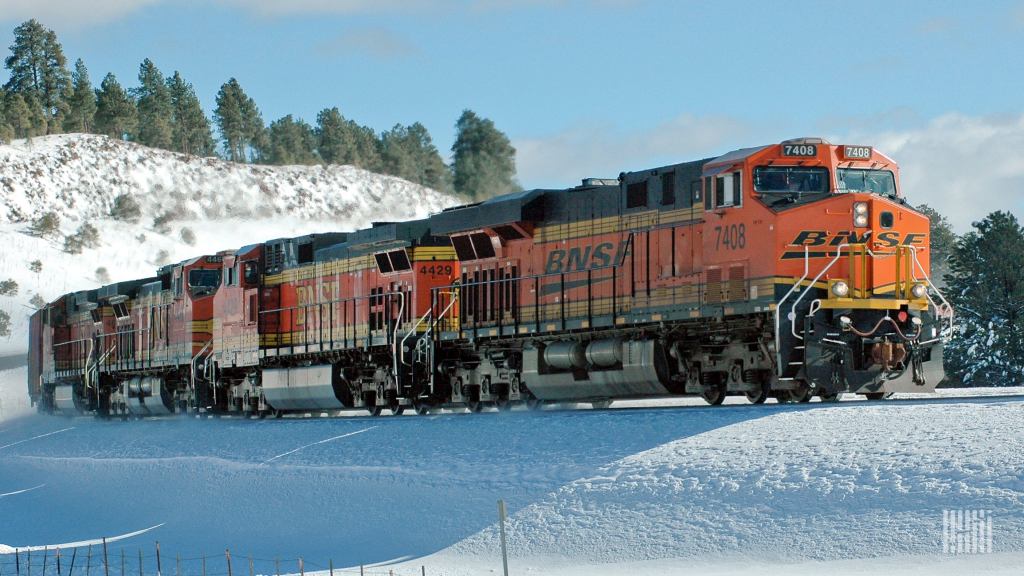
Western U.S. Class I railroad BNSF has added two sites in Iowa and one in Kansas to its certified sites program, which designates areas along BNSF’s network that are primed for industrial development.

The Iowa sites are in Fort Madison and Glenwood, while the Kansas site is in De Soto. Prior to their selection, the railroad analyzed each site’s existing and proposed infrastructure, available utilities, site availability, and environmental and geotechnical standards, according to BNSF (NYSE: BRK-B).

Both Iowa sites have been certified by the Iowa Economic Development Authority. The Fort Madison site has 116 acres and is located off four-lane US Highway 61. The Mills Crossings Mega Site in Glenwood has over 1,600 acres and is minutes from Interstates 29 and 80 via U.S. Highway 34. The Glenwood site is also within the Omaha Metropolitan Statistical Area, BNSF said.

The Astra Enterprise Park in De Soto has 205 acres and features quick access to Lawrence and Kansas City, Kansas, via BNSF’s mainline. The site is part of the Kansas City Metropolitan Statistical Area. Additional noncertified acreage is also available.

“We are pleased to add these three new locations to our list of growing certified sites across BNSF’s network,” Chris Danos, BNSF assistant vice president of economic development, said in a Wednesday release. “It’s a win-win for our customers who are ready to develop their business offerings through rail, saving them several months of construction time.”

A total of 35 sites are currently part of BNSF’s certified sites program

Subscribe to FreightWaves’ e-newsletters and get the latest insights on freight right in your inbox.

Click here for more FreightWaves articles by Joanna Marsh.

Loaded and Rolling: Freight media’s evolving landscape on display at F3

Freight media’s evolving landscape on display at F3

(Photo: Jim Allen/FreightWaves)

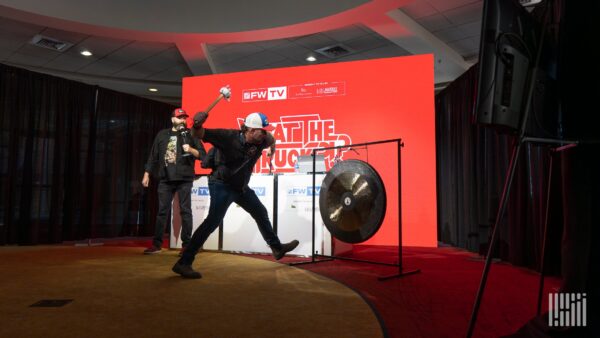
The changing freight media landscape was on full display at the F3: Future of Freight Festival last week in Chattanooga Tennessee, as influencers, salespeople, presenters and executives intermingled during and after the events. One topic discussed is the changing way media is being consumed and how traditional legacy media outlets are responding to tech-savvy upstarts. While at the event, I noted that for drivers who consume media, Facebook groups and YouTube videos remained the mainstay for consuming information but TikTok was gaining ground among the cadre of younger drivers. 

The changes in how media is being consumed is evident in the rise of TikTok, a video app by Bytedance, a Chinese technology company. A Pew Research Center survey released Wednesday found that “Among adults, those ages 18 to 29 are most likely to say they regularly get news on TikTok. About a third of Americans in this age group (32%) say they regularly get news there, a higher share than in years before. This compares with 15% of those ages 30 to 49, 7% of those 50 to 64 and just 3% of those 65 and older.” For U.S. adults under 30, TikTok’s rise appears meteoric. In 2020, only 9% of adults under 30 used it for news, according to the data. 

Barriers to entry was another topic, with one YouTuber telling me he uses his cellphone to record, edit and distribute his content to his channel, which regularly sees between 30 million and 50 million views a month. These viewing numbers have allowed him to expand his business from being a driver to a full-time content creator who interviews drivers and uploads the edited interviews while selling a line of driver-branded lifestyle apparel. 

Freight execs less optimistic at investor conference

(Photo: Jim Allen/FreightWaves)

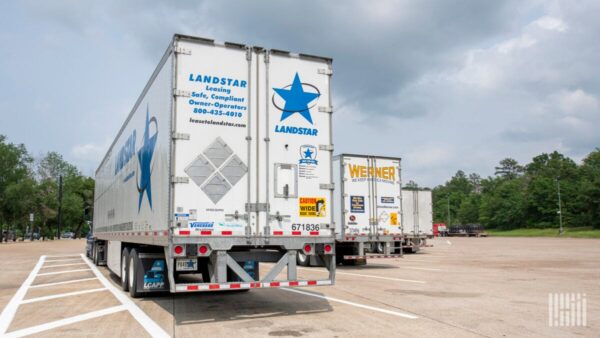
Trucking and 3PL executives, once optimistic for green shoots following a brutal ongoing freight recession, are pumping the brakes, according to comments from the Stephens 25th Annual Investment Conference in Nashville, Tennessee, on Tuesday. Freight broker Landstar System noted it doesn’t expect a peak season this year per its fourth-quarter guidance. Jim Gattoni, Landstar president and CEO, said, “There’s no excitement out there — whether it’s the parcel carriers, the shippers — or anybody who thinks this thing is going [to] turn anytime soon.”

Landstar has thousands of smaller fleets as part of its business capacity owner (BCO) program.  FreightWaves’ Todd Maiden wrote, “[Gattoni] doesn’t see spot rates stepping materially higher until next year and said that it usually takes better demand versus capacity attrition to move the market. Turnover among Landstar’s business capacity owners, a proxy for truck capacity, is 39% this year, which is in line with the 36% rate recorded during the 2019 downturn.”

Werner Enterprises described a “fairly muted” peak season as improving volumes collided with weaker pricing, causing lower year-over-year (y/y) revenue. Multimodal provider J.B. Hunt was more upbeat due to gains in its intermodal segment, which saw a larger market share, but management hoped for improving margins in the quarters ahead. 

Market update: Cass October data highlights muted peak season start

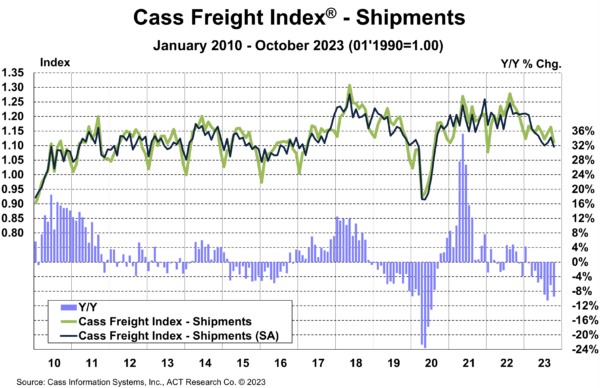
(Source: Cass Information Systems, Inc., ACT Research Co.)

On Tuesday freight audit and payment provider Cass Information Systems released its October Freight Index data, showing the for-hire freight market remaining at the bottom of a cycle that began 22 months ago. The shipments index fell 6.3% from September and was down 9.5% y/y in October, reversing more than two months of gains. The shipments data includes automotive data, and the report suggests that the United Auto Workers strike may have had an impact.

While for-hire volumes remain at cycle lows, the muted start of the 2023 peak season could be impacted by more private fleet insourcing, creating fewer loads available to for-hire carriers. Cass’ expenditures index data saw a similar decline, with total freight spend falling 2.2% month over month and down 23% y/y. 

The report is more optimistic for peak season ending better than expected. “We continue to expect modest y/y growth in consumer spending this holiday season, driven by the acceleration in real disposable incomes and the ongoing strong labor market. The recent easing in oil prices improves our confidence that peak season will end on a higher note.”

The growth of private fleets may moderate moving into 2024. The report said for private carriers, “general economic conditions remain better than those in the for-hire freight market. Although private fleet capacity expansion continues to pull freight from the for-hire market, we think equipment purchasing patterns are changing, which should propel the cycle forward in 2024, even if the broad economy slows.”

(Source: FreightWaves SONAR)

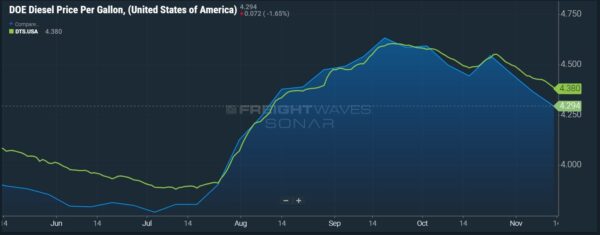
Summary: On Monday the Department of Energy/Energy Information Administration released its latest average price of diesel, which declined 7.2 cents in the past week to settle at $4.294 a gallon. This is the lowest price recorded since Aug. 7, which was $4.239 a gallon. Monday’s report has declined in seven of the past eight weeks and is down almost 34 cents a gallon from two months ago. FreightWaves’ John Kingston said an ongoing debate rages between oil investors on whether supply side cuts will matter if demand falls worldwide and how that will play out.

Kingston wrote: “The trend pointing downward on the supply side sees increasing crude flows out of several countries from the OPEC+ group, a rise in barrels that is not supposed to occur given the group’s agreement from April to limit production. It also is based on more oil from several other non-OPEC nations, such as the U.S. — which is up roughly 1 million barrels a day from the end of July — as well as Guyana and Brazil.”

One challenge will be if diesel will see higher prices for the winter due to competition with home heating oils. An EIA forecast released on Oct. 26 is projecting higher heating oil demand, with those locations primarily being in the Northeast. The EIA expects the Northeast will consume 40 more gallons of heating oil per household this winter than last due to lower temperatures. The good news is that only 4% of U.S. households heat primarily with heating oil, but the downside will be those households spending 8% more on average this winter, to $1,851. The interchangeability for household heating means if heating oil stockpiles dip below replacement levels, diesel fuel can step in to fill the gap as a temporary solution.

Truck dispatcher needing part-time, remote work wasn’t covered by ADA, 11th Circuit rules (HR Dive)

3PLs get fresh legal win in fight to block liability in truck accidents (FreightWaves)

I-10 bridge could reopen in 3 to 5 weeks after Los Angeles blaze (Trucking Dive)

Advisers to FMCSA waver on support for trucker overtime pay (FreightWaves)

JB Hunt, BNSF and GMXT to launch Mexico-to-Midwest intermodal service (FreightWaves)


FMCSA tightens regulations to prevent fraud by brokers (FreightWaves)

Like the content? Subscribe to the newsletter here.

UAW at Mack Trucks overwhelmingly ratifies earlier rejected deal

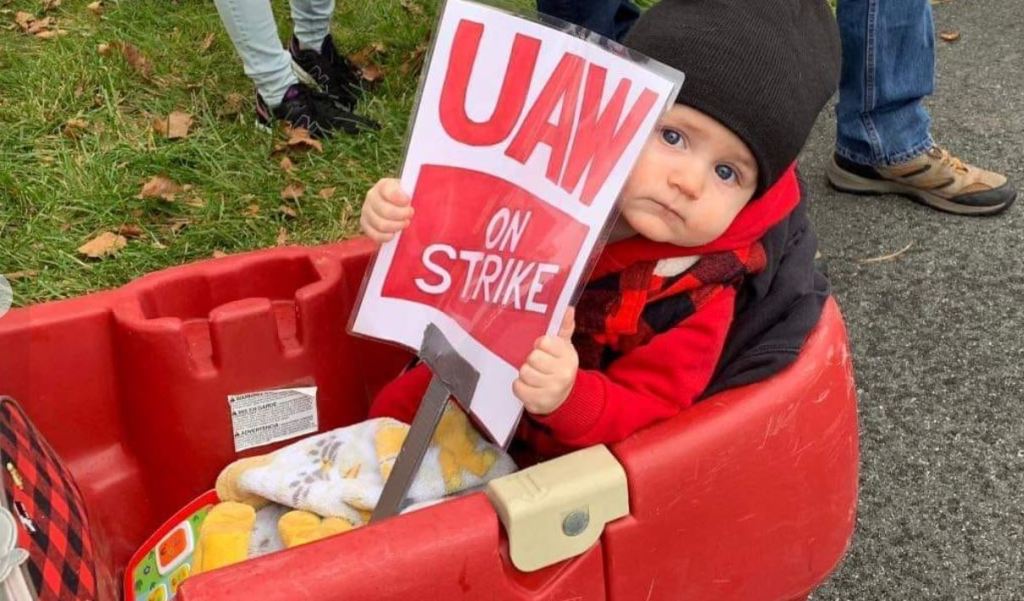
Infant with strike sign in wagon

United Auto Workers members at Mack Trucks ratified a new five-year contract they had earlier rejected, ending a 39-day strike.

Mack called the Oct. 1 tentative agreement its “last, best and final” offer. It threatened to declare an impasse and hire outside workers if the 3,900 workers in three states rejected the contract that included an immediate 10% base wage increase and a signing bonus of $3,500.

Perhaps emboldened by richer offers to striking UAW employees at the Detroit Three automakers, the locals representing assembly and remanufacturing workers in Pennsylvania, an engine plant in Maryland and parts warehouses in Maryland and Florida voted 73% against the proposed contract on Oct. 8. They struck Oct. 9.

The 146,000 UAW members at General Motors, Ford and Stellantis, the parent company of Chrysler, Dodge and Ram Trucks, began selective strikes. Those deals are separate from Mack, which is part of Volvo Group North America.

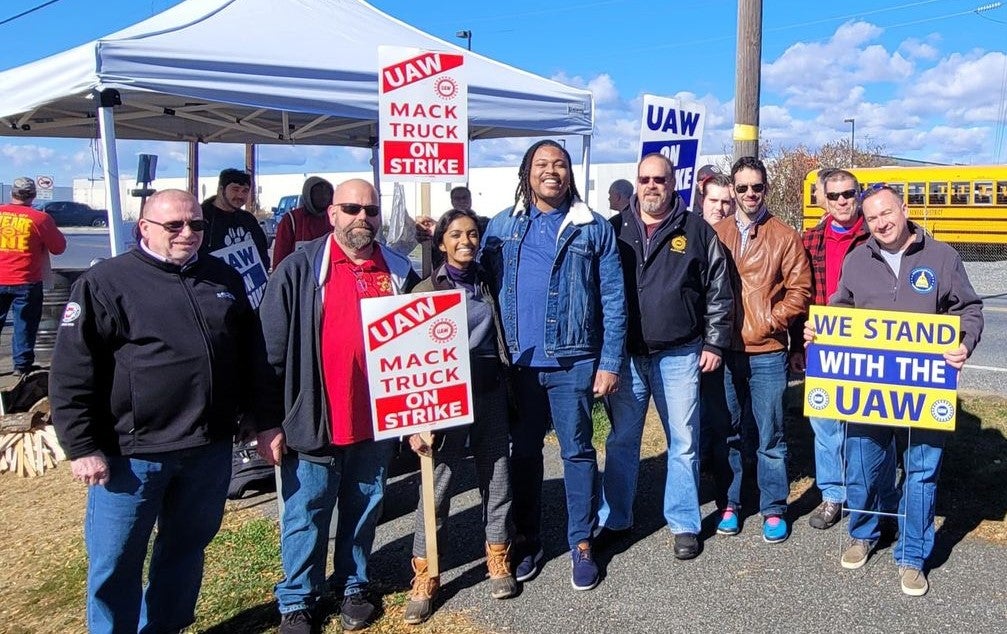
UAW strikers at Mack Trucks. (Photo: UAW)

The World Socialist Web Site (WSWS) railed against the proposed Detroit Three and Mack agreements, urging workers to reject the contracts and join rank-and-file committees seeking greater transparency in bargaining. 

Mack worker Will Lehman, a socialist supported by the WSWS, unsuccessfully opposed Shawn Fein to become president of the international union earlier this year. Fein narrowly defeated incumbent Ray Curry.

Additional gains in local UAW agreements

Union bargainers at Mack said they won additional gains in local agreements during the strike. But the master agreement remained unchanged. The second vote passed with 93% approval, the UAW said. Workers return to their jobs on Monday.

“The new agreement guarantees significant wage growth and delivers excellent benefits for our employees and their families,” Mack President Stephen Roy said in a statement Wednesday night. “At the same time, it will safeguard our competitiveness and allow us to continue making the necessary investments in our people, plants and products.”

The new contract extended by one year the length of the contract. About 45% of the total workforce is in progression, meaning they started at a lower wage and would grow into the top rate across five years, down from six years in the last contract. 

For that group of workers across all sites, the average wage increase over five years would be 55%, with an immediate wage increase of more than 20%, Volvo Group spokesman John Mies said.

Health care premiums remain unchanged despite a 66% increase in the company’s costs over the past decade, the company said.

Striking UAW will vote again on rejected Mack Trucks offer

Analysis: How costly is Mack Trucks’ stridency with striking UAW?

Mack Trucks fires back at striking UAW’s new demands

Click for more FreightWaves articles by Alan Adler.

Estes execs recap hack experience in unusual video presentation

Two of the key executives caught up in the maelstrom of the recent hack on Estes Express — including one whose name is on the headquarters — have released a remarkable video that talks about how the company dealt with the cyberattack that led to a shutdown of most of the LTL’s operations. 

The video features President Webb Estes and CIO Todd Florence. It was released password protected to the media, and a spokesman for Estes said it may eventually be released to the public but is not available now. 

There is no requirement for such a presentation; Estes Express is private and can do what it wants.

But Webb Estes said he and other company executives had chosen to be public “in an effort to make the industry stronger and to share with as much of the industry as we can, to help make us all stronger and better.”

“It really is us versus them as opposed to trying to play a corporate game of gotcha with one another,” he said. 

The video is short on specific recommendations on avoiding a cyberattack but covers a wide range of steps that a company should consider in dealing with one. 

Todd Florence (l) and Webb Estes in video presentation on company’s recent cyberattack. (Photo: Estes Express)

Crying while recording a video

Webb Estes in particular talked in an openness normally not heard from top executives of companies that have about 22,000 employees. Webb Estes, who released videos during the hack to keep the company’s customers and others up to date on progress, said several weeks earlier he had sat in the same room where the latest video was being recorded and as he got ready to record that first status video, “I cried through the first two takes, and that’s humbling.

“There’s just emotions there and I would say you kind of have to fight through those,” he said. “You have to recognize them, not hide from them. But you also have to recognize that I’m paid for a job and we’re going to find a way through this together.”

And while the discussion between Webb Estes and Florence did focus heavily on the issue of team management during a crisis, there were several points of discussion regarding what other companies should do to ready themselves for an attack that Florence said is most likely “not if, but when.”

One question submitted by the media that was not addressed was whether Estes paid ransom to help end the attack. 

Webb Estes said when a company is hit like Estes Express was, “you realize that customers have choices and options, and they don’t have to go with you.”

Estes Express is private, so it does not disclose its finances. Webb Estes also said it has no debt, so he “didn’t need to speak with bankers.”

Lack of a financial impact

But he indirectly shot down any suggestion that other LTL companies were able to grab significant market share as a result of the hack. “I am proud to say that at this point, we are back  hitting numbers that are up year over year,” he said. 

Florence said Estes Express had “noticed some outside actor activity on our network” on Oct. 1, a Sunday. By later that day, the word was spreading, boosted by an Estes Express tweet that didn’t use the word “cyber” but told the world that it was having technical problems. 

Operations returned in stages, often accompanied by a video from Webb Estes. His final pronouncement that all operations were back to normal was put on X Oct. 24

But the attack was not all-encompassing, Florence said, and many of the technical capabilities at Estes were shut down by the company’s own decision.

“If there was a big red button, this is kind of what we pushed,” Florence said. All network connectivity was turned off, “and we did that in an attempt to protect our employees, our customers, our partners and then to give us a playing field from which we understood what was going on.”

Estes Express did have an “incident response” plan that it had put together with Guide Point Security Services. “We probably had them engaged within 90 minutes of turning off all the network connectivity,” Florence said.

That relationship came in for significant praise by both Florence and Webb Estes. Companies should have “somebody they know on speed dial” when they get hit in such an attack. “We surveyed lots of different companies to pick one,” he said, adding that a cybersecurity partner needs to understand culture as well as technology.

Having a partner also helps a company get past some tough internal times. “Conversations can get heated pretty quickly when you’re trying to figure out what is the right path to go,” Florence said, noting that a partnership with an outside company, with an incident response plan in place, allows a company to avoid “spending a lot of time in the worrying and more about how do we move forward.”

Communication systems mostly weren’t affected by the hack and instead stopped working because of Estes Express’ decision to shut them down, Florence said.

And Webb Estes said the company needed to avoid the temptation to bring back too quickly those systems that weren’t hacked. “I almost felt like we could get up in 24 hours,” he said. “But part of that process is you’re also trying to make sure that when you do come back up, you come back up clean and secure.”

A message that came through numerous times during the discussion is that mistakes are going to be made in the recovery and the best way to deal with them is to accept that they are going to occur. Florence said there were plenty of instances of seeing some employees take steps that were inventive but then on further review, “we’d come back and say, ‘Don’t do that, please.’” But overall, “the teams found lots of ways to get things done.”

Go home! 

Dealing with burned-out employees is a key challenge, both Florence and Webb Estes said.

“I saw that our role wasn’t just to be making good decisions,” Webb Estes said. “It was counselor. It was, ‘Hey, you need to go home and get eight hours of sleep and then come back and give me a strong 16, but like get out of here now. Take your break.’”

Both Florence and Webb Estes recommended spending money to prepare and defend in advance. 

“I think what you’ll see coming out of this is continued investment in more security,” Florence said, adding that earlier investments in cloud technology were able to prevent the hack from being more extensive.

Webb Estes referred to a recent presentation he heard at a conference where a speaker discussed “building out a digital twin and giving customers visibility to do all their freight.”

Estes Express will “continue to lean into those things,” Webb Estes said. 

More articles by John Kingston

Reliance’s Albrecht sees capacity disappearing from market at rapid pace

3PLs get fresh legal win in fight to block liability in truck accidents

Haslam family sues Berkshire over valuing of final chunk of Pilot

‘Ambitious dreamer’ Trevor Milton seeks probation instead of prison

Trevor Milton’s lawyers portrayed the Nikola Corp. founder as “guileless” and well meaning in a motion seeking probation instead of prison time at his scheduled Nov. 28 sentencing on three federal fraud convictions.

A jury found the 41-year-old Milton guilty on Oct. 14, 2022, for lying about the progress and prowess of the electric truck startup to inflate the company’s stock value.

“Trevor’s enthusiasm, his optimism, his spontaneity, and his ‘deep emotional connection’ to Nikola inspired many of his statements,” according to the 50-page motion filed late Tuesday in U.S. District Court in Manhattan, New York. “And there is no doubt that Trevor is an ‘ambitious dreamer’ who ‘sometimes gets ahead of himself.’

“Those who know Trevor best explain that he is ‘child-like in his passions for what he gets excited about and because of this, his words may come off at times differently than he intends.’” 

Lost bid for new trial

Milton was convicted on one count of securities fraud and two counts of wire fraud. That included the acquisition of a Utah ranch partially paid for with Nikola stock options that ended up being worthless. Prosecutors called Milton a liar and “con man” who intentionally defrauded investors.

Under federal sentencing guidelines, Milton should receive 17½ to nearly 22 years in prison. Judge Edgardo Ramos does not have to follow those guidelines. Milton’s lawyers said the sentence should range from 12-18 months. But they are seeking probation, in part because Milton is caring for his ill wife. He is free on a $100 million bond, secured in part by his $32 million ranch in Utah.

Milton lost a bid for a new trial in August. In a recently concluded arbitration case, Milton must pay Nikola and was $165 million, in part to cover a $125 million Securities and Exchange Commission fine levied against the Phoenix-based company.

Nikola builds hydrogen-powered fuel cell electric trucks at a plant in Coolidge, Arizona. Milton envisioned a fuel cell truck when he founded the company in the basement of his Utah home in 2015. 

“It is undisputed that Trevor and his team delivered a cutting-edge company that developed track-tested trucks and a hydrogen station infrastructure,” his motion said. “Nikola’s revolutionary accomplishments were supported by a bona fide business model, proven technology, and sophisticated engineering.”

Social media presence led to trouble

But Milton’s penchant for using social media and interviews to brag about the company’s accomplishments got him in trouble. 

“Putting Trevor out in public to promote Nikola was a strategy conceived and endorsed by two of the most sophisticated and esteemed members of the company’s board, Jeff Ubben and Steve Girsky,” his motion said. “And Trevor’s public statements were largely consistent with the Nikola business model.”

Nikola went public in a reverse merger with special purpose acquisition company VectoIQ, led by Girsky, in June 2020. The company value at one point exceeded $30 billion. Girsky in August became the company’s fourth CEO in four years. Company shares trade around $1 today compared to an intraday high of more than $90 in June 2020.

In a rare public statement on social media, Milton in June opposed Nikola’s bid to double the number of authorized shares in the company. The activation of those shares dilutes the value of current holders.

Milton cashed out tens of millions in Nikola stock

Milton at one time owned more than 25% of the company stock and landed on the Forbes magazine lists of billionaires under the age of 40. He resigned from Nikola in September 2020. That followed a 67-page report by short seller Hindenburg Research alleging the company was built on “an ocean of lies.”

Milton collected tens of millions of dollars from selling company shares after his lockup expired in December 2020. 

“Trevor is a decent, guileless, hard-working, kind-hearted, generous and caring person,” his lawyers wrote. “We respectfully submit that any misstatements Trevor made were the product of his deeply-held optimism and belief in Nikola, rather than any sinister motive or intent to harm retail investors.

“The government introduced no evidence whatsoever that Trevor intended to sell all, or a substantial portion, of his shares upon the expiration of the lock-up period. In fact, to this day, Trevor remains the single largest shareholder of Nikola, the company that he conceived, built and still loves.”

Prosecutors have a week to file their sentencing recommendation with the court.

Nikola claws back $165M from founder Trevor Milton

Nikola founder loses bid for a new trial

Milton cashes out $131M in Nikola stock, slicing dominant ownership

Click for more FreightWaves articles by Alan Adler.

Solera lays off staff via Teams, video goes viral on TikTok

Vehicle life cycle management software provider Solera Holdings Inc. is going viral for all the wrong reasons.

Solera conducted a round of layoffs via Teams on Monday. Unbeknownst to company officials, the cutback announcement was filmed by one of its employees and later posted on TikTok.

https://www.tiktok.com/@liz_queenvirgo/video/7300219341897796907

Employees were evidently upset and quick to voice their opinions of the layoffs and the way they were executed in the video.

“This is bull—-,” said one woman in the video.

“You guys don’t care, that’s the problem with this company,” said another upset employee. “You guys have not cared about your employees at all. Automate [acquired by Solera in 2019] used to be an awesome company. You guys bought us and f—– us royally. I’m so disgusted and I’m the only one on this team who has tried to f—— fix everything. Good luck with the billing, you guys are screwed.”

FreightWaves reached out to both Solera Holdings and the TikTok account to clarify details of the layoffs but had not received comment by the time of publication.

According to a Tuesday update on Layoff.com, West Lake, Texas-based Solera released 44 members of its U.S.-based billing team and “now all of their billing is done in Mexico.”  

A LinkedIn post suggested layoffs were also carried out at Dealersocket, an automotive dealership management system acquired by Solera in May 2021. That deal also included fleet management software Omnitracs. All three companies are portfolio companies of Vista Equity Partners.

Past layoff problems

This is not Solera’s first time executing mass layoffs to ship jobs out of the country.

Five months after acquiring Omnitracs and Dealersocket in 2021, Solera laid off 30% of its total employee count, moving many of those jobs to Mexico and India.

According to an Omnitracs human resources employee at the time, layoffs were a regular occurrence, taking place two to three times a year since 2019 as part of Vista Equity Partners’ overall strategy to sell the company.

“They have been trying to sell Omnitracs and have been very focused on profits. At one point there were talks with Goldman Sachs that didn’t go through because they just wanted more money than Goldman was willing to pay. … Continuously being in talks with someone to try to sell has been a trend,” the HR employee said.

Those talks would represent the fifth time Vista Equity has attempted to exit its Omnitracs investment. 

In March 2021, there were talks to combine the three companies — Omnitracs, Solera Holdings and Dealersocket — to go public under blank-check firm Apollo Strategic Growth Capital (NYSE:APSG) for a potential $15 billion. Unfortunately for Vista Equity, the special purpose acquisition company strategy had cooled off on Wall Street as technology valuations fell 3.5% that month.

This is a developing story. 

Have a story to share about FreightTech? Email gsharkey@www.freightwaves.com


https://youtu.be/vuKzrKyOj_g?si=dI_osb5Rj7vUzNuL


Updated: Massive layoffs hit Omnitracs and DealerSocket

Vista’s SPAC exit of Omnitracs on ice

Vista eyes SPAC for another attempt at Omnitracs exit