Reported incidents of cargo theft soared 59% in Q3, CargoNet says
Cargo security company CargoNet says it recorded 692 incidents of theft and pilferage in the U.S. and Canada during the third quarter, a 59% increase from the third quarter of 2022.
The increase was largely fueled by a sharp rise in what are known as “shipment misdirection” attacks, in which bad actors use stolen identities from truckers and freight brokers to obtain freight that can be “misdirected” from the intended receivers. These so-called strategic thefts increased 430% year over year, CargoNet reported. By contrast, the incidence of theft of a fully loaded trailer increased by only 4%.
Cargo theft, especially strategic thefts, is expected to continue at “unprecedented levels” through year’s end, CargoNet said on Thursday. Throughout the year, strategic cargo theft rings have accelerated their efforts during holiday periods, and the upcoming holidays will be no different.
Truckload shipments of commodities like copper, brass and aluminum are being targeted, along with licensed sports apparel and personal care and beauty products, CargoNet said.
The company said that strategic cargo theft groups are pioneering methods of theft that seek to evade common compliance practices used by brokers. In particular, thieves are targeting small truckers or owner-operators in efforts to hijack their accounts or to persuade them to solicit shipments from brokers, CargoNet said. “Both strategies seek to evade identity-theft checks” that a broker normally performs before tendering a shipment, CargoNet said.
The actual incidence of cargo theft is typically higher than what is publicly reported, according to CargoNet. There are various reasons for this, according to Keith Lewis, the company’s vice president of operations. A pilfered shipment is considered a cost of doing business and is seen as an embarrassment to the victims, so it is often never reported, he said. Because law enforcement considers many supply chain disruptions to be civil issues, it can be difficult to report identity theft crimes and hostage loads, Lewis said.
Jurisdictional issues with law enforcement also keep loads from being reported, Lewis said. “Cargo stolen somewhere in transit is difficult to file a report when you don’t know where to file,” he said.
The minor fall and the major lift
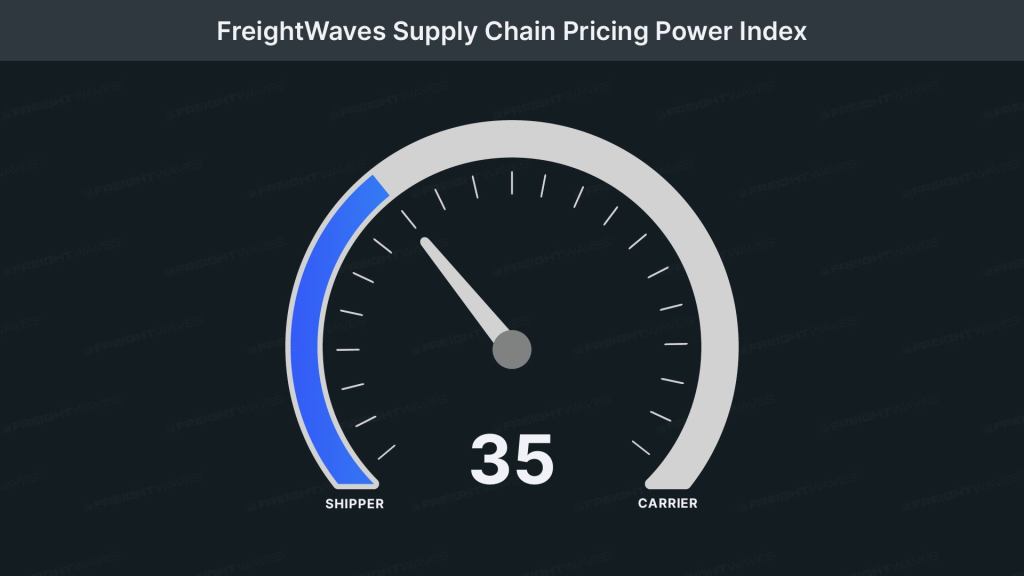
This week’s FreightWaves Supply Chain Pricing Power Index: 35 (Shippers)
Last week’s FreightWaves Supply Chain Pricing Power Index:30 (Shippers)
Three-month FreightWaves Supply Chain Pricing Power Index Outlook: 35 (Shippers)
The FreightWaves Supply Chain Pricing Power Index uses the analytics and data in FreightWavesSONAR to analyze the market and estimate the negotiating power for rates between shippers and carriers.
This week’s Pricing Power Index is based on the following indicators:
Pre-Thanksgiving stuffing
The logistics world’s most exciting industry event has just come and gone. But while my back was turned this week, freight markets underwent a surprising rally that saw a wave of volumes sweep across the country. Interestingly enough, many of the largest markets were relatively stagnant or even in decline this week — with a few notable exceptions.
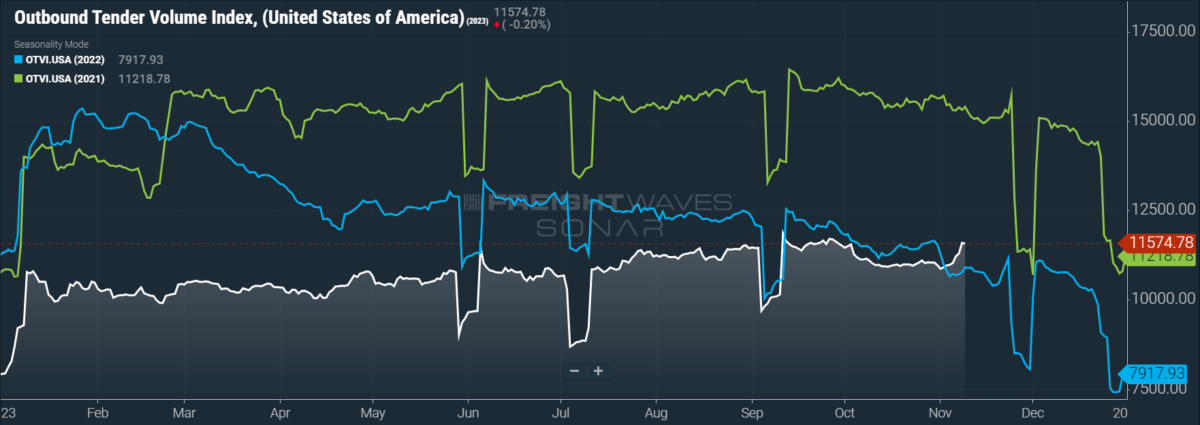
Tender volumes are finally above year-ago levels: SONAR: OTVI.USA: 2023 (white), 2022 (blue) and 2021 (green) To learn more about FreightWaves SONAR,click here.
This week, the Outbound Tender Volume Index (OTVI), which measures national freight demand by shippers’ requests for capacity, is up 6.13% week over week (w/w). On a year-over-year (y/y) basis, OTVI is finally up 6.2%, though such y/y comparisons can be colored by significant shifts in tender rejections. OTVI, which includes both accepted and rejected tenders, can be inflated by an uptick in the Outbound Tender Reject Index (OTRI).
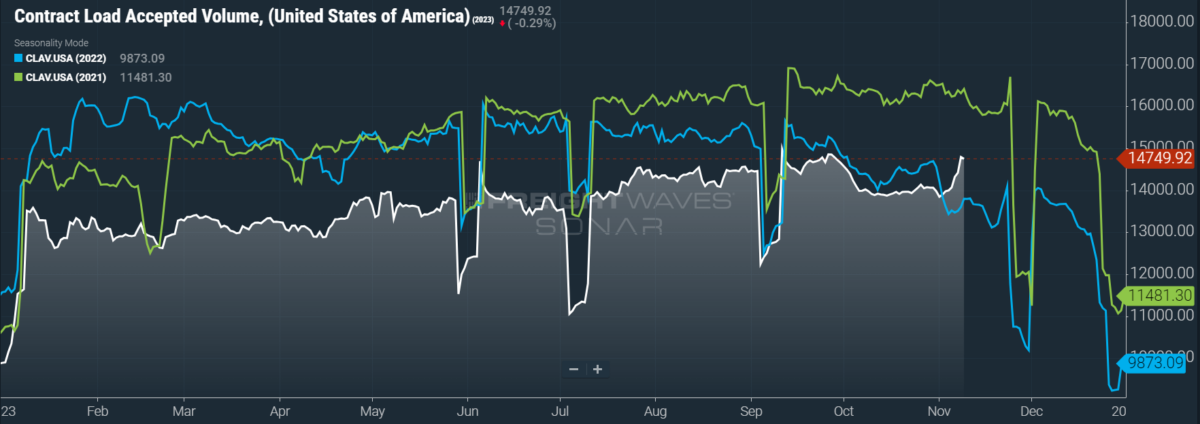
Accepted volumes are outpacing those of 2022: SONAR: CLAV.USA: 2023 (white), 2022 (blue) and 2021 (green) To learn more about FreightWaves SONAR,click here.
Contract Load Accepted Volume is an index that measures accepted load volumes moving under contracted agreements. In short, it is similar to OTVI but without the rejected tenders. Looking at accepted tender volumes, we see a rise of both 6.83% w/w and of 8.75% y/y. This narrowing y/y difference implies that actual freight flow is recovering from this cycle’s bottom.
The industry is indeed recovering, as can be seen from October’s incredible surge in containerized imports. Per data from Descartes Systems Group, imports were up 3.9% y/y in October and 4.7% over September, making for the third-best October on record (behind the obvious front-runners, 2020 and 2021). This surge — particularly the Port of Los Angeles’ 81% increase in imports from Oct. 26 to Nov. 2 — fed truckload markets like a goose bred for foie gras. Truckload volumes in Ontario, California, a heavyweight market that houses and distributes the lion’s share of Los Angeles’ and Long Beach’s imports, are up a staggering 26% w/w.
But as much as I would wish otherwise, the caveats must be restated. First, October’s growth was heavily driven by exports from China. As we have previously noted, China halted or curbed exports at the beginning of October during the national celebration of Golden Week. Taking into account the lead times, transit times and potential delays at either the port of discharge or lading, this disruption will not hit U.S. shores until next week. So by all means, smoke ’em while you’ve got ’em, but the winter is about to hit truckload markets sooner rather than later.
Second, ocean carriers are bracing for unfavorable trade winds that are forecast to persist well into 2024 if not beyond. After a brutal third-quarter earnings miss, Hapag-Lloyd — the world’s fifth-largest ocean carrier — tightened its guidance for the remainder of the year. Rolf Habben Jensen, CEO of Hapag-Lloyd, identified the problem not as volume weakness but as overcapacity driving down rates. “We do not expect a dramatic recovery of demand in the next couple of quarters,” Habben Jensen said. “The macro environment remains challenging, there are two wars going on, interest rates are still pretty high, inflation is higher than it should be, and investor sentiment is not great.”
This outlook is equally applicable to truckload markets, insofar as they are both fed by maritime imports and are also suffering from overcapacity driving down rates. As we will note below, even a 10% increase in actual volumes is not nearly enough to compensate for the lingering aftereffects of the past few years’ freight gold rush. In fact, this problem might be extended by struggling carriers being thrown a lifeline by an all-too-brief surge in volumes.
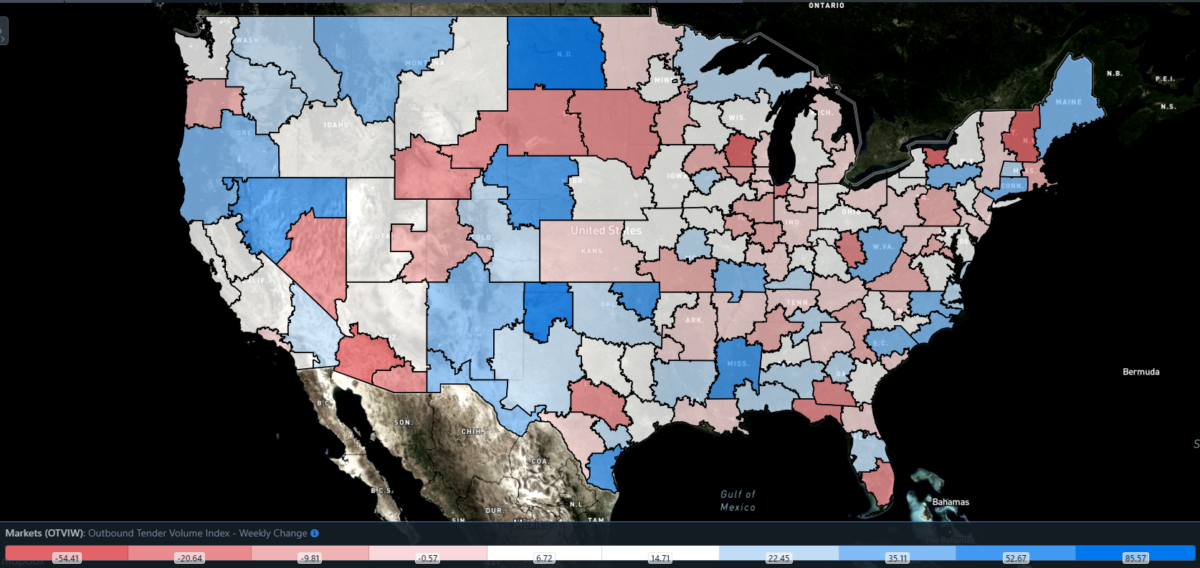
Markets of all stripes see gains, large and small: SONAR: Outbound Tender Volume Index – Weekly Change (OTVIW). To learn more about FreightWaves SONAR, click here.
Of the 135 total markets, 103 reported weekly increases in tender volumes, with gains seen in markets along the Rust Belt, the mid-Atlantic and the Gulf Coast.
Time to get medieval
All of the good news concerning volumes is almost canceled out by the intractable stagnation of rejection rates. If anything, the current uptick in freight demand shows just how impossibly far volumes need to rise in order to keep everyone in the market. Unfortunately, the more likely scenario is that carriers continue to exit the industry during the upcoming quiet season of Q1. Bloodletting as the best solution is a sad reality, but it is reality nonetheless.
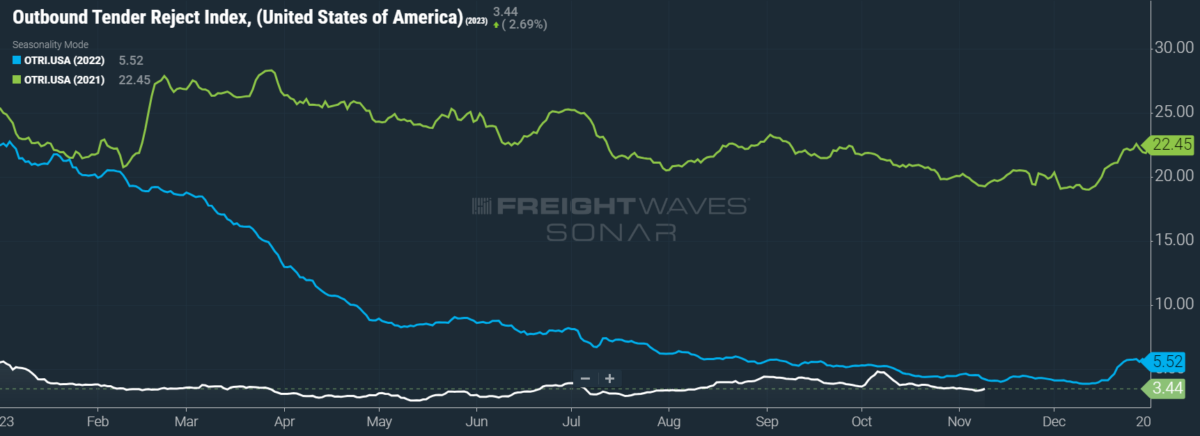
OTRI begins hibernation a bit too early this winter: SONAR: OTRI.USA: 2023 (white), 2022 (blue) and 2021 (green) To learn more about FreightWaves SONAR, click here.
Over the past week, OTRI, which measures relative capacity in the market, fell to 3.44%, a change of 2 basis points from the week prior. OTRI is now 75 bps below year-ago levels, with y/y comparisons becoming more favorable even if OTRI just remains more or less stable.
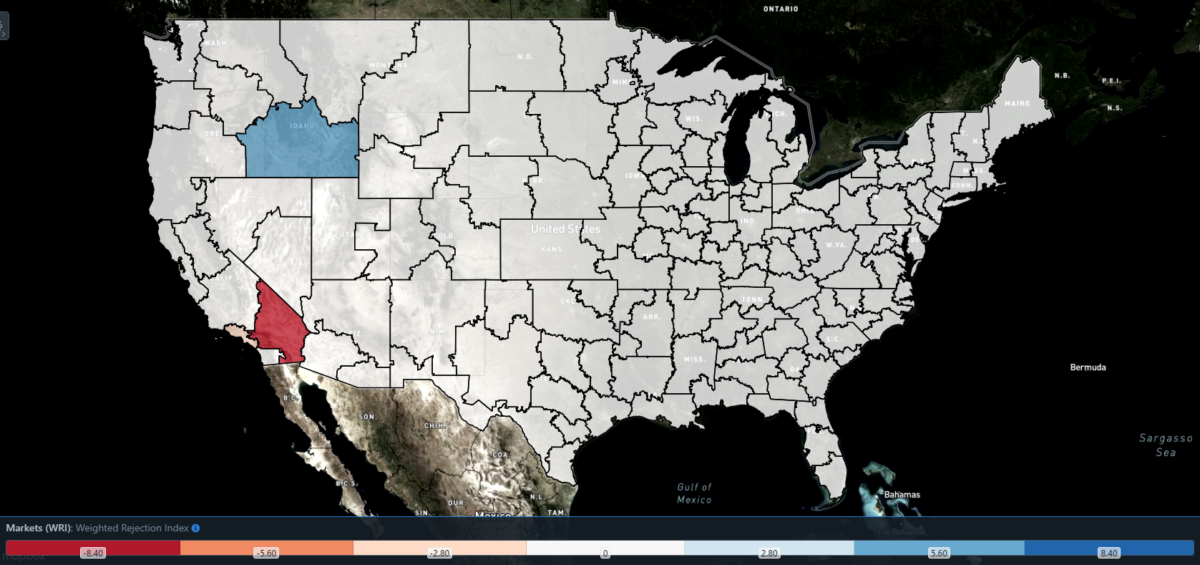
Capacity tightened dramatically in Idaho this week: SONAR: WRI (color) To learn more about FreightWaves SONAR, click here.
The map above shows the Weighted Rejection Index (WRI), the product of the Outbound Tender Reject Index – Weekly Change and Outbound Tender Market Share, as a way to prioritize rejection rate changes. As capacity is generally finding freight this week, only one region posted a blue market, which are usually the ones to focus on.
Of the 135 markets, 65 reported higher rejection rates over the past week, though 39 of those saw increases of only 100 or fewer bps.
Quo vadis, contract rates?
As rejection rates go, so also do spot rates, given that both reflect carriers’ leverage in choosing which freight they haul. But contract rates also suffered a brutal drubbing near the end of Q4’s first month. While nearly every quarter sees a surprise but brief dip in contract rates, not all of them are indicative of those rates’ pace for the rest of the quarter. Yet market dynamics fully support a sustained decline in contract rates, especially relative to spot rates as the spread between the two remains very wide.
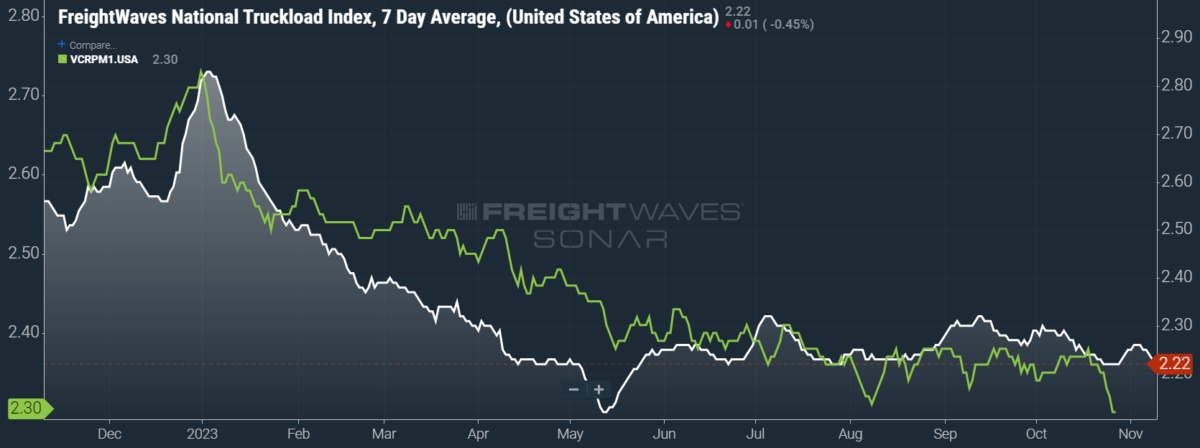
Contract rates take a dive at the end of October: SONAR: National Truckload Index, 7-day average (white; right axis) and dry van contract rate (green; left axis). To learn more about FreightWaves SONAR, click here.
This week, the National Truckload Index (NTI) — which includes fuel surcharges and other accessorials — fell 4 cents per mile to $2.22. Falling fuel prices added to losses in linehaul rates, as the linehaul variant of the NTI (NTIL) — which excludes fuel surcharges and other accessorials — fell 3 cents per mile w/w to $1.54.
As mentioned previously, the recent nosedive in contract rates — which are reported on a two-week delay — should not be prematurely taken as a firm signal for their Q4 direction. Bid season will continue over the next few months, and carriers might still be able to find some extra leverage under the couch cushions, especially if spot rates see a dramatic rise during the upcoming holidays. For the time being, however, contract rates — which exclude fuel surcharges and other accessorials like the NTIL — have tumbled 6 cents per mile w/w to $2.30.
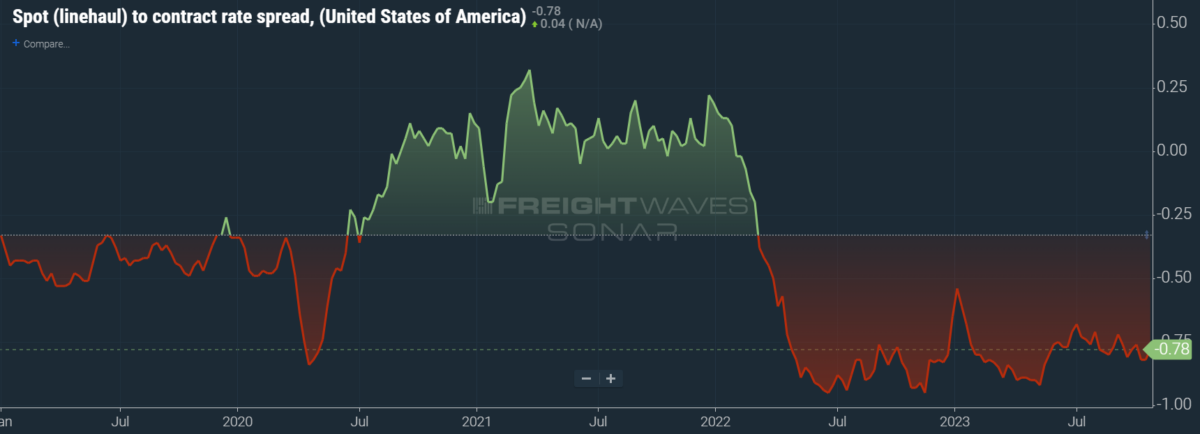
SONAR: RATES.USA To learn more about FreightWaves SONAR, click here.
The chart above shows the spread between the NTIL and dry van contract rates, revealing the index has fallen to all-time lows in the data set, which dates to early 2019. Throughout that year, contract rates exceeded spot rates, leading to a record number of bankruptcies in the space. Once COVID-19 spread, spot rates reacted quickly, rising to record highs seemingly weekly, while contract rates slowly crept higher throughout 2021.
Despite this spread narrowing significantly early in the year, tightening by 20 cents per mile in January, it has remained wide throughout most of the year to date. As linehaul spot rates remain 78 cents below contract rates, there is plenty of room for contract rates to decline — or for spot rates to rise — in the final quarter of the year.
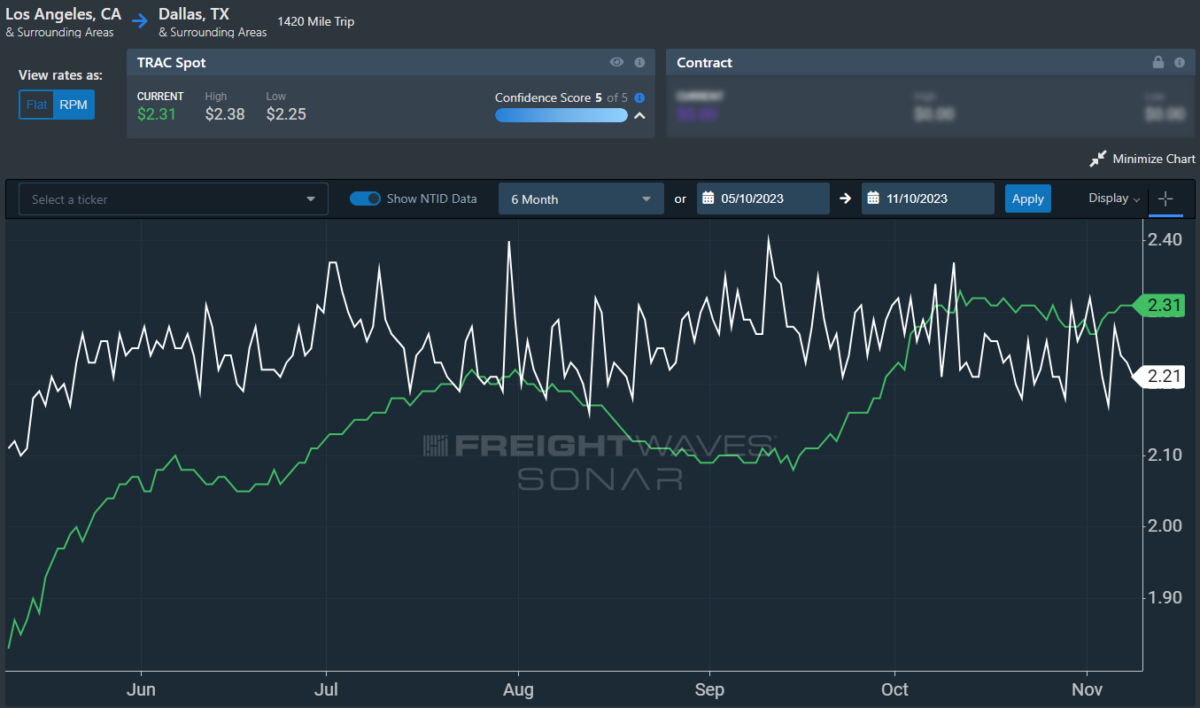
SONAR: FreightWaves TRAC rate from Los Angeles to Dallas. To learn more about FreightWaves TRAC, click here.
The FreightWaves Trusted Rate Assessment Consortium (TRAC) spot rate from Los Angeles to Dallas, arguably one of the densest freight lanes in the country, bounced back from a recent dip. Over the past week, the TRAC rate rose 4 cents per mile w/w to $2.31 — bearing down on its year-to-date high of $2.39. The daily NTI (NTID), which has fallen to $2.21, is again outpaced by rates along this lane.
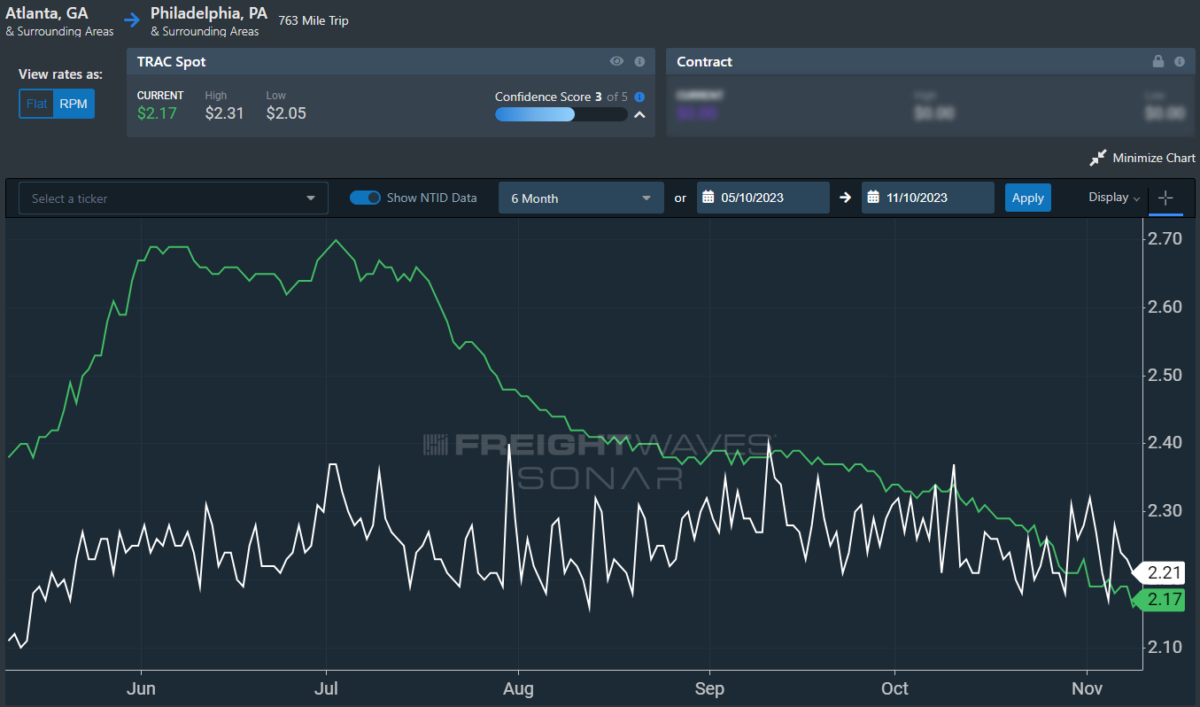
SONAR: FreightWaves TRAC rate from Atlanta to Philadelphia. To learn more about FreightWaves TRAC, click here.
On the East Coast, especially out of Atlanta, rates are facing a protracted decline and are finally being outpaced by the NTID. The FreightWaves TRAC rate from Atlanta to Philadelphia fell 2 cents per mile to $2.17. After a bull run that started at the end of April, this lane had been plateauing well above the national average, which made north-to-south lanes in the East more attractive than West Coast alternatives during the summer.
Autonomous trucking: ‘What’s love got to do with it?’
Lior Ron is a fan of autonomous trucking. You might even say the founder and CEO of Uber Freight loves the idea of driverless trucks.
But as the late Tina Turner asked, “What’s love go to do with it?”
The late Tina Turner asked the important question.
“We see across the board super strong demand for autonomy from shippers,” Ron told me in a recent interview. “We have a list of over a hundred shippers waiting to engage with those deployments. And we’re actually in a supply crunch of not having enough capacity from the autonomy providers to satisfy the demand.”
So, maybe it’s just business, not love.
Uber Freight works with Aurora Innovation and Volvo Autonomous Solutions. It recently signed a 10-year agreement with Waabi, a newer entry to the Level 4, high-autonomy space, to schedule loads on its digital freight network. Before Waymo Via put its autonomous trucking business into hibernation, Uber Freight had big plans with them, too.
Improving road safety and saving money on paying drivers — not necessarily in that order — motivate shippers to line up to take advantage of the coming transition to driverless trucking. Other than a handful of pilots, autonomy today is monitored by safety drivers, who have to be paid just as if they were still doing the driving.
Knocking off 40% of the cost
Removing the driver knocks off 40% of the operating cost. Sure, there are trade-offs — autonomous trucks are way more expensive than human-driven ones. It’s unclear who will take on those assets, but Ron thinks it will likely be carriers. They know about fleet maintenance and the right life spans for the trucks they own.
“They’re looking for opportunities to run a more cost-efficient operation,” Ron said. “And if they look at a five-to-10-year horizon, autonomy is definitely one of the strongest opportunities for them to streamline the operation.”
Uber Freight has some equipment in its Powerloop railer pools. Owning autonomous tractors is not in the cards.
“Never say never,” Ron said. “But that’s not our business model.”
Uber Freight may love the idea of autonomous trucks, but don’t look for the digital freight broker to own any. (Photo courtesy of Waabi/Debora Conn)
Figuring out the issues
Nothing is easy about autonomy, in part because so little is known. Leading players like Aurora Innovation and Kodiak Robotics are trying to figure out those issues now that the driverless autonomous technology targets small-scale commercialization as soon as late 2024.
“It’s going to take some time to adjust, to transition, to understand how to actually iterate on their supply chain to fit an autonomous network,” Ron said. “If it’s a transfer hub, OK, great. How do they do the first mile, the last mile? What do they need to have on both ends in terms of that?”
TuSimple built a fleet of more than 70 trucks equipped with its robot-driving system and completed more than 10 million miles moving freight. Then it realized how much money it was losing and sold off most of the Navistar trucks it had purchased.
“I think everyone understands there’s a role for owning assets and there’s a role for autonomy development. And I don’t think any of those companies have aspirations to build a ginormous fleet,” Ron said.
Texas as the target
Interstate 45 from Dallas to Houston is a generally flat, uninteresting freight-dense stretch of Texas highway. It’s the testing choice of many autonomy developers. Aurora has opened I-45 as its first commercial route. Kodiak likes it, too. But both companies know that neither shippers nor carriers will make a lot of money on the 240-mile run between the two.
“It’s a great practice ground,” Ron said. “If you really make the operation super smooth on both ends, you can gather some success. But there’s more opportunity on the longer lanes.”
Lior Ron, head of Uber Freight, has a list of more than 100 shippers waiting to get access to autonomous trucking. (Photo: Uber Freight)
That’s why Aurora is looking at Fort Worth to El Paso, Texas — 600 miles — for its next undertaking. Kodiak envisions Houston to Atlanta — 790 miles — as its second undertaking.
“We’re working hand in hand with the autonomy providers to educate them on lane topology, and where to make money and how to make money. What will be cost-efficient lanes, and therefore work with shippers to allow everyone to be educated.”
Ron compares it to intermodal where trains move freight on long routes before tractors take over. Transfer hubs make economic sense when they are 300 or 400 miles apart. The additional cost of first- and last-mile positioning of trailers for middle-mile autonomy eats into the savings of removing the driver from the cab.
Kodiak Robotics and Berkshire Hathaway? Why not?
Berkshire Hathaway has an enormous pile of cash — $157 billion — on its balance sheet.
Warren Buffett’s company owns 80% of the Pilot Co. with designs on buying the rest of the travel center network that operates in 44 states.
Pilot Co. led the $125 million B Series funding round for autonomous trucking developer Kodiak Robotics two years ago.
Berkshire Hathaway has about a 10% stake in Chinese electric truck maker BYD. (It sold off some of its stake in May because Buffett didn’t want to compete with Tesla.)
This is nothing Kodiak would comment on, but if Buffett is looking to further embrace autonomous trucking, he need only examine his portfolio.
Kodiak Robotics cobbled together an electric version of its autonomous truck for show-and-tell at the Advanced Clean Transportation Expo in May. (Photo: Kodiak Robotics)
Some love to new players in the FreightTech 25
Several new players cracked the FreightWaves FreightTech 25 announced Thursday at the F3: Future of Freight Festival.
Three companies in the autonomous space made the list: Plus at No. 2, Einride tied at No. 15 with J.B. Hunt Transport Services, and Gatik at No. 18, down one position from No. 17 in the 2023 list.
On the electrification side, first-time entrant ChargePoint made its first appearance at No. 10.
Chattanooga, Tennessee-based accounting and auditing firm HHM administered the vote. A simple points system, based on voters’ rankings, determined the FreightTech 25. A company scored 25 points for each first-place vote, with descending points through to the 25th place, which received one point. Companies were ranked by total points.
“This was the most disrupted list I’ve ever seen,” FreightWaves CEO Craig Fuller said. “If you think about the venture cycle from 2015 to 2022 in freight for that first stage, we’re largely past that. What’s interesting about this list is how different it is than past years. A lot of new names — and a lot of names that have been on the list for many years — did not make the list this year.”
Hydrogen truck startup Quantron AG plans to work togetherwith Ford’s operations in Turkey about making a hydrogen-powered fuel cell version of the heavy-duty F-Max.
Electric infrastructure startup TeraWatt Infrastructure will charge Pepsi trucks at a new facility in Rancho Dominguez, California.
An Arizona federal court dismissed a suit by British electric truck makerTevva against Canada’s ElectraMeccanica because of jurisdictional issues.The fight over a failed tie up likely will continue.
Thanks for reading. I’m always interested in your feedback and story ideas. Email me at aadler@www.freightwaves.com.
Lawyers will square off on California trucking’s latest AB5 exemption request
It’s showtime in the California Trucking Association’s legal fight to protect the state’s trucking sector from the AB5 independent contractor law.
For the first time since early 2020, attorneys for the state and the CTA, as well as lawyers for some new players in the litigation, will be in court Monday in person before Judge Roger Benitez in the U.S. District Court for the Southern District of California. Those new participants will feature lawyers from the Owner-Operator Independent Drivers Association, which has joined CTA as an intervenor in the case, as well as legal representation from the Teamsters, which is working alongside the state to keep AB5 the law of the land. OOIDA and the Teamsters were not participants in the original case filed in 2019.
When they met back in January 2020, Benitez already had handed down a temporary injunction, later changed to a preliminary injunction, that prevented the state from enforcing AB5 against the trucking sector on the grounds that AB5 was in conflict with the Federal Aviation Administration Authorization Act (F4A) of 1994. A 78-page transcript of that day records the in-person arguments made to Benitez as to why the temporary injunction from New Year’s Eve 2019 should be upgraded to a preliminary injunction; the judge agreed.
That lack of action and the end of the injunction combined to implement AB5 in the state’s trucking sector and put the CTA case back to square one, once again before Judge Benitez. And on Monday, lawyers will appear in person to debate the latest CTA/OOIDA request for a new injunction that would block AB5 from trucking in California while the full case proceeds.
AB5 is a state law that seeks to define independent contractors through the ABC test. For trucking, the B prong in the ABC test is a particular burden, as it defines an independent contractor as one who “performs work that is outside the usual course of the hiring entity’s business.” A trucking company hiring an independent owner-operator to move freight could be challenged under the B prong.
The various participants in the case have filed briefs in recent weeks laying out their arguments that will be reiterated in court Monday. The last year has seen revised complaints from CTA and OOIDA, widening the scope of their arguments. Those revisions and the state responses have provided extensive documentation on the positions each side is taking in the case, which is formally known as CTA v. Bonta, after Rob Bonta, the state’s attorney general. (The original defendant in the case was then-Attorney General Xavier Becerra, now the Biden administration’s secretary of Health and Human Services.)
The give-and-take in the most recent briefs and the earlier complaints and responses are by now, four years after the original filling in CTA v. Becerra, increasingly familiar but with the occasional new twist.
CTA/OOIDA argument: F4A preempts state action in trucking that could affect a “price, route or service.” AB5 has the potential to do that. This is the argument that Judge Benitez accepted and used as the basis for the preliminary injunction.
State response: Bonta and his lawyers have the advantage of being able to quote the 9th Circuit’s decision overturning the decision that rejected the F4A preemption argument. “The Ninth Circuit in this case concluded that AB 5’s application to motor carriers is not preempted by the F4A, because AB 5 is a generally applicable law that is not ‘significantly related to rates, routes, or services,” the state wrote in its brief.
And in an argument that pops up repeatedly in the state’s filings in recent months, the attorney general’s office argued that AB5 has been in effect in the trucking sector for more than a year, loomed over trucking even before that as the injunction made its way through the courts, and none of the projected trucking apocalypse has occurred.
“Their dire predictions are supported only by a handful of individual declarations that at most demonstrate personal preferences,” the state wrote in its latest brief. “Such evidence is insufficient to counter the reality that there are many ways to comply with AB 5 and there has been no significant disruption of the motor carrier industry.”
CTA/OOIDA argument: A whole bunch of job classifications got “irrational” exemptions from AB5, but trucking didn’t.
AB5 was followed by another law, AB2257, and the net combination of these two laws was what looks like a patchwork of exemptions granted to various industries that were spared from AB5. From surgeons to hairdressers, it’s a long list, with the CTA saying it tops 100.
The argument made by the plaintiffs is that the exemptions show trucking and gig workers were being targeted and that the authors of AB5, particularly then-Assemblywoman Lorena Gonzalez, didn’t care about many other job sectors except those two.
The CTA brief specifically cites an exemption granted to construction trucking. “When given even moderately close scrutiny, the proffered reasons for the construction trucking services exemption do not pass muster, and instead confirm the unequal treatment offered by the Legislature to (a) similarly situated group,” the CTA argued.
State response: “In the motor carrier industry, the Legislature had before it evidence, confirmed by Defendants’ experts, of the rampant misclassification of truck drivers. AB 5’s inclusion of the motor carrier industry (among hundreds of other industries) therefore serves legitimate state interests.” It also noted that the construction trucking exemption expires next year.
CTA/OOIDA argument: AB5 puts a burden on interstate commerce.
OOIDA’s brief argues that the B2B exemption treats intrastate and interstate drivers differently, thereby running afoul of the Dormant Commerce Clause, which prohibits states from interfering with interstate commerce.
State response: Citing a precedent, the state argued that “the Supreme Court has made clear that a law is not impermissibly discriminatory, for dormant Commerce Clause purposes, merely because the practical effect may be to favor certain in-state entities.” The state also cited the B2B exception several times in its final brief, and has done so earlier, noting its ability to get companies around AB5. But the trucking industry has argued its 12-step, 100% pass rate requirement is too big a burden for companies to meet and makes that argument in its latest brief.
CTA/OOIDA argument: AB5 is seriously messing up trucking in the state and that could impact the “price, route or service” protection in F4A.
The argument also comes back to the state’s stance that California is trying to eliminate independent owner-operators in the state, and it cites a quote from Gonzalez. She referred to — and it is cited in the CTA brief — the “outdated broker model that allows [trucking] companies to basically make money and set rates for people that they called independent contractors.”
Citing a declaration filed by a driver in support of CTA, the association argued that owner-operators who live in California (citing filings by individual drivers in connection with the case) “are forced to choose between becoming employee drivers or abandoning their chosen profession.”
State response: No, it isn’t.
The state has said multiple times that the record shows AB5 is not turning the trucking industry upside down.
The plaintiffs “have not presented any substantial, let alone compelling, evidence that the implementation of AB 5 over the past year and half in California has disrupted motor carrier services in any significant way,” the state said. “Nor have they shown that the law has had or will have any actual significant impact on the prices, routes, or services, as necessary for their express and implied preemption claims.”
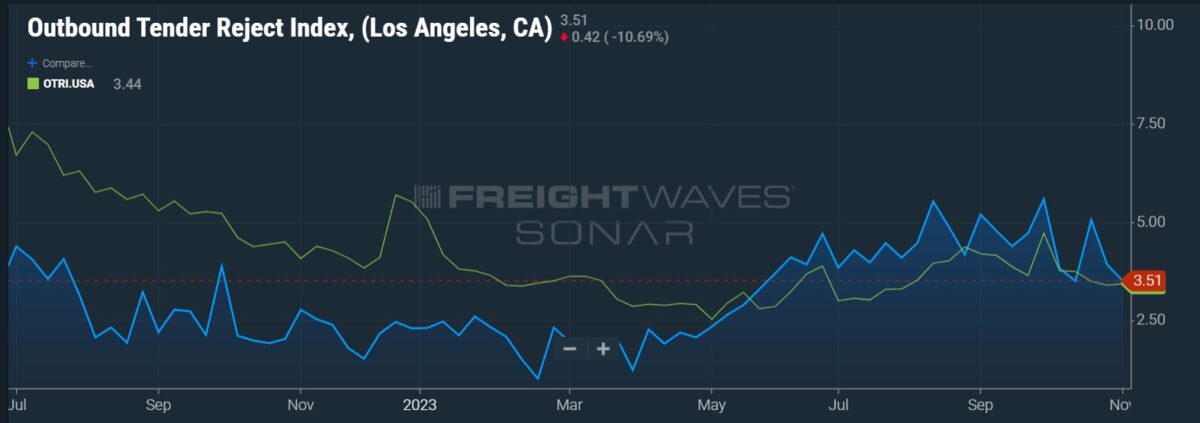
The Outbound Tender Rejection Index in FreightWaves SONAR is a measure of contracted freight rejected by contract carriers. A lower number reflects higher trucking capacity in a market. This chart compares the Los Angeles OTRI against the national OTRI. This data series begins July 1, 2022, right after the Supreme Court denied certioari in the AB5 case, ensuring it would be implemented against trucking in the state.
Volvo Group wins bid for bankrupt Proterra battery assets
Swedish truck maker Volvo Group will pay $210 million for the battery-making and charging assets of bankrupt Proterra Inc.
Volvo Battery Solutions was selected as the winning bidder for the business and assets of Proterra Powered, one of two auctions for the electric bus, battery and energy company that filed for bankruptcy protection in August.
“We entered into the Chapter 11 process with a mission to maximize the potential of each of our product lines. Today, we have taken an important step towards that goal for our Proterra Powered business,” Gareth Joyce, Proterra CEO, said in a news release.
Bids for Proterra’s electric transit bus and energy businesses closed Oct. 26. A bankruptcy auction is planned for Monday. Proterra went into business in 2004 as a maker of electric transit buses and generated more than $200 million in revenue. The energy and charging business units came later.
A huge financial fall
Proterra expects the bankruptcy court to approve Volvo’s purchase on Nov. 28. It includes a development center for battery modules and packs in Burlingame, California, and an assembly factory in Greer, South Carolina.
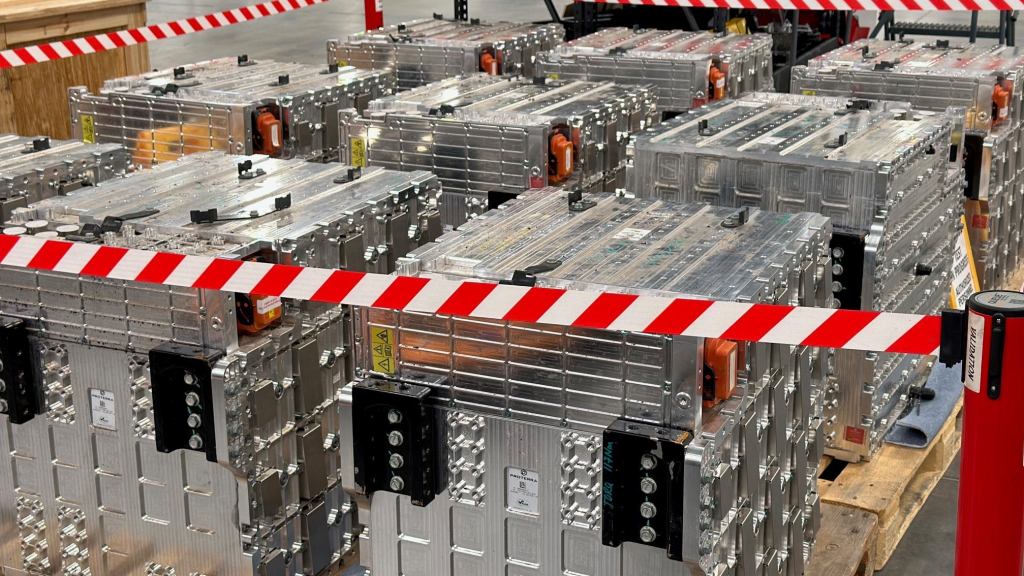
The Proterra Powered battery pack manufacturing plant in Greer, South Carolina. (Photo: Alan Adler/FreightWaves)
Volvo expects the deal to close in the first quarter of 2024. The company said the purchase would be immaterial to Volvo Group’s financial performance.
That declaration shows how far Proterra has fallen since it went public via a reverse merger with special purpose acquisition company ArcLight Clean Transition Corp. in June 2021 at an enterprise value of $1.6 billion. Proterra received $640 million in SPAC proceeds.
The pandemic created massive supply chain disruptions for the company and slowed transit bus orders because so many people worked from home. Proterra burned through its SPAC cash and additional borrowings quickly.
Proterra included a notice of going concern with the Securities and Exchange Commission in March as part of its 2022 10-K filing. Such a filing calls into question whether a company would be in business a year from the filing. The company filed for Chapter 11 bankruptcy protection on Aug. 7.
Jobs safe but awkward discussions on customer contracts may lie ahead
Proterra continues supplying customers with battery packs. That includes Volvo rival Daimler Truck North America’s Thomas Built Buses and Freightliner Custom Chassis Corp. It is unclear what will happen with those contracts. Proterra also makes battery packs for Nikola Corp.’s fuel cell electric trucks.
“At this stage it is too early to comment on any current or future business,” Volvo Group spokesman Claes Eliasson said in an email Friday morning. “We intend to operate the business as a going concern.”
Volvo plans no immediate changes to Proterra Powered, which means trained employees are “of utmost importance to retain,” Eliasson said.
Changing landscape
When Nikola purchased the since-liquidated battery pack maker Romeo Power, the electric truck maker said it planned to keep the pack-making capacity for itself. Paccar Inc.’s Peterbilt had a five-year contract for battery packs with Romeo. Deals with startups Lion Electric and Lightning eMotors both fell apart.
Volvo rivals Daimler and Paccar formed a $2 billion-$3 billion joint venture with Cummins Inc. in September to make lithium iron phosphate batteries in the U.S. with technical guidance from a Chinese battery maker. The joint venture plans production in 2027.
“With this acquisition, Volvo Group will complement the current, and accelerate its future, battery-electric road map,” the company said in a news release.
Daily Infographic: Zipline and Cleveland Clinic partner on prescription drone delivery
To view more FreightWaves infographics, click here
Cargojet to sell off new B757 freighters, pause 767 conversions
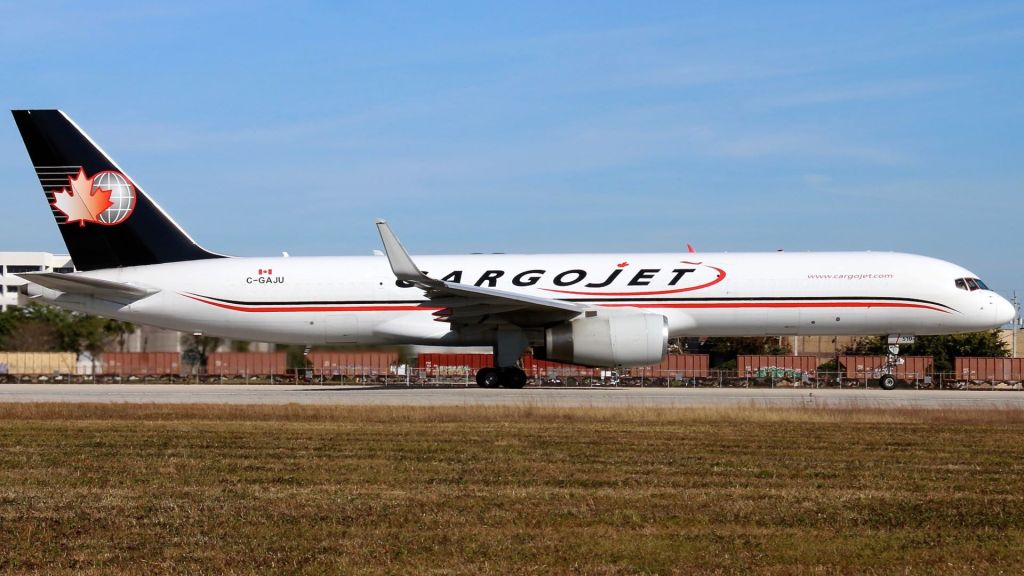
Cargojet, which operates a nationwide air cargo network in Canada for e-commerce express companies plus international services, is moving more aggressively to cap fleet growth and preserve strong cash flows in response to the continued slowdown in shipping demand.
The airfreight specialist has a surplus of Boeing 757 converted freighters and recently listed four of them for sale, Chief Financial Officer Scott Calver said Tuesday during a conference call with analysts about third-quarter results. The planes were recently converted and had their engines overhauled. It costs about $5.2 million to remodel a 757 for cargo, not including millions more for acquisition, according to industry experts.
Until a sale is consummated, the planes are available for lease to other airlines and still will be used for charter work, Calver added.
The move follows an earlier decision not to proceed with converting four 777-300 passenger jets. One of the planes was sold during the summer at a $1.6 million (CA$2.3 million) loss, and two were sold in the third quarter. They were severely damaged in a hailstorm, which delayed their sale. Cargojet (TSX: CJT) received $8.8 million from its insurance claim, but the amount didn’t fully cover repairs. The fourth 777-300 was never purchased.
Management also said plans to convert two Boeing 767 passenger jets it owns are on hold.
Cargojet has 39 aircraft in its fleet, up from 34 at the end of 2022. More than half of them are Boeing 767 medium freighters. It expects to have 41 aircraft by the end of the year after two 757s it purchased complete conversion to cargo configuration, and 46 by the end of 2025, according to company figures. The Canadian carrier is moving forward with the passenger-to-freighter conversion of four Boeing 777-200s under a contract with aerospace startup Mammoth Freighters. Cargojet will operate the planes for DHL Express, one of its major customers and a minority owner.
But if the 757s are sold off, the number of aircraft will stay nearly the same. Executives said they hope to get about $87 million for the midrange freighters or will use the parts on other aircraft in the fleet if a buyer isn’t found.
Air Transport Services Group, a U.S. aviation firm that provides aircraft leasing and cargo services, is also cutting back on capital expenditures for fleet growth because of down market conditions. Executives this week said they have put on hold plans to convert seven used Boeing 767-300 passenger jets that were recently purchased.
Cargojet reported revenue in the third quarter declined 8% to $155 million, partially due to lower fuel surcharges, and adjusted earnings before accounting measures fell 17% to $50.6 million year over year, in line with analysts’ estimates.
The airline flew 8.8% fewer hours during the period versus last year.
Domestic revenues were marginally lower at $64.4 million due to a decrease in e-commerce and B2B volumes, partially offset by inflation adjustments in long-term contracts. CEO Ajay Virmani said consumer spending on household essentials is offsetting declines in discretionary items purchased through online channels.
Revenue from long-term transportation services agreements and one-time charters was $45.4 million, 9% below the 2022 level, as the company realigned international routes to match lower demand. Nonscheduled charter work has picked up, and the carrier is taking advantage of extra aircraft and crews to meet that demand.
Chief Strategy Officer James Porteous said a 9% reduction in revenue from long-term transportation contracts and one-time charters reflected a realigned international route structure with shorter stage lengths to match lower demand. In 2022, when shipping demand out of China was still strong, Cargojet operated two dedicated aircraft for DHL from Shanghai to the DHL hub in Cincinnati via Vancouver, British Columbia. Those aircraft were shifted to routes in North and South America when volumes declined late last year.
Optimizing routes is the primary way a cargo airline can reduce waste, but Cargojet has also combated revenue losses with what Virmani called a “new culture of frugality.” That has led to reductions in overtime, training and temporary employees.
Cargojet is also selling two Beechcraft that were purchased for crew transportation.
Management said it projects peak season to be flat year over year, which likely means sequential growth in the fourth quarter of 10% to 15%.
Wanna succeed as a small carrier? Get to know your neighbor.
Know your neighbor.
The advice is common sense for anyone looking to build a business.
But in the rough-and-tumble cyclical freight world, it is essential.
As individual drivers signed on for Department of Transportation trucking authorities during the pandemic, the vision of unending top-dollar-per-mile freight rates — a fixture of social media — blinded some truckers to reality.
As freight rates plummeted in the past year, those who jumped in with both feet — and maybe purchased a used truck at record-high prices — are trying to get out without breaking a leg.
“Business is hard. It is capital-intensive and if you are not prepared for that, you don’t have the resources available, you don’t understand,” Adam Wingfield, founder and managing director at Innovative Logistics Group said Thursday at the FreightWaves F3: Future of Freight Festival.
Load board reliance may be a one-way trip
Reliance on load boards takes a carrier only so far, often just one way with a load and searching for haulage to generate revenue on the back haul.
Without building mutually beneficial relationships with local businesses, most small trucking companies are destined for failure, especially when the cycle turns down as is the current situation.
“Building those relationships with small-town shippers and things like that,” Wingfield said. “You’ve got to get comfortable doing hard things.
“If you’re a carrier in Freight Alley, you’re not going to get the Kimberly-Clarks. You’re not going to get Procter & Gambles [as customers]. But you might get two loads a week from Rachel’s T-Shirt shop,” Wingfield told Rachel Premack, FreightWaves editorial director.
“This industry has always been built on relationships,” he said. “You’ve got to be intentional about building relationships. Those are the connections that can change your business.”
Smartphones are great, but they are overused.
“Over time, we forget about people,” Wingfield said. “You can’t run a business off phones and apps all the time.”
Reliance’s Albrecht sees capacity disappearing from market at rapid pace
CHATTANOOGA, Tenn. — From his position as CFO and chief revenue officer of one of the largest truck-specific insurance companies, Thom Albrecht can see trucking capacity bleeding out of the market.
In one of the final fireside chats at FreightWaves’ F3: Future of Freight Festival in Chattanooga, Tennessee, on Thursday, Albrecht provided hard numbers about the disappearance of companies from the customer base of Reliance Partners as a result of the tough freight market.
“I think there are already and will continue to be more failures than the industry is able to track,” Albrecht said.
He has been a leading Wall Street transportation analyst and was brought in to try to rescue truckload carrier Celadon from closure, but its problems proved too intractable.
Albrecht said Chattanooga-based Reliance believes it has the largest market share for insurers serving smaller fleets, whether it would be in the category of a carrier with one to 20 trucks or 21 trucks to 100.
The numbers in both those categories are declining, Albrecht said. “We have seen over 20% of our customer base cease operating this year, with an average fleet size of four or five units. We’ve also still grown our monthly premiums about 10% as we’ve also added a bunch of new customers, typically a bit bigger, around 15 to 50 trucks for many agents and a few of our agents have added a number of motor carriers between 100 to 200 trucks.”
He added that tracking companies like that are the “hardest part of the market” to see when taking stock of a decline in trucking capacity. But from what Albrecht said he can witness, “there’s more consolidation going on at that end of the market than people are able to see.”
Albecht added that Reliance sees it “every day. It’s brutal.”
FreightWaves CEO Craig Fuller, who interviewed Albrecht in the fireside chat, cited numbers that had been provided to him by Truckstop, known mostly as a load board provider. He said of companies that had “turned out of the network,” one frequently found feature of those companies is that they had bought trucks near the top of the market. “You’re paying $140,000 for a truck that would have cost $40,000 pre-COVID,” he said.
“You got stuck and locked in at that high, high cost at a time when the market has been challenged,” Fuller said.
Another challenge for companies that got into the trucking market not all that long ago when rates soared in the second half of 2020 through early 2022, Fuller said, is that the focus on double brokering and other types of fraud has steered some brokerages away from dealing with those operations. If the MC authority number is relatively new, “they’ve not been able to get brokers to touch it because of these issues.”
Albrecht noted that at Reliance, the focus on signing up new customers has shifted in part because of those concerns regarding fraud. Reliance “producers,” who seek out new business, “have tried to focus on entities that have been in business at least two or three years.”
Despite that focus on the tough conditions for carriers and their impact on capacity, Albrecht put a date range on the time when the capacity loss might begin to turn the market around: the middle of next year.
Albrecht made reference to “the vital signs being a little bit more green kind of in the middle of next year.”
“I believe that somewhere between May and July that based on the number of drivers that we are seeing exit the marketplace that the market will be inching toward equilibrium,” Albrecht said. But while the market will be stronger, it won’t be enough to give what he called “great power on a contract basis until 2025.”
Albrecht’s overall macroeconomic outlook was not as bullish, not surprising given that his optimism for freight markets was a function of capacity declining, not any sort of economic rebound.
He ticked off recent data on consumer health: a third-quarter increase of 57% of automobile loan defaults and a 25% increase in mortgage delinquencies. “Those are big, big numbers.”
The result is that banks are likely to be “more cautious,” Albrecht said, with a subsequent impact on freight demand.
How better inventory planning has offset the need for speed
The landscape for freight — and FreightTech — has changed. It’s not as much about shipping goods as fast as possible anymore as it is about getting customers the goods exactly when they expect them. It’s more about using FreightTech to position inventory correctly so that delivery windows can be met, as opposed to FreightTech as a “disruptor.” And layered on top of these changes, there’s a cyclical factor as volumes snap back from COVID-era boom levels.
That is the view of industry veteran Alan Gershenhorn, formerly a UPS executive and now a strategic adviser, who outlined the market evolution at FreightWaves’ F3: Future of Freight Festival on Thursday.
“Obviously, we’re in a downcycle and I think it’s exacerbated by the upcycle we had with COVID. Because of that, it has made this downcycle seem even worse than it really is,” he explained.
“During that huge upcycle, there was a tremendous amount of cost and capacity added, and rightfully so to take advantage of the opportunity and make sure you could grab every piece of business you possibly could. Then the wheels came off the truck, so to speak, and everybody found themselves with a huge amount of cost and excess capacity and everybody’s having to make those adjustments.
“We’re in a period of excess capacity across all of logistics.”
Reduced need for speed
Airfreight faces an added challenge beyond the capacity adjustment, said Gershenhorn, a former board member of Cargojet, the largest airfreight carrier in Canada.
Airfreight “is being impacted by the same phenomenon that the rest of the industry is, but there’s also a push back to surface transportation. A number of years ago there was the big just-in-time phenomenon, but I think folks have now figured out how to run their businesses more efficiently using surface transportation.
“Another thing is that a lot of the goods in the parcel industry are now being stored very close to the last mile, so I think the parcel air business is not going to grow as fast as the ground business anymore. There’s going to be some rightsizing that needs to take place.”
This reduced emphasis on speed is also supporting the intermodal rail business.
“There had been this tremendous need for speed and putting stuff on rail was cheaper but you could move things faster by truck, but when you did the research, you found that consumers weren’t as interested in speed as knowing when they were going to get what they ordered at the time they ordered it.
“I think that’s why rail and some of these other ‘slower’ modes are becoming in vogue.”
The role of FreightTech
According to Gershenhorn, “The tools — the technologies — that folks are implementing allow them to better manage their inventories and put more of their inventory in the right place at the right time so they can take advantage of surface transportation rather than air.”
In hindsight, the story of FreightTech hasn’t been as much about disruption as it has been about the benefits to logistics planning and performance that have accrued over time.
“With FreightTech, we’ve been in a little bit of a hype cycle. It’s really not about disruption,” said Gershenhorn.
“If you look at Convoy and even Flexport, they’ve built some really good tech. It’s good stuff. The challenge is that one [Convoy] couldn’t make the economics work and one [Flexport] is still struggling to make the economics work.
“But somebody’s going to be the beneficiary of all that, and it also caused the rest of the industry to begin to look inside their own house and figure out what they could do better.”