Haslam family sues Berkshire over valuing of final chunk of Pilot
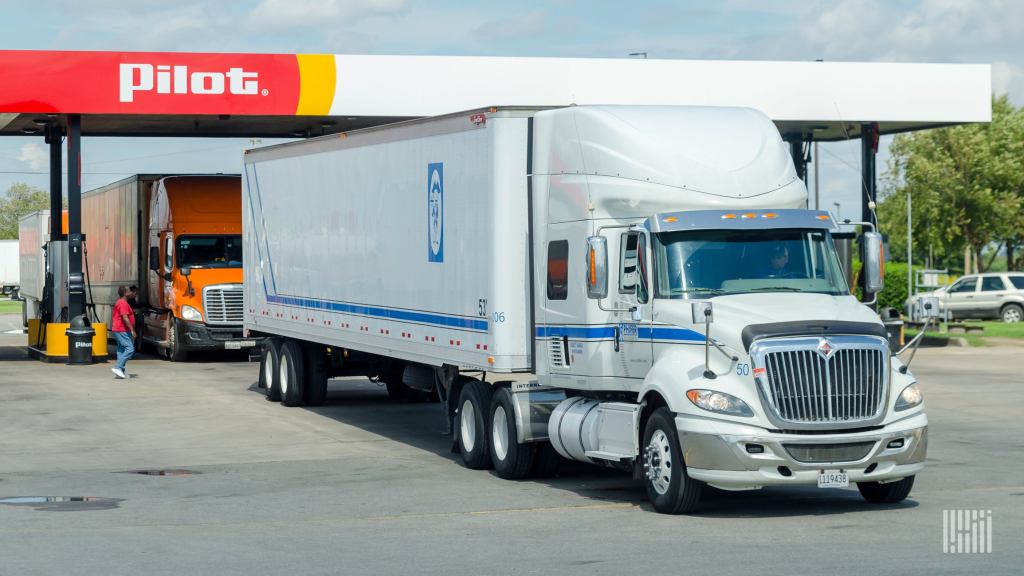
The fate of the final 20% of Pilot Travel Centers not owned by Berkshire Hathaway and still in the hands of the founding Haslam family is at the heart of a lawsuit filed late last month in Delaware, with the Haslams accusing Berkshire Hathaway of adopting new accounting practices that could impact the value of that final one-fifth ownership.
The suit, filed in Delaware Chancery Court, is about the “put right” that enables the Haslams to choose to sell their remaining 20% to Berkshire Hathaway. That right can be exercised beginning Jan. 1, 2024 and is described in the lawsuit as annual but can only be exercised within 60 days after the close of a Pilot Travel Centers (PTC) fiscal year. The entity that would exercise the put right is identified as Pilot Corp., controlled by the Haslams. Pilot Corp. is the plaintiff in the lawsuit.
There is nothing in the lawsuit to suggest that exercising the put right is mandatory.
According to the lawsuit, the formula for determining the value of the put right is the same formula that was used when Berkshire Hathaway (NYSE: BRK.B) bought its two tranches of PTC equity, first in 2017 and the second earlier this year. That formula is 10 times earnings before interest and taxes at PTC, with adjustments for debt and cash on hand.
According to the lawsuit, the accounting process used for the first two purchases is to be utilized in determining the value of PTC and the 20% share if the put right is implemented by the Haslams. That accounting method, according to the suit, is the acquisition method, “which the acquirer recognizes the assets acquired and liabilities assumed at fair value with limited exceptions.”
But the suit says after Berkshire Hathaway acquired controlling interest in the first quarter, it began valuing PTC through “pushdown accounting,” which impacts several valuations of an acquired company.
“Pushdown accounting does nothing to change the value of performance of PTC’s business,” the suit says. “But the application of pushdown accounting, and the various subsidiary changes in accounting policies that necessarily result, artificially depress the reported earnings of PTC by, among other things, increasing depreciation and amortization expenses and by preventing the recognition of gains on derivative instruments and other hedges in the income statement.”
The suit lays out what Pilot sees as the specific hit on the PTC valuation due to the accounting change, but the numbers are redacted in the publicly available document. “Berkshire’s choice to impose pushdown accounting on Pilot Travel Centers thus risks unfairly transferring (amount redacted) or more to Berkshire … from the pocket of minority member Pilot.”
The suit says the Haslams’ representatives on the PTC board proposed a resolution to halt pushdown accounting and revert to the previous methods. But the Berkshire representatives on the board rejected it.
According to the suit, there have been indications from Berkshire personnel that the previously agreed upon accounting methods would be implemented should the put right be triggered by the Haslams. That assurance came from as high up the chain as Berkshire Hathaway Chairman Warren Buffett, according to the lawsuit.
Buffett told James Haslam on Oct. 13 that “Berkshire would abide by the agreement,” according to the lawsuit. James Haslam, the original founder of Pilot, sent Buffett a letter “seeking confirmation that Berkshire would not apply pushdown accounting in calculating the value of Pilot’s Put Right.”
But he didn’t get a straight answer, according to the lawsuit. “Instead, Buffett repeated: ‘I said that Berkshire will comply with the terms of the contract. That’s exactly what the contract says.’”
The suit charges that Buffett’s actions amounted to a “refusal to even disclose Berkshire’s position on the proper method of valuing Pilot’s Put Right.” As a result, the suit says, “litigation [is] inevitable” because it is not clear to the Haslams that Berkshire “will not commit to honor their contractual obligations and fiduciary duties.”
Berkshire Hathaway is a Delaware corporation although based in Omaha, Nebraska, which led to the suit being filed in Delaware Chancery Court. The defendants include Berkshire Hathaway, Pilot Travel Centers (since it is now controlled by Berkshire Hathaway), a Berkshire subsidiary named NICO and several members of the Berkshire board of directors.
This monthly report analyzes the current state of the freight market based on critical insights from our SONAR platform. The theme for October explored the disconnects between rate and volume in the freight market. All insights are provided by FreightWaves’ Craig Fuller, Founder and CEO, and Zach Strickland, Head of Freight Market Intelligence.
The report’s key topics include: • Difficulties facing asset-based freight brokerages • How different market segments are experiencing a variety of rate environments • Downward pressure on trucking rates in the current bid cycle • How high-frequency freight data can help users detect market shifts
This recap is a takeaway from our monthly State of Freight webinar series that offers expert industry insights, previously made available only to subscribers of FreightWaves’ supply chain analytics and high-frequency data platform, SONAR.
To download the full white paper and access our latest insights, complete the form below.
Maersk cutting 10,000 jobs in face of ‘worsening market conditions’
Maersk, the world’s second-largest ocean carrier, revealed Friday that it is “intensifying” job cuts in light of the “worsening market conditions” in ocean shipping.
“Given the challenging times ahead, we accelerated several cost and cash containment measures,” said Vincent Clerc, CEO of A.P. Moller-Maersk (Copenhagen: MAERSK-B).
“We are in a very uncertain trading environment with significant further downside risk potential — one that could stay with us for quite a while,” Clerc said on the call with analysts.
Maersk began the year with 110,000 global employees. Year to date, it has cut 6,500 jobs, which it has not previously disclosed. It has now decided to cut a further 3,500 jobs, including 2,500 by year-end and 1,000 in 2024. The total reduction — 10,000 layoffs — will reduce global headcount by 9%.
“This is not a diet. This is a reset of the baseline,” said Clerc.
Job cuts will lead to restructuring charges of $350 million this year (up from the $150 million guidance announced in February) followed by $600 million in cost savings from lower compensation next year.
It’s not just job cuts. Maersk said it is “considering all options to preserve cash.” Capital expenditures (capex) will be slashed both this year and next year, and share buybacks could be halted next year.
Maersk now expects 2023 capex of $8 billion, down from previous guidance of $9 billion-$10 billion, and 2024 capex of $8 billion-$9 billion, down from previous guidance of $10 billion-$11 billion. Based on the range midpoints, that equates to total 2023-2024 capex cuts of $3.5 billion or 17.5%.
Maersk executives said on Friday’s call that capex reductions will largely come from delaying investments in the ocean shipping division. Both Clerc and CFO Patrick Jany cited high yard costs, implying that Maersk has pushed back orders for some methanol-powered newbuildings that it would have otherwise ordered.
Extreme uncertainty for 2024 and beyond
Maersk’s Copenhagen-listed shares plunged 17% to a new 52-week low in over five times the average trading volume in the hours after it disclosed cost cuts and the potential halt to stock buybacks.
The shipping giant is not cutting costs because it’s running short of cash: Liquidity was $26.8 billion at the end of Q3, on par with $26.9 billion at the end of Q2. Rather, it is cutting costs because the outlook is so uncertain. It is preemptively battening down the hatches.
“We have a strong balance sheet but we also have a high uncertainty ahead,” said Jany. “There are quite a wide range of scenarios for 2024 … so we are preparing to weather any type of scenario that might happen.
“We do see scenarios where we start to be cash negative, as we guide for in Q4 already. In the direst path of the scenarios, you do have a cash burn that you need to prepare for,” Jany said.
What happens in the fourth quarter will be key to how 2024 turns out, explained Clerc. Maersk is heavily reliant on contract rates, which largely reset on a calendar-year basis in the Asia-Europe market and in May in the Asia-U.S. market. European contracts are about to reset, with those contract rates contingent on what happens in the spot market over the coming months.
According to Clerc, “What happens with spot rates during the next three months is going to determine how much of an impact there will be from contract renegotiations. One of the reasons we are taking these [cost-cutting] measures is that we don’t have the visibility yet on where [contracts] will reset — on where spot rates will be and what type of premium we can achieve [versus spot rates] on our contracts.
“With the [spot rate] decrease we have seen in the third quarter and with what we’re guiding in the fourth quarter, if contract rates were to come down to what the prevailing [spot] rates are today, that is not an insignificant gap,” he said. In other words, what Maersk is worried about is that 2024 contract rates could reset to current spot levels.
The biggest driver of rates is overcapacity as a result of newbuilding deliveries, said Clerc, who expects supply side pressure to extend into the medium term.
“We expect market conditions in ocean to worsen further due to the additional capacity coming into the market and due to the fact that mitigating measures such as ship idling and ship recycling have not been effective.
“If you simply look at the amount of tonnage that is in the process of being built at the yards and the phasing in of that capacity, these difficult market conditions are likely to stay with us, not only for 2024, but also for longer.”
Q3 volume better than expected, rates worse
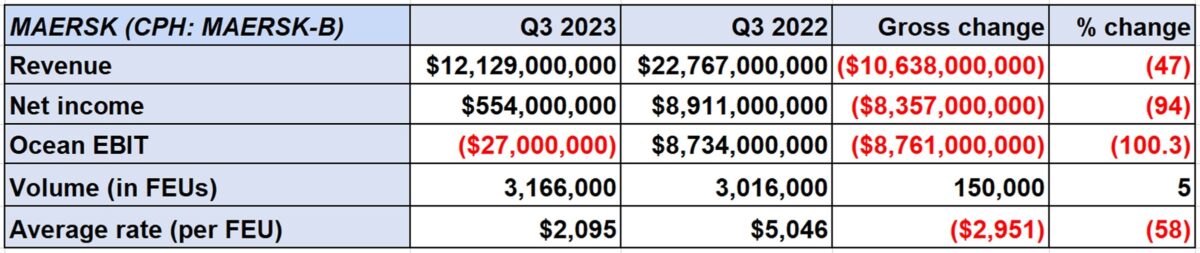
Maersk reported net income of $554 million for the third quarter of 2023, in line with expectations and down from the record-setting $8.9 billion of net income in Q3 2022.
Maersk’s ocean division reported a modest operating loss in the latest period. Ocean shipping earnings before interest and taxes (EBIT) were minus-$27 million.
Third-quarter volumes came in better than expected. Maersk carried 3,166,000 forty-foot equivalent units, up 9% from 2,906,000 FEUs in the second quarter. As a result of the volume uptick, it now expects full-year 2023 demand to decline in the range of 0.5% to 2%, compared to prior expectations for a drop of 1% to 4%.
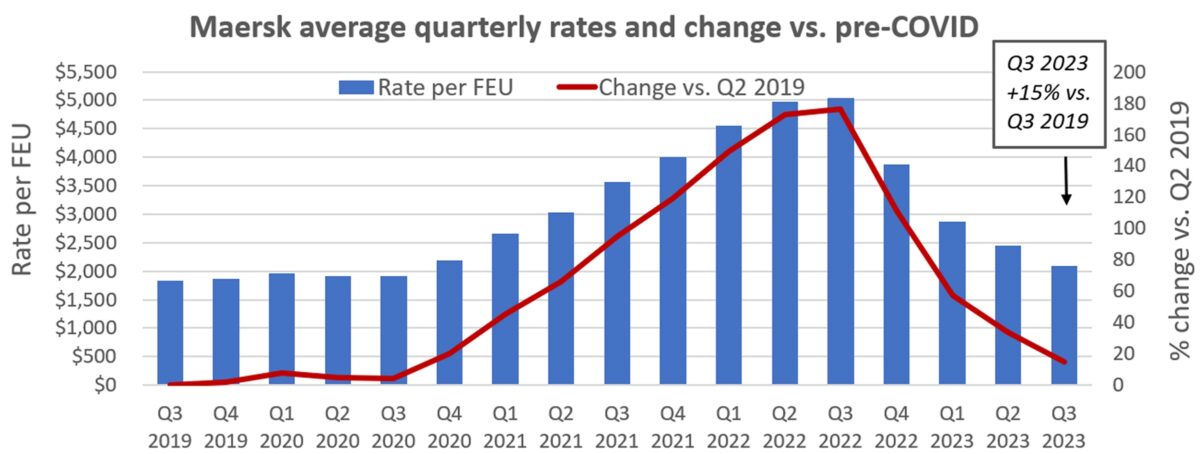
Average rates (68% on contract, 32% on spot) came in at $2,095 per FEU in the third quarter, down 14% sequentially from $2,444 per FEU in the second quarter of this year. “Prices declined at an accelerated pace, overshadowing the positive impact of higher volumes,” said Clerc.
Even so, Q3 2023 rates were still 15% above the average in Q3 2019, pre-pandemic.
(Chart: FreightWaves based on Maersk data)
Maersk did not reduce its full-year guidance but now expects results to come in toward the bottom end of the range. Guidance is for adjusted full-year EBIT of $3.5 billion-$5 billion.
That implies a very rough fourth quarter. Maersk’s EBIT over the first nine months totaled $4.47 billion. Full-year EBIT of $3.5 billion equates to Q4 EBIT of minus-$970 million.
A few months after the Federal Aviation Administration released its Innovate28 plan for scaled advanced air mobility (AAM) operations by 2028, Utah officials have revealed their own plan to integrate delivery drones, electric air taxis, vertiports and more into the state’s airspace.
At the request of the state Legislature, the Utah AAM Working Group, part of the Utah Department of Transportation’s Aeronautics Division, this week released a legislative report and study on the implementation of AAM services in regions such as the Salt Lake City metro area.
The Utah AAM Infrastructure and Regulatory Study is a 58-page framework — similar to the FAA’s Innovate28 and its previously released AAM blueprint — that identifies the benefits, limitations, assets, timelines and funding mechanisms associated with the state’s adoption of these emerging services. It does not establish any new rules or regulations but simply provides guidance.
The Utah Legislature also called on researchers to review state laws and identify any changes that could be made to speed the development of the state’s AAM operations. But according to the report, Utah already has plenty of potential to support technologies like drones and air taxis.
“Through leadership foresight, from the legislature to state agencies, Utah has positioned itself to embrace AAM,” the report reads. “The state already has significant assets in place that could be utilized in early implementation of advanced air mobility.”
Researchers identified several positive effects AAM could have on the state, the two biggest being a reduction in carbon emissions — since many drones and air taxi designs are electric — and “clear and compelling” economic benefits.
The report suggests that AAM services would create the potential for thousands of high-paying jobs in vehicle manufacturing, maintenance and vertiport operations. For example, Zipline — which operates drone delivery in Utah through a partnership with Intermountain Healthcare — hires FAA-certificated drone pilots directly out of high school and helps them to pay for college. Utah is also one of seven states where Walmart and delivery partner DroneUp are flying.
Electric vertical takeoff and landing (eVTOL) manufacturers could bring further employment opportunities. Two of the U.S.’ largest, Archer Aviation and Joby Aviation, have begun building production plants in Georgia and Ohio, respectively, far from their California headquarters. Both firms expect to produce hundreds of vehicles and thousands of lucrative jobs.
On the other hand, the biggest limitations of AAM may be safety and privacy concerns from Utah residents and impacts on local or migrating animals, according to the report.
Researchers believe that Utah has plenty of readily available assets that could serve the AAM industry with some slight modifications. They note, for example, that the Aeronautics Division is already assisting airports with electrification and vertiport installation.
The report considers airports, unsurprisingly, to be “prime” locations for AAM operations. It lists South Valley Regional Airport (U42), Skypark Airport (KBTF) and Spanish Fork Airport (KSPK) as potential urban air mobility hubs, adding that local or rural airports could be turned into regional air mobility hubs or drone delivery service centers.
Based on data from the Wasatch Front Regional Council, the report also identifies potential sites for vertiports in communities without airports: underutilized parking garages. Shopping center parking lots, for example, could be transformed into landing pads by rearranging paint and lighting.
Utah’s “excellent” statewide fiber-optic and cellular network coverage should allow drones to easily broadcast data and communicate with remote pilots when flying beyond the visual line of sight (BVLOS) — an FAA requirement.
The state’s electric grid, meanwhile, produces around 37,000 MWh of electricity per year to charge eVTOL or other electric aircraft. Utah relies on a shared grid system, which allows it to draw some additional power as demand increases. But its electric substations may require upgrades to support an influx of AAM aircraft. And at first, the state may need to build vertiports selectively based on the capacity of local facilities.
The road map
The report examines what AAM operations in Utah may look like in various phases, zooming in to the next two to three years and zooming out decades from now.
“Everything does not have to be in place on day one,” the report reads. “The prudent approach is to follow a phased implementation plan that allows government and markets to grow one step at a time and adjust as appropriate to shifting market demands.”
Researchers broke down the plan into four segments based on “current industry projections.” The initial phase, which covers the next two to three years, will focus mainly on community outreach and public engagement. It will also involve the initial build-out of infrastructure, such as a statewide unmanned traffic management (UTM) system.
A UTM — and an aerial traffic operations center for the personnel managing it — is one of the “hard” infrastructure components Utah will need to add to its AAM ecosystem. Its creation, along with the improvement of cellular and internet broadcast receivers, will be one of the more challenging tasks the state faces.
In addition, Utah will require “soft” infrastructure improvements: more personnel, man-hours and expertise, to name a few. The designing of aerial corridors, adaptation of land-use planning and development of AAM policies are also on the agenda.
Phase two of the plan, expected to last three to five years, is primarily aimed at expanding UTM capacity and building the initial vertiport sites, with continued local outreach and engagement. Matt Maass, director of Utah’s aeronautics division, told The Salt Lake Tribune that 2028 — which would fall under this stage — could mark the entry of AAM services such as electric air taxis.
The third stage is planned to last seven to 15 years. By this point, Utah hopes to have comprehensive UTM services, including a fully operational Aerial Traffic Operations Center. Vertiport infrastructure and operations should be at a “commercially viable” level, providing capacity for daily commutes.
The final phase, which could stretch from anywhere between 15 and 30 years, will tie everything together. By then, the state should have a fully integrated electric- and hydrogen-hybrid aviation and ground transportation system. This network would connect urban and rural communities statewide, the report predicts.
To get there — or to even advance beyond phase one — Utah will need plenty of funding. As things stand, municipalities looking to add vertiport infrastructure can apply for loans from the state. They can also issue general or revenue-obligated bonds if they expect to make money from those sites. And through a pair of recent House bills, federal financing is now becoming available. More is expected when the FAA is reauthorized.
“Mechanisms to acquire the money needed to pay for the new technologies are already in place, and more funding is anticipated from the federal government,” the report reads. “Most importantly, Utah’s preparation allows the state the flexibility to start at a methodical, yet efficient, pace.”
Researchers suggest the state might consider issuing bonds, appropriating general revenues or using green revolving funds to help finance AAM projects. Potential funding mechanisms could also include fees (such as for landing, airspace usage or permitting) and sales or excise taxes (such as on aircraft sales or facility charges).
How Utah could get AAM laws on the books
Though the report is not meant to create any new AAM rules, the researchers do suggest a few initial steps legislators could take to get the regulatory ball rolling.
For example, they point out that Utah Senate Bill 166, passed last year, defines the term “AAM system” and calls for state preemption of local AAM laws. Legislators could consider adding definitions such as “aerial transit corridor,” “vertiport” or “UTM” to the rule, the report suggests.
To address property rights concerns, Utah could establish avigation easements, which would essentially give the state the rights to use airspace above private property, with the owner’s permission. The creation of an AAM Program Office and formal processes for licensing vertiports and registering AAM aircraft could also clear up things.
Researchers also say the state should consider requiring all municipalities to add the terms “drone package delivery” and “aerial taxi operations” to their approved conditional use permit lists. This would provide a basis for early AAM entrants to operate legally. Enacting zoning language for takeoff and landing sites and “vertiport overlay zones” could help municipalities further prepare for the birth of a new sector.
“Advanced air mobility is an entirely new transportation system and presents new opportunities and challenges never before encountered by departments of transportation,” the report concludes. “However, national-scale solutions for the entirety of the system do not need to be resolved prior to Utah implementing the first steps and phases toward active operations.”
UPS, Teamsters and the matter of unintended consequences
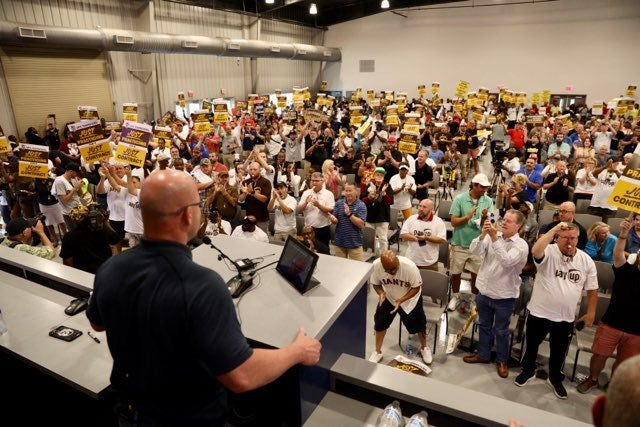
Sean O’Brien vowed to bring the belligerence during contract talks with UPS Inc. The Teamsters union’s general president didn’t disappoint.
Negotiations between the two, never lovefests, were particularly contentious this time around. Leveraging the scale of social media, the Teamsters ramped up the rhetoric for months. It reached the point where O’Brien was referring to UPS, in person and online, as a “white collar crime syndicate,” an unconventional way of characterizing the union’s largest employer.
O’Brien’s words resonated. Scared of a work stoppage disrupting their delivery schedules, shippers shifted, at the peak, 1.5 million daily parcels to competitors, according to UPS (NYSE: UPS) estimates. That amounted to roughly 8% of UPS’ normal U.S. daily volume of 18.6 million parcels as of July.
The volume exodus intensified in the late spring and early summer as the July 31 contract deadline drew closer. UPS executives, who in the words of longtime transport analyst Donald Broughton were “looking to stop the bleeding,” agreed on July 25 to a five-year contract considered generous to the Teamsters and detrimental, at least in the relative short term, to UPS. The union said the contract, which the rank-and-file ratified in early September, brought in $30 billion in new funds over the five-year cycle. That figure, if accurate, is real money even for a company UPS’ size.
The combat has ended, but a question that nagged folks during the negotiations remains unanswered: Did the Teamsters’ aggressive negotiating posture compromise UPS’ cost structure, volume growth and profit margins to the extent that the company will institute union layoffs in order to align higher expenses with lower top- and bottom-line levels?
O’Brien’s twofold endgame was to achieve the best possible economic deal for 340,000 UPS union workers and to send a message to Amazon.com Inc. (NASDAQ: AMZN) that the union is prepping to get its nonunion warehouse workers a similar deal should the Teamsters represent them.
A labor-friendly UPS contract was somewhat foreordained because the last agreement, in 2018, ended up allowing UPS to bypass much of the post-pandemic employment-cost spikes that brought higher employee costs on rival FedEx Corp., (NYSE: FDX) among others. O’Brien also had the dual tailwinds of a supportive White House and improving public sentiment toward organized labor.
Labor talks are as much a behavioral game as an economic set-to. Behind the emotion, however, are smart and pragmatic people on both sides tasked with determining how much they can ask for and concede without giving away the store.
Throughout its history, UPS has effectively adapted its costs to demand fluctuations. It also has long experience adjusting to wage and work-rule changes wrought by Teamster contracts. As for the Teamsters, “I’m assuming they can do math and do volumetrics,” said Michael C. Duff, professor of law at the Saint Louis University School of Law.
Duff, a former Teamster who remains well connected in organized labor circles, said O’Brien and his negotiators recognized that UPS bargaining-unit jobs might be lost due to slowing demand and the company’s push toward automation. However, they also knew that 7,500 full-time jobs would be created over the contract’s life by combining part-time hours, while three times that many open jobs would be filled during the cycle, Duff said.
“I believe the Teamsters, at some point, just said that ‘These are costs we are willing to live with,’” he said, referring to the potential for job losses.
Duff believes that O’Brien and company will not yield in their efforts to extract as much economic benefit as possible from union employers. Part of that effort is a sense of urgency to return labor to prominence after being on the back foot for more than 40 years, he said. For all the media chatter about 2023 being the “summer of strikes,” the fact remains that organized labor represented in the private sector hit a record low of 6% in 2022 despite a pro-union administration in the White House. (See chart.)
UPS declined comment. The Teamsters did not respond to a request for comment.
Will diverted volumes return?
The jury will be out for a while on UPS’ ability to win back diverted volumes. Over 116 years, the company has built a reputation for reliable, high-quality service. Executives have expressed confidence that it will win back all diversion as shippers recognize the unique value of its network.
According to UPS’ estimates, as of mid-October it had recovered 600,000 of the daily diverted parcels. FedEx said on its last analyst call in late September that it captured 400,000 daily UPS parcels. UPS has said it has recaptured 300,000 of them.
According to ShipMatrix data, about 1.25 million daily parcels were diverted. The 1.5 million figure cited by UPS included business that actually never existed because consumers were doing more in-store shopping and shifting their spending from goods to services, according to Satish Jindel, ShipMatrix’s president.
Of the 1.25 million packages, 750,000 went to FedEx, 315,000 to the U.S. Postal Service and 185,000 to regional delivery carriers, said Jindel. Those estimates were as of the end of August. UPS said that many customers waited until the contract was ratified before returning their volumes.
Ian Reagan, an analyst at consultancy The Colography Group LLC, said he expects UPS to eventually recover 900,000 daily parcels through volume recapture and new business. It may not happen by the end of the year, Reagan said. UPS executives have said that full volume recapture will likely be a 2024 story.
Michael H. Belzer, professor of economics at Detroit’s Wayne State University and one of the nation’s foremost transport labor relations experts, said he expects shippers to return to UPS because they will receive the service they want and are accustomed to from the carrier. UPS “will be successful in getting back the business as long as the service is there,” Belzer said.
Not everyone is so sanguine. Jindel said UPS will be saddled with higher costs and lower volumes through the life of the contract, and will be challenged to recover parcels in an increasingly competitive delivery marketplace. In 1997, UPS won back virtually all business lost during a 15-day Teamsters strike because shippers had effectively nowhere else to go, Jindel said. Today’s shippers, by contrast, have multiple alternatives, such as FedEx Ground, FedEx’s ground-delivery unit; Amazon; the Postal Service; and a slew of regional delivery carriers, among other providers, Jindel said.
Broughton told the Yahoo! Finance TV outlet at the end of July that UPS stands little chance of winning back parcels from FedEx unless FedEx falls down on service, a scenario that Broughton said was unlikely.
Alan Amling, who spent 27 years at UPS before retiring in 2019 as vice president of corporate strategy, said UPS will likely need to manage through a period of lower volumes caused by this summer’s diversions and a general slowing of delivery demand. As fewer packages move through facilities that already have substantial fixed costs, the average cost of every package rises, said Amling. This challenges the company’s core approach of building density to optimize its network, streamline processes and take out costs, said Amling, who today is assistant professor of practice at the University of Tennessee’s Global Supply Chain Institute.
“UPS has shown it is willing to sacrifice margin in their win-back efforts,” said Amling. “However, unless it reverses its strategic direction, it will have slow volume growth at best.” Fewer packages mean fewer workers, he said.
Technology the catalyst
Technology will be the catalyst, Amling said. “As wages rise, the relative cost of technology drops,” he said. “I expect you will see accelerated investments in technology that help employees become more productive, and in some cases, replace them. With the rise of AI, this will extend into the white-collar workforce as well.”
Amling doesn’t expect significant layoffs at UPS. Rather, he sees low to zero employee growth.
An industry executive who asked not to be identified said that UPS frequently adjusts driver manpower based on current volume trends. “With volume trends normally being up, UPS is not regularly laying off drivers. However, it does lay off drivers when volume is soft, but it doesn’t tell anybody they are laying drivers off. Given current downward volume trends, it is safe to assume that drivers are being laid off,” the executive said.
The company told analysts in late September that it will aggressively invest in technology to automate certain tasks inside its facilities. A byproduct of these investments is to lower the 140,000 part-time-employee head count in its sortation centers over the next few years, analysts were told. Collectively, these part-time unionized workers represent about $3 billion a year in potential cost savings, according to analysts.
Language in the contract requires UPS to negotiate with the Teamsters at least 45 days before it introduces technologies into the workplace. Much of the public discussion centered on technology like autonomous vehicles and drones that support transportation functions. A Teamsters spokesperson said the union has established a Committee on Technological Change to ensure the contract is adhered to and members are protected.
No one outside UPS knows for sure the type of business that was lost over the spring and summer. It may very well be that a good chunk of diverted volumes did not fit the carrier’s profit profile to begin with. Through CEO Carol B. Tomé’s “better not bigger” strategy introduced when she took over in June 2020, UPS focused on higher-margin traffic at the expense of big volume, lower-margin parcels. In went an emphasis on B2B traffic, lucrative verticals like health care, and small to midsize (SMB) customers that lacked the volume leverage to demand significant discounts. In turn, lower-priced e-commerce business-to-consumer traffic from enterprise customers — notably Amazon — were deemphasized.
According to Amling, UPS has over the past three-plus years built its higher-margin B2B, health care and SMB volumes. “This strategy played like a symphony during the high-demand pandemic period,” he said. “But that core capability becomes more difficult without the volume growth.”
Josh Taylor, senior director of professional services for consultancy Shipware LLC and a former UPS executive, said that long before contract talks heated up, UPS was selective about the type of business it would accept. Now with higher operating costs, lost volumes and slow demand, UPS is no longer as picky, he said.
“Unless it’s really lousy business, they will accept it,” Taylor said.
DOT pumping more truck capacity into US ports
WASHINGTON — About $290 million of $653 million in new federal grants awarded by the Biden administration will be used to improve truck capacity at U.S. ports.
The U.S. Department of Transportation announced on Friday the winners of the latest annual round of funding under the Port Infrastructure Development Program (PIDP), administered by DOT’s Maritime Administration.
Of the 41 port projects receiving money through the program in 2023, 11 feature significant improvements aimed at speeding truck freight in and out of coastal and inland ports.
“This is a day of good news for America’s supply chains and good news for every American interested in seeing the price of goods go down and stay down,” said Transportation Secretary Pete Buttigieg at a press briefing prior to the announcement.
“There is still an enormous amount of work to do. The goal is not to get American supply chains back to what they looked like in 2019 — which was adequate on a good day but not able to handle a disruption. Our goal is to strengthen those supply chains in a durable fashion while bringing more of them home to America, so that they are not just fair weather supply chains but ones that are going to be able to withstand all of the challenges and surprises that future years can throw at us.”
Among the 11 projects where truck capacity will get a major boost is the Port of Long Beach, California, which is receiving $52.6 million for its North Harbor Improvement Project. The $280 million multimodal project is increasing internal road capacity to create more space for trucks as well as making road and rail improvements outside the terminal areas to enhance cargo flow.
At the Port of Tacoma, Washington’s Husky Terminal — whose customers include major trans-Pacific container ship operators — a $54.2 million grant will be used to reconfigure the terminal yard to improve truck circulation. The federal grant represents 43% of the project’s $126 million cost.
On the East Coast, Diamond State Port Corp. at the Port of Wilmington, Delaware, is receiving $50 million for the new Edgemoor Container Terminal, a $132 million project that includes building a modern truck gate complex, terminal buildings and a 100,000-square-foot warehouse. “The new truck gate will allow the facility to handle additional cargo safely, efficiently, and reliably at higher speeds and with fewer accidents,” according to a project summary.
DOT is also awarding a $10.1 million PIDP grant to an inland river port on the Ohio River, the Shawneetown Regional Port District in southeast Illinois. The district has several private terminal operators, but the grant would cover 100% of the cost to develop a new 1.25-mile port access road for future port expansion.
“The new access road will improve efficiency and reliability by increasing the port’s truck staging capacity from 10 trucks to 105 trucks at any given time, resulting in an increase in throughput capacity at the port as well as a reduction in bottlenecks and congestion resulting from trucks having to stage throughout the local street network surrounding the port,” according to DOT.
One port project getting a wholesale makeover — thanks in part to a $32 million PIDP grant — is a berth at Port Newark, New Jersey. When the $197 million project is completed, it is expected to increase the port’s capacity to handle projected increases in dry bulk goods “and provide an additional layer of reliability for the regional and national supply chain,” DOT stated, by raising the elevation of the berth to better withstand flood events.
Sen. Cory Booker, D-N.J, pointed out that the berth, out of service since September 2021 “due to structural safety concerns,” will be reconstructed for a 75-year service life.
“New Jersey’s ports are engines of economic development for our region, moving goods, creating jobs, and strengthening our economy,” Booker said. “These investments will fund critical upgrades that improve port operations and shore up supply chains, secure New Jersey’s position as a leader in clean energy, and create thousands of jobs.”
The Stockout: Walmart announces Black Friday with brilliant ‘Mean Girls’ spoof
Now that is an ad!
If you haven’t seen it yet, I’m going to waste two minutes of your time: Please check out the “Mean Girls” Walmart ad here. I’ll wait — The Stockout will still be here when you’re done. Who needs to buy Super Bowl advertising space with something so sharable? A few takeaways:
It’s all about driving growth in Walmart Plus subscribers! Giving customers early access to Black Friday deals is the latest and, for many, best reason to sign up. Other benefits include “scan and go,” special rates at select gas stations, and free delivery from your local store. So, it’s a competitive response to both Amazon Prime and Costco at once. Adding Walmart Plus subscribers as well as driving general app downloads unlocks potential for targeted advertising, growth in e-commerce and share gain. There is also the psychology of subscriptions — customers shop where they have a subscription just so they don’t feel bad about paying for an unused subscription. I think once more consumers realize that Walmart delivers high-quality fresh foods as part of their subscription along with everything else, its e-commerce sales will really take off across demographics — the edge they have on Amazon is in grocery.
Walmart’s Black Friday starts a whopping 16 days before Black Friday. That seems like a competitive response to the second helping of Amazon Deal Days. For freight it probably also supports the view that the peak season was pulled forward, as was discussed in the latest State of Freight.
Highlighting Lego bricks for Black Friday was smart because they are stupidly expensive for what they are.
Lacey Chabert (Gretchen Wieners) hasn’t aged a day in 20 years. I know — right? She needs to tell us what sunscreen to buy.
My son (just under 2) would probably love the radio-controlled Teenage Mutant Ninja Turtles skateboarder.
Selling profitably on Amazon Marketplace possible, but not easy
(Photo: FWTV)
On Monday’s The Stockout show, I interviewed Chris Moe, CEO of Cartograph, a company that helps brands grow on Amazon and Instacart. While the recent lawsuit brought against Amazon by the Federal Trade Commission and 17 state attorneys general shed public light on the challenges that sellers on Amazon Marketplace face, Cartograph has long been helping sellers navigate those issues. Remarkably, more than 90% of Cartograph’s clients sell profitably on Amazon — that’s even more impressive considering that most are selling consumable items, a category that is notoriously difficult to sell profitably on Amazon.
Here are a few takeaways:
Upstream techniques, such as designing products and packaging that fit well into Amazon’s logistics network, are far bigger determiners of profitability on the site than anything that can be done in regard to optimizing search results and page views.
Amazon applies its favored nation price-matching inconsistently and seems to be deliberately unspecific about what the rules are. One strategy that some sellers employ is to act as though their products won’t be price-matched, until they are.
Amazon does not price-match against direct-to-consumer sites. Rather, it applies price-matching to other superstores sites, such as Walmart, Target and Kroger properties.
Sellers often introduce unique SKUs to be sold on Amazon. The uniqueness makes it more difficult for Amazon to price-match, but the retailer will sometimes price-match anyway by converting unique SKUs to a price per ounce.
Moe also helps sellers grow their brands on Instacart, and he believes that the service, which involves hiring a personal shopper, will likely remain a niche because of its premium status (although consumers can now use the Supplemental Nutrition Assistance Program for the service). However, he likes the company’s strategy of diversifying away from grocery into other categories that can often be more time-sensitive.
Amazon’s shift to regional fulfillment model has gone better than expected
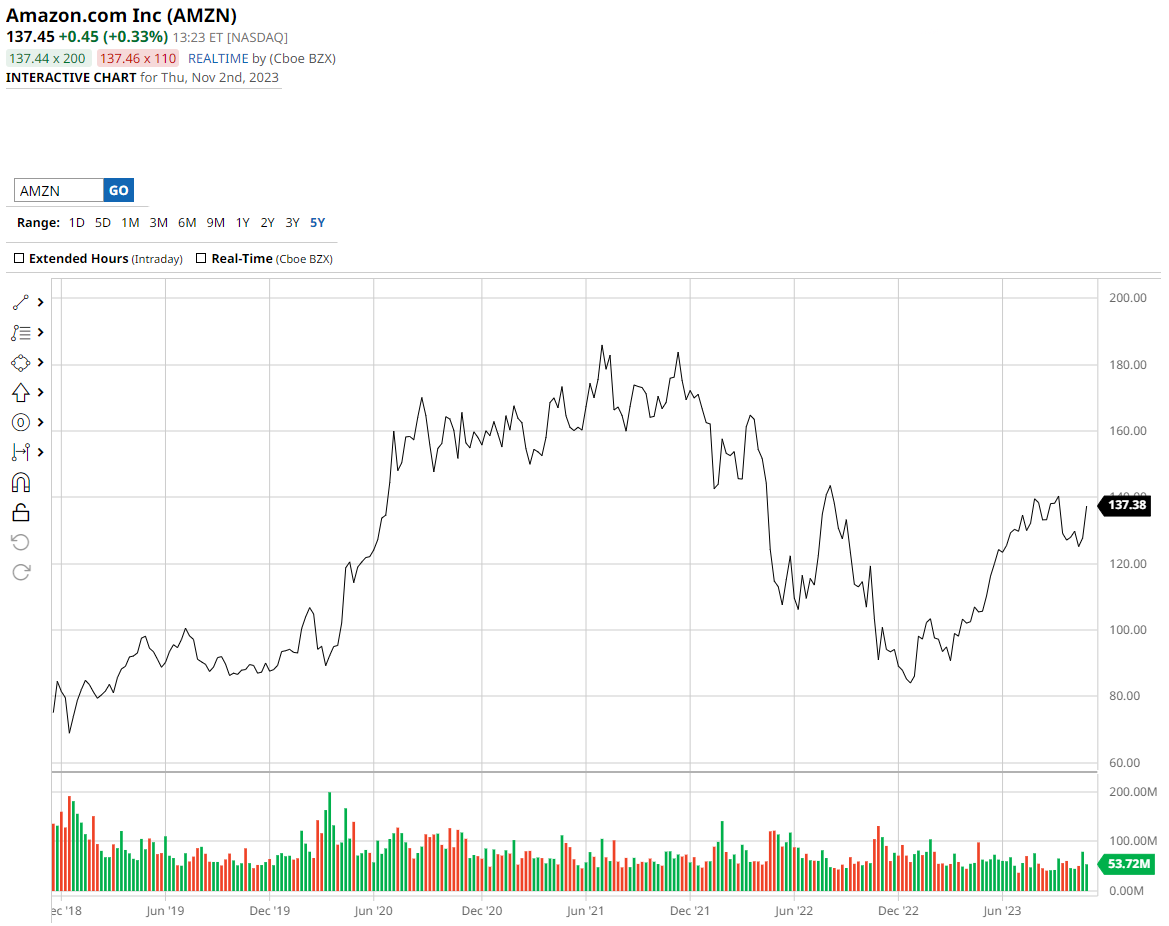
(Barchart.com Inc.)
In April, Amazon announced that it had completed a shift from a national fulfillment network to a regional fulfillment model, using eight distinct regional networks, to reduce handling cost, increase shipment consolidation and increase delivery speeds. Management described the process as one of the most significant changes to its fulfillment network since its inception. Half a year later, early results have exceeded initial expectations.
To support this effort, the company touts improved connectivity between fulfillment facilities and continued improvements in placement algorithms. Previously, using a national fulfillment network, items sometimes needed to be transported across the country when they were not available locally in the region where they were ordered.
For sellers on Amazon Marketplace, such as CPG companies, that potentially means needing higher inventory levels since they will have to maintain inventory in eight regions to qualify for Prime — which is critical since Prime customers buy about four times as much on the site as non-Prime members. For competing retailers, it means that the bar for fast deliveries is rising even higher — few retailers have the scale to offer such a wide array of products so close to consumption. Walmart is the notable exception.
State of Freight webinar highlights capacity overhang that is likely to persist
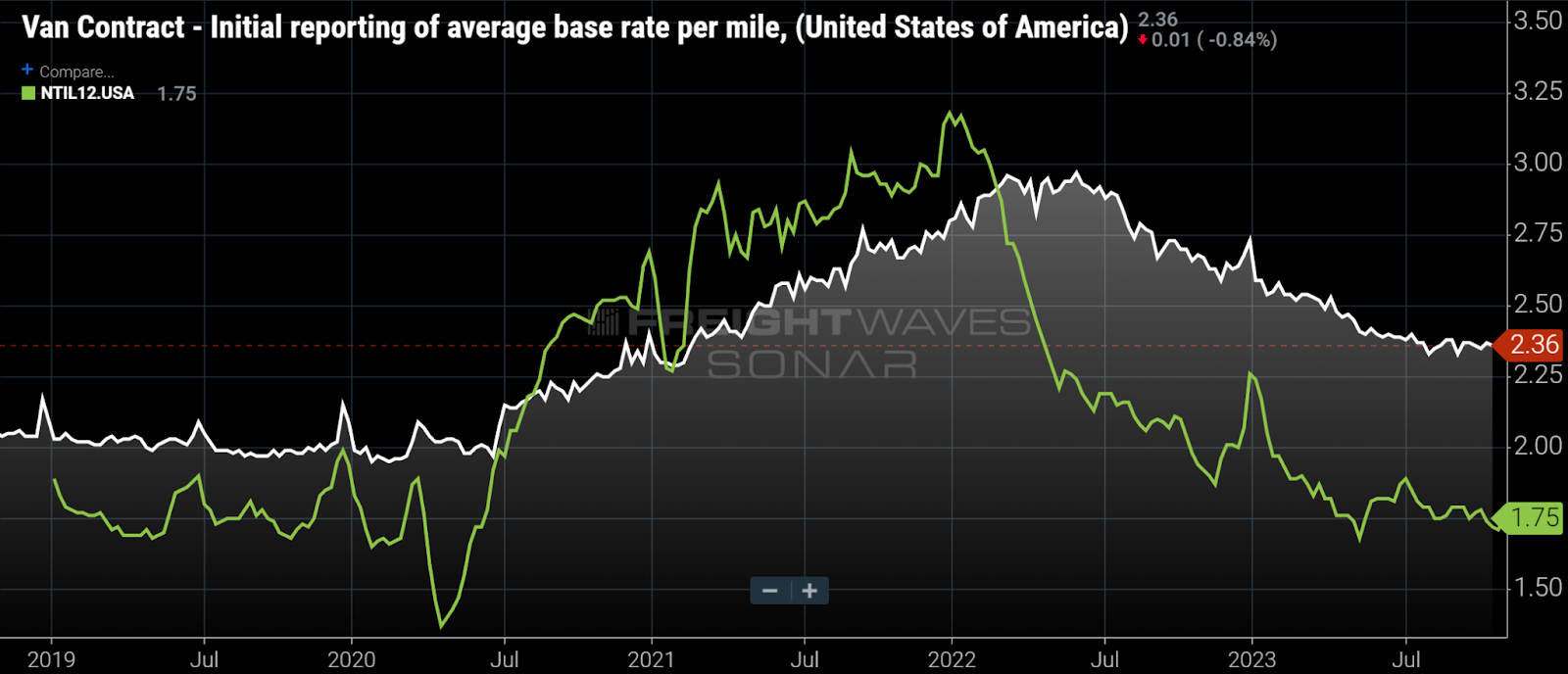
The spread between contract rates (white) and spot rates (green) is set to decline with spot rates approaching a floor and contract rates being rebid to lower levels. (Chart: SONAR)
I recommend going back and viewing the full webinar and/or at least reading John Kingston’s summary. Since this newsletter is written primarily with shippers in mind, here are a few takeaway from their perspective:
Freight demand increased in Q3, which is unusual seasonally. But, rather than representing true growth in freight demand, it appears to have been a sign of an early peak season.
Despite an elongated period of loose freight markets, a tightening doesn’t seem imminent. While freight demand has held up remarkably well considering pressures on the consumer and sharply rising interest rates, excess capacity that came into the market following a tight freight market and an interest rate at zero during the early years of the pandemic is the main reason why freight markets remain loose. FreightWaves CEO Craig Fuller estimates that another 20% of capacity needs to come out of the freight market in order to see tightening. Capacity has exited the industry only slowly — at the current pace, capacity could take another year or longer to come into balance with demand.
Shippers are in the driver’s seat for the upcoming bid season, which is most active in the fourth and first quarters. Therefore, contract rates in 2024 are likely to be below 2023 levels on top of a year-over-year decline this year.
Some carriers are parking trucks “against the fence” since rates in certain lanes are low enough that carriers are not incented to put more miles on their equipment. That suggests that latent capacity could be redeployed once the freight market turns around some, muting the impact of a freight market recovery.
Rail intermodal has taken some share back from long-haul truckload in response to improved rail service levels, falling intermodal rates and goods becoming less time-sensitive. But that is unlikely to significantly impact the truckload market because intermodal is a relatively small niche within the domestic surface transportation industry.
To subscribe to The Stockout, FreightWaves’ CPG and retail newsletter, click here.
US holiday spending to climb 3%-4% over 2022, NRF predicts
U.S. holiday spending will grow by 3% to 4% over the 2022 holiday to reach record levels of between $957.3 billion and $966.6 billion, the National Retail Federation said Thursday.
This year’s holiday spending is consistent with the average annualized increase of 3.6% between 2010 and 2019, NRF said. It also represents a slower pace than the past three years, when goods-buying soared amid trillions of dollars of pandemic-related federal stimulus provided to consumers, NRF said.
“It is not surprising to see holiday sales growth returning to pre-pandemic levels,” NRF President and CEO Matthew Shay said. “Overall household finances remain in good shape and will continue to support the consumer’s ability to spend.”
Online and other nonstore sales, which are included in the total, are expected to increase between 7% and 9% to a total of between $273.7 billion and $278.8 billion. That is up from $255.8 billion last year.
NRF’s forecast is based on economic modeling that considers employment, wages, consumer confidence, disposable income, consumer credit and previous retail sales. NRF’s calculation excludes auto dealers, gasoline stations and restaurants to focus on core retail. NRF defines the holiday season as Nov. 1 through Dec. 31.
The holiday forecast undercounts seasonal spending because 43% of holiday shoppers planned to start making purchases before November, according to a separate NRF-commissioned survey. The forecast also excludes holiday purchases that may be made in January 2024.
“Consumers remain in the driver’s seat, and are resilient despite headwinds of inflation, higher gas prices, stringent credit conditions and elevated interest rates,” NRF Chief Economist Jack Kleinhenz said. “We expect spending to continue through the end of the year on a range of items and experiences, but at a slower pace. Solid job and wage growth will be contributing factors this holiday season, and consumers will be looking for deals and discounts to stretch their dollars.”
NRF expects retailers will hire between 345,000 and 450,000 seasonal workers, in line with 391,000 seasonal hires in 2022. Some of this hiring may have been pulled into October to support retailers’ holiday buying events in October, NRF said.
Speaking Thursday at the CNBC Evolve Global Summit, FedEx Corp. (NYSE: FDX) President and CEO Raj Subramaniam said that retailers have moved beyond the inventory destocking cycle but haven’t entered the restocking phase. Subramaniam also said that spending between goods and services is returning to balance after a tilt toward goods purchases during and immediately after the pandemic, and then a shift to spending on so-called experiences once the pandemic was in the rearview mirror.
Subramaniam said the industrial economy remains weak in the U.S. and in many parts of the world.
The dangerous job of delivering mail by air in the early 20th century
FreightWaves Classics is sponsored by Old Dominion Freight Line — Helping the World Keep Promises. Learn more here.
In 1918, the U.S. Postal Service started to experiment with delivering mail by planes, even though the technology was still new. Cockpits were still open-air and passenger planes weren’t even considered yet. From 1918 to 1927, 34 airmail pilots lost their lives in accidents on the job.
Despite the risks, it was a coveted job and pilots were treated similarly to how astronauts are treated today.
Find out all about this method of mail delivery in this week’s episode of Tracks Through Time with Deputy Editor Brielle Jaekel and co-host Mary O’Connell.