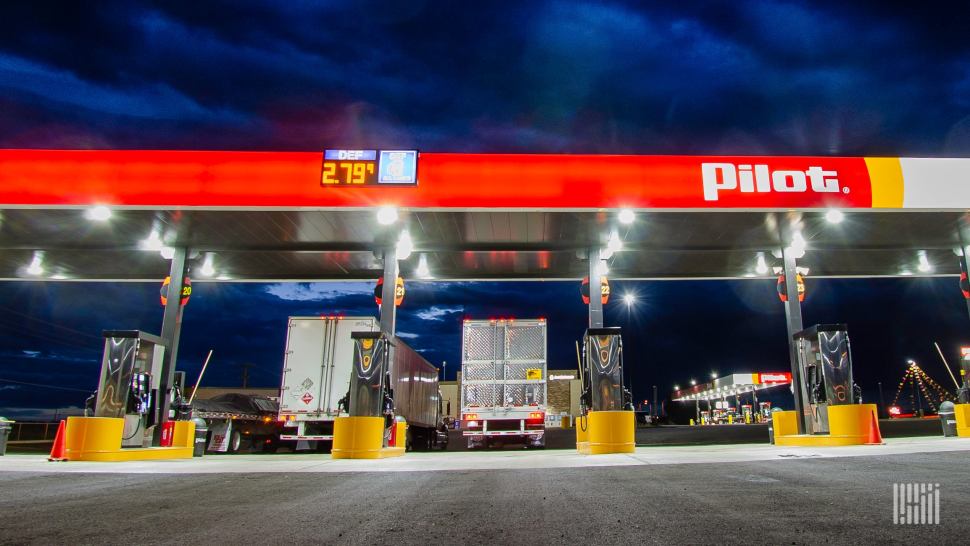
Berkshire Hathaway said a lot more than usual about Pilot Travel Centers in its latest quarterly earnings report.
Pilot became a fully-owned subsidiary of Berkshire Hathaway early in 2024 after it acquired the last 20% of the business it had not already bought from the Haslam family that founded and controlled the nation’s largest network of travel centers.
Data and commentary on Pilot’s financial condition has been relatively bare bones in Berkshire Hathaway’s quarterly earnings reports since then.
But there’s a fuller discussion in the 2025 annual report released Saturday. Much of the increased discussion about the business came primarily through the letter to shareholders authored by Greg Abel, who has taken over as CEO at Berkshire from Warren Buffet. (Buffet’s final letter a year earlier did not mention Pilot by name).
The letter and some of the data released in the annual report provided more information on how Pilot is doing. Bottom line: it wasn’t a great 2025 for the company.
The end-year data reported that Pilot’s pre-tax earnings for the year took a nosedive. Revenues at Pilot dropped to $42.2 billion from $46.9 billion a year earlier, some of which can be attributed to a decline in diesel prices on average in 2025.
An average of every weekly price of the Department of Energy/Energy Information Administration average weekly retail diesel price produces a number of $3.65/gallon in 2025, about 10 cts/g less than the prior year.
Profits fell harder than revenue
But pre-tax earnings dropped to $190 million from $614 million a year earlier, a decline of just over 69%.
The Abel letter did boast of net cash flow at Pilot of $1.7 billion for the year, which he said was an unspecified improvement over 2024.
“As operations continue to strengthen and capital needs normalize, we expect more cash to be returned to Berkshire,” Abel said.
Abel’s letter also touted Pilot’s Pro Preference score. It described that number as “a third party study of how often professional drivers choose Pilot over travel center competitors.” The Pilot score rose to 35% in 2025, it said, up from 27% in 2022.
That reference led to what could be interpreted as a dig against the Haslam family.
The road to full Berkshire Hathaway control began in 2017 when the company made its first purchase of a 38.6% share of privately-owned Pilot from the Haslam family.
Berkshire Hathaway and the Haslams’ relationship was contentious as the final 20% acquisition neared in 2024. A lawsuit in Delaware Chancery Court by the Haslams against Berkshire Hathaway over certain accounting changes was settled in January 2024, allowing that final 20% sale to go forward.
A subtle dig
The Abel letter noted that its initial 2017 investment in Pilot did not turn into control until 2023. Discussing the Pro Preference score, Abel said Pilot “should be number one and we will not be pleased until that standard is achieved.” Abel then added that Berkshire Hathaway’s “ability to manage (Pilot) was contractually delayed until 2023.”
“That mistake will not happen again,” Abel said.
Pilot’s weaker performance in 2025 was attributed by the company in its annual report to “lower wholesale fuel and in-store gross margins and higher selling, general and administrative expenses, primarily due to higher employee compensation and benefits, insurance and maintenance costs, as well as by charges from adjustments to certain fuel-related balance sheet accounts.”
The impact of those factors, Berkshire Hathaway said, were “partially offset by lower interest expense, primarily attributable to reduced borrowing levels, and gains from asset dispositions.”
Pilot cited “lower average fuel prices” as one of the reasons for the 10% decline in revenue.
Employee headcount at the end of the year was about 29,300 workers. That is just 100 more than the prior year.
Given the fragmentation of the trucking industry, it was not surprising to see that Pilot said its top 10 customers for diesel sales accounted for just 10% of the volume sold, unchanged from the prior year
The store count did not change much over the course of the year. In the report for 2025, Pilot said it operated 675 travel centers, and 82 “fuel-only” retail locations in the U.S. with an additional five in Canada. Pilot owned 663 of those locations. There are an additional 94 operated under what Berkshire Hathaway called “unconsolidated joint ventures.”
In the report for 2024, the numbers were 677 travel centers, 77 fuel-only outlets, 658 company-owned locations and 97 consolidated joint ventures.
More articles by John Kingston
Derek Barrs defends FMCSA’s bold moves at TCA
How New York’s new driving penalties impact truckers
BMO’s quarterly earnings suggest truck credit might be improving
Brokerage Compliance Symposium
The day before F3. Every compliance issue you face - fraud exposure, carrier liability, FMCSA rules, cargo theft, insurance gaps - navigated by attorneys and operators defining best practices in a changing industry.
F3 Awards Dinner
The night before F3. FreightTech100 companies honored. FreightTech 25 and Shipper of Choice winners revealed live. Cocktail reception into dinner and live music - 300 industry leaders in one purpose-built room.
F3: Future of Freight Festival
Industry-defining keynotes, rapid-fire technology demos, and industry leaders networking in experiences across Chattanooga - plus the inaugural F3 Awards Dinner featuring the FreightTech and Shipper of Choice reveals.
The day before F3. Every compliance issue you face - fraud exposure, carrier liability, FMCSA rules, cargo theft, insurance gaps - navigated by attorneys and operators defining best practices in a changing industry.
The Signal at Chattanooga Choo Choo • Chattanooga, TN Register NowThe night before F3. FreightTech100 companies honored. FreightTech 25 and Shipper of Choice winners revealed live. Cocktail reception into dinner and live music - 300 industry leaders in one purpose-built room.
The Signal at Chattanooga Choo Choo • Chattanooga, TN Register NowIndustry-defining keynotes, rapid-fire technology demos, and industry leaders networking in experiences across Chattanooga - plus the inaugural F3 Awards Dinner featuring the FreightTech and Shipper of Choice reveals.
The Signal at Chattanooga Choo Choo • Chattanooga, TN Register Now