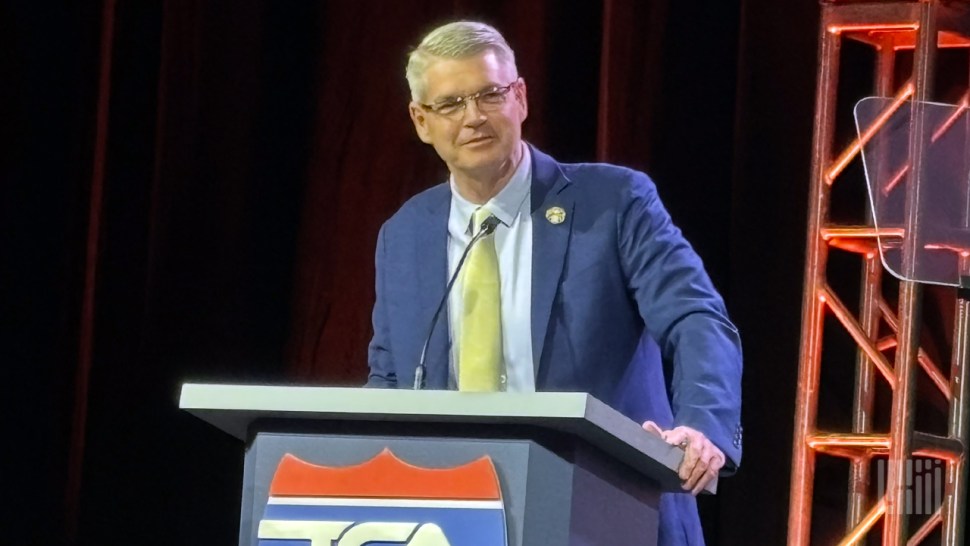
ORLANDO–Derek Barrs received a standing ovation when he completed his address to the Truckload Carriers Association (TCA) and it felt completely spontaneous and genuine.
The new administrator of the Federal Motor Carrier Safety Administration spoke to his first TCA annual meeting Monday, fiercely defending the steps that the agency and other parts of the federal government have taken to either enforce existing rules governing driver eligibility or create new standards that have led to a significant decrease in the number of truck drivers on the road.
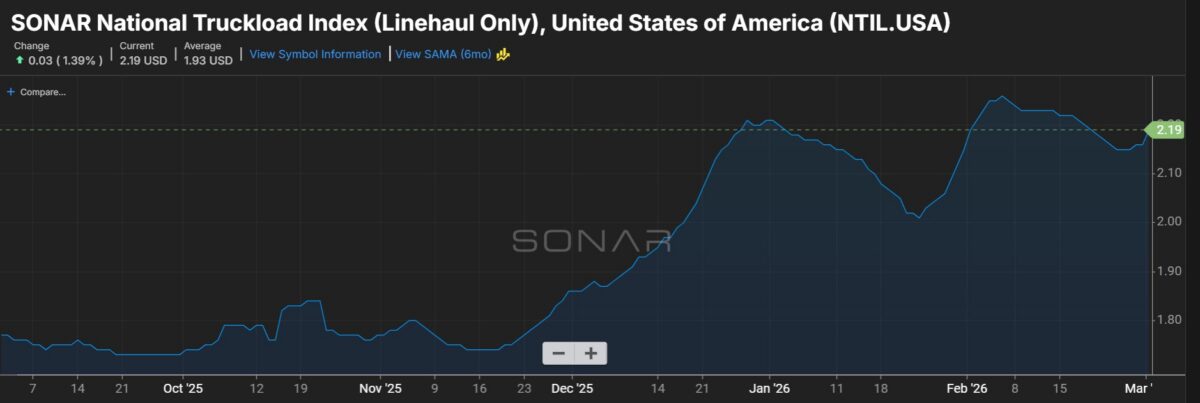
That decline in capacity has been seen as the primary driver of an increase in freight rates and rejection rates that may be leading the attendees at the TCA conference to cautiously accept the idea that maybe the freight recession is over. It isn’t because of any large-scale increase in demand, as Bob Costello, chief economist of the American Trucking Associations, said in an address to the audience after Barrs finished his speech. It’s a supply issue.
Barrs began his ATA address by discussing President Trump’s recent State of the Union and his inclusion of truck safety in the speech, specifically to boost recently-introducted legislation known as Dalilah’s Law that would even more severely restrict the ability of non-English speakers and non-domiciled residents from obtaining a CDL. The bill is named after a young girl seriously injured who survived a crash with a truck driven by a driver in the U.S. illegally.
“I think that’s the first time in history I have ever heard a President talk about this industry at the State of the Union address,” Barrs said. “It spoke directly to something that we all understand, or we should understand, that your CDL actually should mean something, and it shouldn’t be just because I went through a fly-by-night training school, and I went and got a job at some fly- by-night company.”
Barrs spoke of the various English-language requirements that FMCSA has pursued in the second Trump presidency, in language that was clearly welcomed by the TCA audience.
The English language policies taken by FMCSA and other parts of the federal government are designed to ensure “the ability to read road signs, understand safety instructions and communicate effectively.”
“When that standard is applied inconsistently, it creates risk, not only to the public but professional drivers operating alongside someone who may not fully understand the critical instructions,” Barrs said.
Barrs had been chief of the Florida Highway Patrol, retiring in 2020. It was experiences in that role that appeared to be the basis of this statement: “It’s difficult whenever you’re doing roadside inspections nobody can understand what you’re saying. We are ensuring this requirement is applied as written and as it is intended, not selectively, not unevenly, but consistently.”
Recapping what’s been done
Among the trucking-focused rules promulgated by the Trump administration, one of the most significant was the executive order signed by President Trump last year that required English proficiency from drivers, a rule that already had been on the books but had been largely unenforced. In addition, the Department of Transportation is requiring that all proficiency tests be given in English.
Other steps taken by Barrs and other parts of the government in recent months include a rule issued in September, finalized last month, that cracked down on the issuance of non-domicile CDL and commercial learner’s permit holders. That rule limits non-domiciled CDL eligibility to foreign nationals holding H-2A agricultural worker visas, H-2B temporary non-agricultural worker visas, or E-2 treaty investor visas.
There have been areas where FMCSA has backed off the most strict interpretations of its regulations. For example, it recently clarified that there aresome exceptions near borders where enforcing English language requirements will not immediately be taken out of service.
During his speech, Barrs spoke about the federal government push that has resulted in what he said was the closure of 7,000 training schools.
“To be honest with you, I would just as soon as we go through and just clear all of them out and start all over again,” Barrs said. “We have a systematic problem here that we have to work through to ensure that we are putting the right drivers behind the wheel of commercial motor vehicles who want to do it right and not circumvent the system.”
In a post-speech interview with FreightWaves, Barrs qualified that statement about such a sweeping agenda.
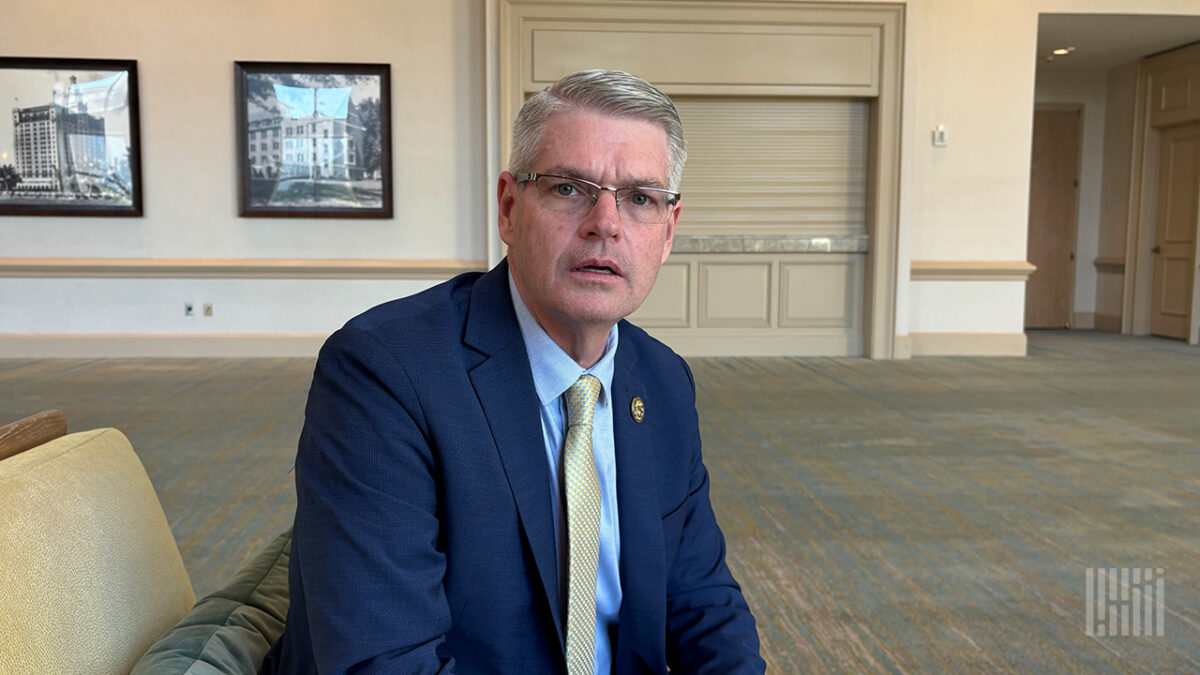
Derek Barrs speaks with FreightWaves at TCA
“I’m not saying that that’s what we’re going to do,” he said. “I’m just saying that’s kind of my thoughts on it when you have so many bad actors that are in the system.”
Barrs said there needs to be a “cleaning out so we can kind of start all over. I don’t know what that necessarily looks like.”
But it would ultimately mean reforming what Barrs called the “self certification process when it comes to entry level driver training.” He put the certification of ELDs into that category as well, noting the large-scale withdrawal of approval for ELDs.
Barrs said the issue of schools and ELDs would be part of the proposed rulemaking that also is targeting English-speaking requirements. (He discussed those so far loosely defined proposals in a recent online press conference.)
Rates not a concern
In the interview with FreightWaves, Barrs was asked about the impact on freight markets from the agency’s policies as a result of the steps FMCSA is taking.
“If safety strengthens freight rates, then so be it,” he said. “My job is about saving lives. It’s not about rates. I don’t look at freight rates to determine safety.”
Barrs used the occasion to repeat the agency’s recent call for volunteers that would test changes in Hours of Service rules regarding time spent in the sleeper berth. “This is an opportunity for for professional drivers to directly inform national policy through real world experience and measurable data,” he said.
Barrs is the latest FMCSA administrator in a long line of people, men and women, who have held that job in recent years either with or without Senate confirmation (the latter serving on an acting basis) without any of them sticking around too long. Barrs was confirmed in October.
One of those acting administrators, Jim Mullen, was in attendance at the TCA meeting, ready to take over as president of the TCA and was acknowledged by Barrs. “Jim has been a great friend, a great mentor, and I know this organization is in great hands with Jim,” Barrs said.
But asked why this role can’t seem to get a person in it who puts together a lengthy tenure, Barrs said he didn’t know. “It’s demanding,” he said. “It’s 24/7 if you want to do it right. You’ve got to work at it. But we’re not shying away from the work.”
More articles by John Kingston
How New York’s new driving penalties impact truckers
BMO’s quarterly earnings suggest truck credit might be improving
The high-stakes fight over New York City’s renewed delivery regulation law
Brokerage Compliance Symposium
The day before F3. Every compliance issue you face - fraud exposure, carrier liability, FMCSA rules, cargo theft, insurance gaps - navigated by attorneys and operators defining best practices in a changing industry.
F3 Awards Dinner
The night before F3. FreightTech100 companies honored. FreightTech 25 and Shipper of Choice winners revealed live. Cocktail reception into dinner and live music - 300 industry leaders in one purpose-built room.
F3: Future of Freight Festival
Industry-defining keynotes, rapid-fire technology demos, and industry leaders networking in experiences across Chattanooga - plus the inaugural F3 Awards Dinner featuring the FreightTech and Shipper of Choice reveals.
The day before F3. Every compliance issue you face - fraud exposure, carrier liability, FMCSA rules, cargo theft, insurance gaps - navigated by attorneys and operators defining best practices in a changing industry.
The Signal at Chattanooga Choo Choo • Chattanooga, TN Register NowThe night before F3. FreightTech100 companies honored. FreightTech 25 and Shipper of Choice winners revealed live. Cocktail reception into dinner and live music - 300 industry leaders in one purpose-built room.
The Signal at Chattanooga Choo Choo • Chattanooga, TN Register NowIndustry-defining keynotes, rapid-fire technology demos, and industry leaders networking in experiences across Chattanooga - plus the inaugural F3 Awards Dinner featuring the FreightTech and Shipper of Choice reveals.
The Signal at Chattanooga Choo Choo • Chattanooga, TN Register Now