




WASHINGTON — The Federal Motor Carrier Safety Administration has released new guidance defining the boundaries of where truck drivers are effectively immune from being placed out of service (OOS) for failing to speak English.
Last year the Trump administration initiated strict, national enforcement of English Language Proficiency (ELP) by requiring that such violations result in truckers being designated OOS and being taken off the road.
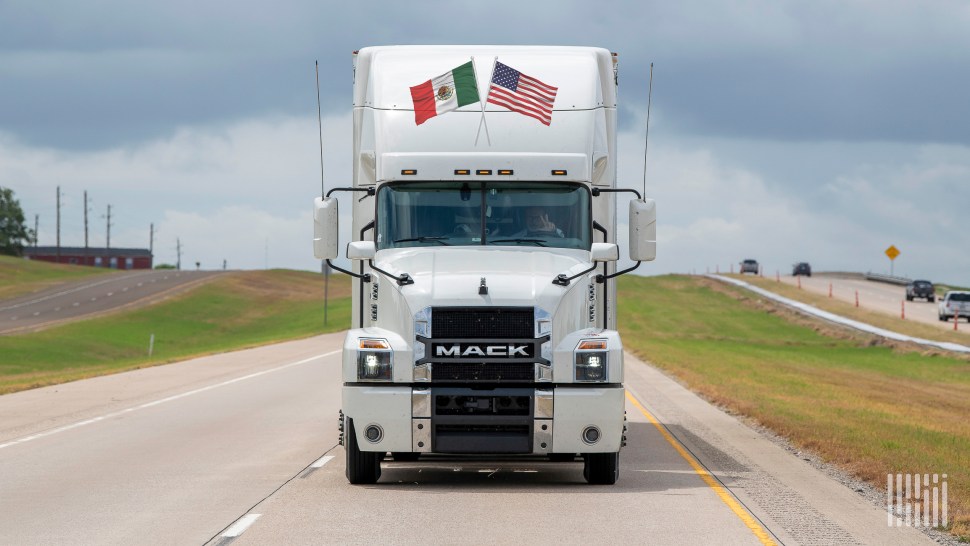
But FMCSA has now clarified that there are geographic exceptions to enforcement: Drivers stopped within specific commercial border zones – ranging from three to 20 miles from the border, depending on the size of the population within the municipality – will not be grounded if they fail a language evaluation. Instead, inspectors are directed to cite the violation but let the driver proceed.
This exception applies “irrespective of the driver or motor carrier’s country of domicile or whether the driver holds a U.S. CDL, Mexican Licencia Federal de Conductor, or Canadian CDL,” the FAQ states.
In addition to commercial zones defined in 49 CFR Part 372, subpart B, the agency specifically cited El Paso, Texas, several Texas counties (Cameron, Hidalgo, Starr, and Willacy) and two New Mexico counties (Dora Ana and Luna) as protected zones where the “no-shutdown” rule applies.
In the FAQ, which was published in response to a request for clarification by the Commercial Vehicle Safety Alliance, FMCSA also confirms that it has implemented “hardcoding” in its SafeSpect inspection software to ensure that all ELP violations (with the exception of the commercial border zones) are automatically marked as out-of-service offenses.
The intent of the software update is to prevent local inspectors from using their own discretion to “go easy” on drivers who fail the test outside of the border zones.
“One-strike” ELP assessment
The guidance also clears up confusion regarding the two-step ELP evaluation process (Interview and Sign Recognition). FMCSA confirmed that if a driver fails the initial interview, the inspector will not proceed to the highway sign test.
FMCSA also emphasized that failing the ELP check can trigger more than just a roadside delay, clarifying that it may initiate formal “driver qualification proceedings” via a letter of disqualification – a process that could sideline a driver permanently.
Related articles:
Brokerage Compliance Symposium
The day before F3. Every compliance issue you face - fraud exposure, carrier liability, FMCSA rules, cargo theft, insurance gaps - navigated by attorneys and operators defining best practices in a changing industry.
F3 Awards Dinner
The night before F3. FreightTech100 companies honored. FreightTech 25 and Shipper of Choice winners revealed live. Cocktail reception into dinner and live music - 300 industry leaders in one purpose-built room.
F3: Future of Freight Festival
Industry-defining keynotes, rapid-fire technology demos, and industry leaders networking in experiences across Chattanooga - plus the inaugural F3 Awards Dinner featuring the FreightTech and Shipper of Choice reveals.
The day before F3. Every compliance issue you face - fraud exposure, carrier liability, FMCSA rules, cargo theft, insurance gaps - navigated by attorneys and operators defining best practices in a changing industry.
The Signal at Chattanooga Choo Choo • Chattanooga, TN Register NowThe night before F3. FreightTech100 companies honored. FreightTech 25 and Shipper of Choice winners revealed live. Cocktail reception into dinner and live music - 300 industry leaders in one purpose-built room.
The Signal at Chattanooga Choo Choo • Chattanooga, TN Register NowIndustry-defining keynotes, rapid-fire technology demos, and industry leaders networking in experiences across Chattanooga - plus the inaugural F3 Awards Dinner featuring the FreightTech and Shipper of Choice reveals.
The Signal at Chattanooga Choo Choo • Chattanooga, TN Register Now