




Fewer ship calls in the midst of the coronavirus pandemic as well as lingering effects from the United States’ trade war with China resulted in a 17.9% year-over-year drop in imports at the Port of Long Beach in February.
The port noted that although the United States and China signed a Phase One trade agreement in January, about $370 billion in Chinese goods remain under increased tariffs. The coronavirus has further disrupted the supply chain, with an increase in canceled sailings and a reduction in cargo moving through the nation’s second-busiest port.
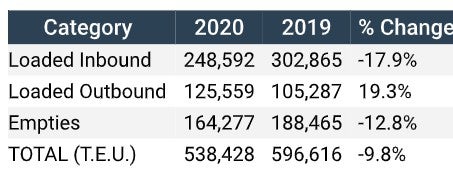
The port reported terminal operators and dockworkers moved 538,428 twenty-foot equivalent units (TEUs) last month, down 9.8% compared to February 2019. Imports dropped 17.9% to 248,592 TEUs, while exports increased 19.3% to 125,559 TEUs. Empty containers sent overseas decreased 12.8% to 164,277 TEUs.
“With the extended factory closures and slowdown of goods movement in China and other Asian countries in February due to Lunar New Year and COVID-19, we are seeing shipping lines needing to cancel some sailings,” said Mario Cordero, executive director of the Port of Long Beach, in a statement. “Once the virus is contained, we may see a surge of cargo, and our terminals, labor and supply chain will be ready to handle it.”
According to Long Beach Health and Human Services, the city had three confirmed cases of the coronavirus as of Wednesday morning.
Long Beach Harbor Commission President Bonnie Lowenthal said, “The port will continue to monitor the outbreak internationally and work with our stakeholders to keep our crucial link in the supply chain open and operating.”
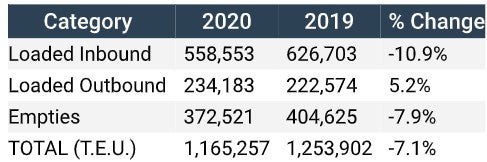
In January and February, the port moved a total of 1,165,257 TEUs, a 7.1% decline from the 2019 figure. Imports accounted for 558,553 TEUs, a 10.9% year-over-year decrease.
Brokerage Compliance Symposium
The day before F3. Every compliance issue you face - fraud exposure, carrier liability, FMCSA rules, cargo theft, insurance gaps - navigated by attorneys and operators defining best practices in a changing industry.
F3 Awards Dinner
The night before F3. FreightTech100 companies honored. FreightTech 25 and Shipper of Choice winners revealed live. Cocktail reception into dinner and live music - 300 industry leaders in one purpose-built room.
F3: Future of Freight Festival
Industry-defining keynotes, rapid-fire technology demos, and industry leaders networking in experiences across Chattanooga - plus the inaugural F3 Awards Dinner featuring the FreightTech and Shipper of Choice reveals.
The day before F3. Every compliance issue you face - fraud exposure, carrier liability, FMCSA rules, cargo theft, insurance gaps - navigated by attorneys and operators defining best practices in a changing industry.
The Signal at Chattanooga Choo Choo • Chattanooga, TN Register NowThe night before F3. FreightTech100 companies honored. FreightTech 25 and Shipper of Choice winners revealed live. Cocktail reception into dinner and live music - 300 industry leaders in one purpose-built room.
The Signal at Chattanooga Choo Choo • Chattanooga, TN Register NowIndustry-defining keynotes, rapid-fire technology demos, and industry leaders networking in experiences across Chattanooga - plus the inaugural F3 Awards Dinner featuring the FreightTech and Shipper of Choice reveals.
The Signal at Chattanooga Choo Choo • Chattanooga, TN Register Now