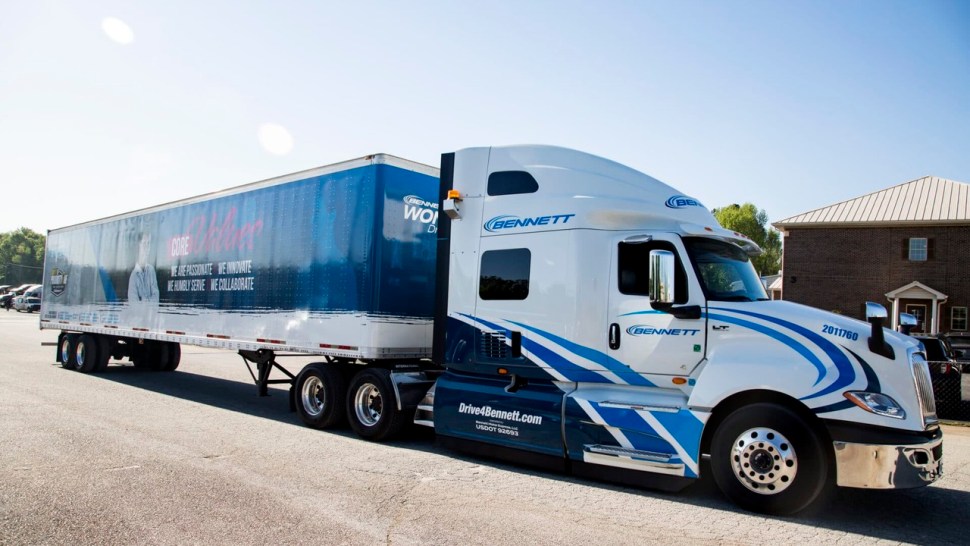
When Praveen Boppana started as a programmer at Bennett International Group more than two decades ago, the company was still heavily reliant on paper-based processes for tracking driver hours. Back then, before electronic logging devices, drivers mailed in their logs weekly. A dedicated logs department audited every page by hand, and violations were flagged only after a partner sifted through stacks of documentation.
“Everything was manual at that time,” Boppana told FreightWaves in an interview at Motive’s Vision 26 event.
Today, Boppana serves as chief information officer for the Bennett Family of Companies, overseeing a fleet of approximately 4,500 pieces of equipment — about 3,600 on the trucking side alone, including its drayage division. The company has an ambitious three-year roadmap to migrate its legacy systems into an artificial intelligence-powered future. His journey and Bennett’s strategy offer insights into how large carriers are modernizing without losing operational footing.
From Mail-In Logs to Electronic Compliance
Bennett’s transformation accelerated with the 2017 federal mandate for electronic logging devices. The company adopted Motive as its ELD provider, making it one of the platform’s early adopters.
The shift was not seamless. Bennett relies heavily on owner-operators, who initially resisted devices that track both their time and loads.
“When you’re talking about putting ELDs in their trucks, they’re not too happy about it initially,” Boppana said. “There was a lot of resentment. They don’t want ELDs, they don’t want anything tracking their trucks.”
The regulation forced adoption, but effective change management was essential. Today, Bennett operates at roughly 90 percent ELD compliance, with the remaining 10 percent on paper logs for equipment qualifying for exemptions due to age.
“If you think about it, it was really a blessing for large fleets like us to go from paper-based logs to electronic logs,” Boppana said. “Now we can’t even think of it as automation, but at that time it was huge.”
Dash Cams: The Hearts-and-Minds Campaign
ELD adoption came with the force of regulation. Dash cam adoption required a different approach — more carrot than stick. Boppana called it the most challenging change-management effort of his career.
Unlike ELDs, dash cams were not mandated. “It wasn’t regulated — it’s not a regulation,” he said. “There’s an option there; owner-operators can even say no to it because of the business model.”
Bennett used a “hearts-and-minds, marketing-style approach.” The central pitch: video evidence would enable faster exoneration for drivers not at fault in accidents.
“If you have a dash cam, we have visibility of what’s going on,” Boppana said. “We can actually exonerate you faster. That was one of the big selling points.”
The company covered all hardware and subscription costs, shared incident reports up to the CEO level and made dash cams mandatory for newly onboarded drivers. Transitioning the existing fleet took nearly a year.
Safety Scores, Insurance and Customer Trust
Investments in safety technology deliver returns beyond regulatory compliance. Shippers and customers evaluate carriers in part on their Compliance, Safety, Accountability scores.
“They look at our CSA scores — are we a safe carrier or not? Because that directly affects whether their commodity gets delivered safely and on time,” Boppana said. “The safer we are, the fewer incidents, the better our chances of getting more business.”
Bennett also leverages its safety posture to help manage insurance costs. The company provides coverage to its owner-operators. Lower claims translate to lower premiums for drivers as well.
“If we’re not paying as many claims, our insurance rates stay lower, which means driver premiums stay lower too,” Boppana said. “It’s a twofold win-win.”
Modernizing the Foundation
Like many large truckload carriers, Bennett still runs older core systems — what Boppana refers to as “legacy software.” Rather than exposing the AS/400 system directly to field employees and agents, the company built a modern Java application layer on top of it more than two decades ago.
“That allows us to more easily leverage new technologies like AI agents because the middle layer is still modern,” he said.
Bennett is now in the midst of a roughly three-year effort to migrate components off the AS/400 and into an AI-powered transportation management system. Motive data feeds directly into the safety module, with plans to expand visibility and coaching capabilities to operations teams and agents.
“What we’re trying to do is give operations that visibility and bring them into the coaching process — not just rely on the safety team, but expand coaching capabilities across operations and even to our agents,” Boppana said.
For Bennett, dash cams and telematics represent one piece of a broader modernization strategy. The company is integrating advanced capabilities from partners like Motive into its evolving tech stack. This modular approach allows Bennett to adopt the latest technology without having to build every solution in-house, as large fleets more commonly did in years past.
Brokerage Compliance Symposium
The day before F3. Every compliance issue you face - fraud exposure, carrier liability, FMCSA rules, cargo theft, insurance gaps - navigated by attorneys and operators defining best practices in a changing industry.
F3 Awards Dinner
The night before F3. FreightTech100 companies honored. FreightTech 25 and Shipper of Choice winners revealed live. Cocktail reception into dinner and live music - 300 industry leaders in one purpose-built room.
F3: Future of Freight Festival
Industry-defining keynotes, rapid-fire technology demos, and industry leaders networking in experiences across Chattanooga - plus the inaugural F3 Awards Dinner featuring the FreightTech and Shipper of Choice reveals.
The day before F3. Every compliance issue you face - fraud exposure, carrier liability, FMCSA rules, cargo theft, insurance gaps - navigated by attorneys and operators defining best practices in a changing industry.
The Signal at Chattanooga Choo Choo • Chattanooga, TN Register NowThe night before F3. FreightTech100 companies honored. FreightTech 25 and Shipper of Choice winners revealed live. Cocktail reception into dinner and live music - 300 industry leaders in one purpose-built room.
The Signal at Chattanooga Choo Choo • Chattanooga, TN Register NowIndustry-defining keynotes, rapid-fire technology demos, and industry leaders networking in experiences across Chattanooga - plus the inaugural F3 Awards Dinner featuring the FreightTech and Shipper of Choice reveals.
The Signal at Chattanooga Choo Choo • Chattanooga, TN Register Now