




Routing guides are crumbling. Truckload contract rates set early in the 2026 bid season aren’t holding, management teams at some of the nation’s largest carriers told investors at a conference last week.
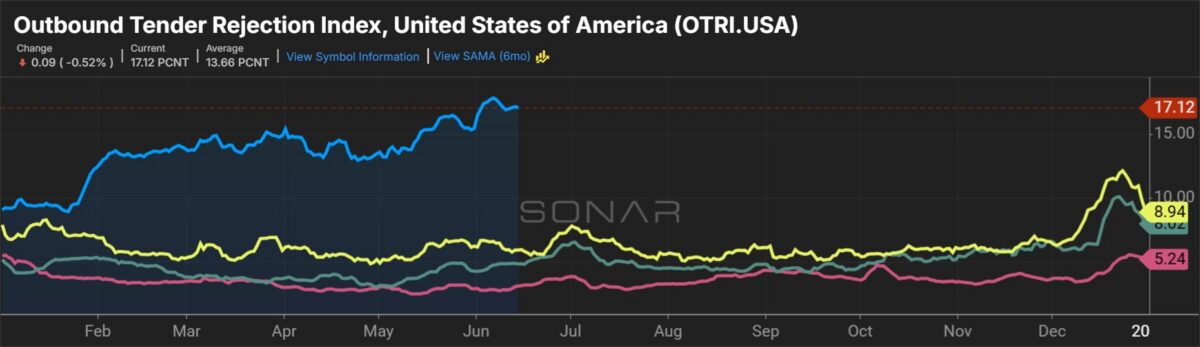
Mini-bid activity has spiked, and some shippers have been forced to rebid their entire book as tender rejections surge, Spencer Frazier, head of sales and marketing at J.B. Hunt Transport Services (NASDAQ: JBHT), told investors at the Wells Fargo Industrials & Materials Conference in Chicago.
“The only reason that happens is because routing guides, once implemented, start to crumble,” Frazier said. “They’re falling apart. And that’s what has happened at an accelerated pace … from March through today.”
Heightened regulatory enforcement has been purging noncompliant drivers from the market since last fall. The impact on the supply side was notable in the spot market around Thanksgiving when rates began to step higher. With additional levers being pulled more recently (strict policing of cabotage rules and the Supreme Court’s broker liability ruling) many believe market fundamentals have been structurally altered.
“It is different this time,” Frazier said. “Our customers are experiencing basically the increased enforcement of government regulations, and regulations that were existing, and a few new ones.”
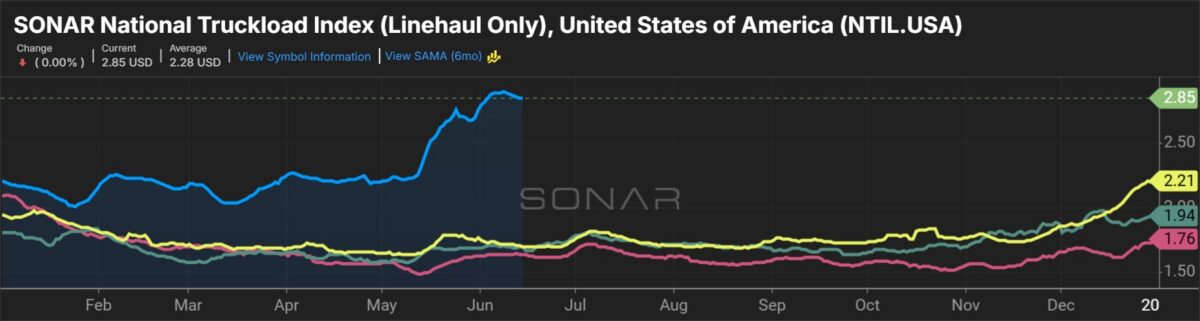
He said the shift in industry capacity is structural, not transitory, implying TL rates could stay inflationary much longer than in past cycles. The regulatory push on top of cost hurdles (elevated equipment expenses, safety-driven insurance headwinds and higher fuel prices) will likely keep new entrants at bay for a while. This contrasts with previous gold-rush-like cycles, where an influx of new entrants oversupplied the market and drove pricing lower as they were forced to rely on load board rates to service truck lease payments.
“The ability for our industry to respond to that in the old way is just not going to be there,” Frazier said.
Jim Filter, group president of transportation and logistics at Schneider National (NYSE: SNDR), echoed a similar sentiment on the market’s turnabout due to increased driver standards.
He pointed to the Supreme Court’s Montgomery v. Caribe Transport II ruling, which widened liability exposure for freight brokers found negligent in their driver hiring practices, as an additional gating factor.
“Based on our experience, there aren’t 50,000 carriers in this country that you could vet and say that they’re safe,” Filter said.
That runs counter to just a few years ago when brokers were touting the 100,000-plus third-party-carrier lists that they had amassed.
Filter said it will likely take “a couple of allocation events to recoup price” after a runup in nearly every operating expense line on the P&L over the past few years.
Management from Werner Enterprises (NASDAQ: WERN) was also bullish on the company’s prospects. It views the Montgomery ruling as a “net benefit” for its brokerage business. It said shippers are aligning with asset-based brokers that can guarantee trucks and driver compliance.
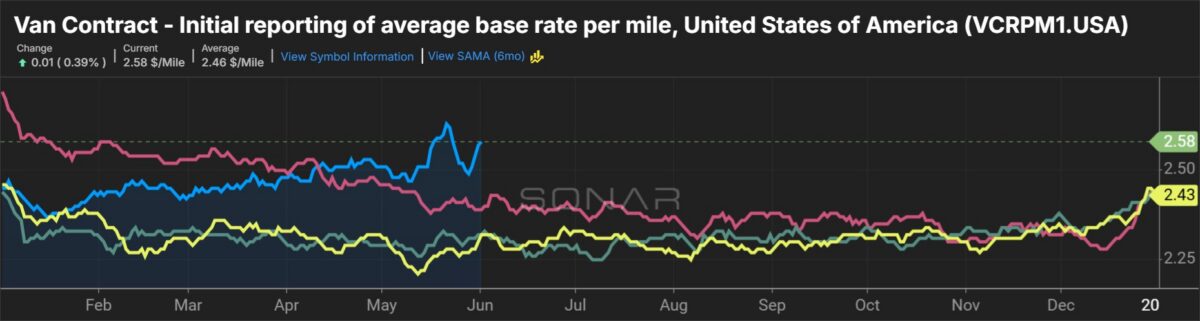
Most carriers raised bid season expectations during the first-quarter earnings season, which ended in early May. The group had targeted low- to mid-single-digit rate increases entering the year, but a tightening supply side now has it calling for mid- to high-single-digit increases, with some shippers already seeing double-digit rate hikes.
Schneider said contract renewals were at the highest level since 2021 on its first-quarter call.
J.B. Hunt flagged the likelihood of a cumulative 20% rate hike over the next two years at an investor conference last month.
An increase in demand will likely be required at some point to sustain the upcycle. Carriers have seen typical season demand patterns in recent quarters, but not material improvements. A still-resilient but weakening consumer has carried the economy since the pandemic. The data center boom has helped spur industrial activity this year, but the housing and auto sectors remain drags, and the next move in interest rates may be up, not down. Virtually every TL recovery has been demand-led, not supply-led.
Brokerage Compliance Symposium
The day before F3. Every compliance issue you face - fraud exposure, carrier liability, FMCSA rules, cargo theft, insurance gaps - navigated by attorneys and operators defining best practices in a changing industry.
F3 Awards Dinner
The night before F3. FreightTech100 companies honored. FreightTech 25 and Shipper of Choice winners revealed live. Cocktail reception into dinner and live music - 300 industry leaders in one purpose-built room.
F3: Future of Freight Festival
Industry-defining keynotes, rapid-fire technology demos, and industry leaders networking in experiences across Chattanooga - plus the inaugural F3 Awards Dinner featuring the FreightTech and Shipper of Choice reveals.
The day before F3. Every compliance issue you face - fraud exposure, carrier liability, FMCSA rules, cargo theft, insurance gaps - navigated by attorneys and operators defining best practices in a changing industry.
The Signal at Chattanooga Choo Choo • Chattanooga, TN Register NowThe night before F3. FreightTech100 companies honored. FreightTech 25 and Shipper of Choice winners revealed live. Cocktail reception into dinner and live music - 300 industry leaders in one purpose-built room.
The Signal at Chattanooga Choo Choo • Chattanooga, TN Register NowIndustry-defining keynotes, rapid-fire technology demos, and industry leaders networking in experiences across Chattanooga - plus the inaugural F3 Awards Dinner featuring the FreightTech and Shipper of Choice reveals.
The Signal at Chattanooga Choo Choo • Chattanooga, TN Register Now