




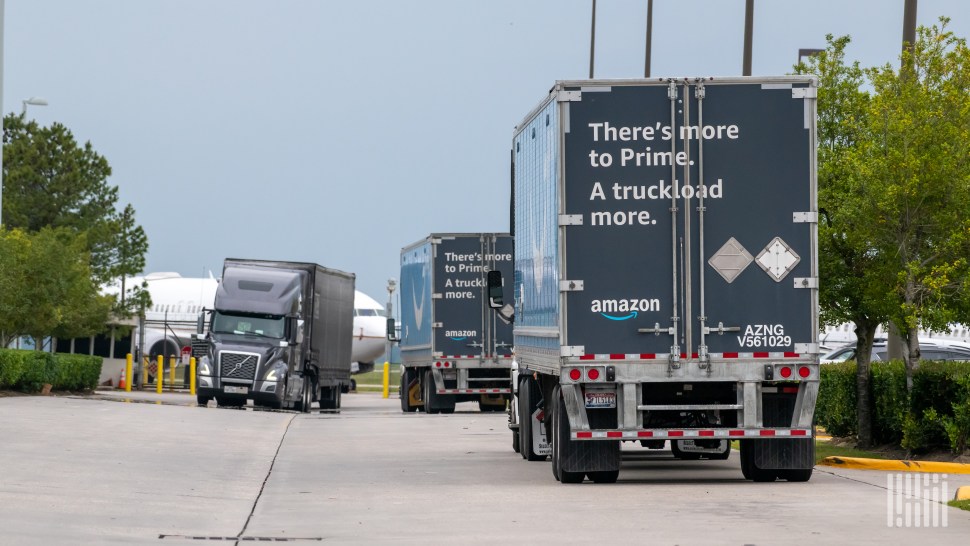
Amazon’s announcement of its full entry into the less-than-truckload market sent shares of publicly traded carriers modestly lower on Wednesday. The group was off 5% on the day, which is a relatively small move considering the space has run over 60% year-to-date as market indicators continue to signal a recovery.
Analysts largely looked past the news, too.
Amazon (NASDAQ: AMZN) has openly provided in-bound LTL services in the U.S. for over a year, mirroring an operation it has run in Europe for several years. The e-commerce company’s expanded U.S. service appears to include an asset-light model at roughly 30 terminals across its package-delivery network, which primarily moves parcels weighing less than five pounds. However, the offering in its current form is unlikely to challenge traditional incumbents, which specialize in transporting heavy pallets with stringent service requirements.
Richa Harnain, equity research analyst at Deutsche Bank (NYSE: DB), told investors in a Wednesday note that Amazon’s LTL service is more akin to what brokers offer.
“We don’t think AMZN’s LTL footprint is enough to become a more formidable full-fledged nationwide asset-based operator,” Harnain said. “We also acknowledge the space has typically bounced back strongly following other AMZN-related knee jerk negative reactions.”
Amazon certainly has the pocketbook to compete and dominate in the space. But the market is relatively small (roughly $60 billion) and an asset-light model is typically not the path to industry-leading margins and returns. The company could be attempting a very-targeted approach in select markets to utilize latent capacity in the network. It could also be planning to compete at the less-service-sensitive end of the LTL market.
Jason Seidl, an analyst at TD Cowen, said Amazon’s use of an intermodal container pool likely “suggests the offering will primarily compete with the economy (3-4 day) sub-segment of the LTL market.” He said Amazon could take some market share “on the margins” from legacy carriers “without driving en-masse share exodus.”
Amazon’s latest LTL foray
Before the market opened Wednesday, Amazon Supply Chain Services (ASCS) announced LTL service for “all businesses” to “any type of destination” in major U.S. markets. The offering is targeting “businesses of all sizes,” with shipment sizes likely ranging from one to six pallets (150 to 15,000 pounds).
Customers can arrange next-day live pickup and same-day pickup through drop-trailer service. Volume shippers are eligible for recurring daily pickups. Amazon offers EDI interfacing for ordering, real-time tracking and invoicing.
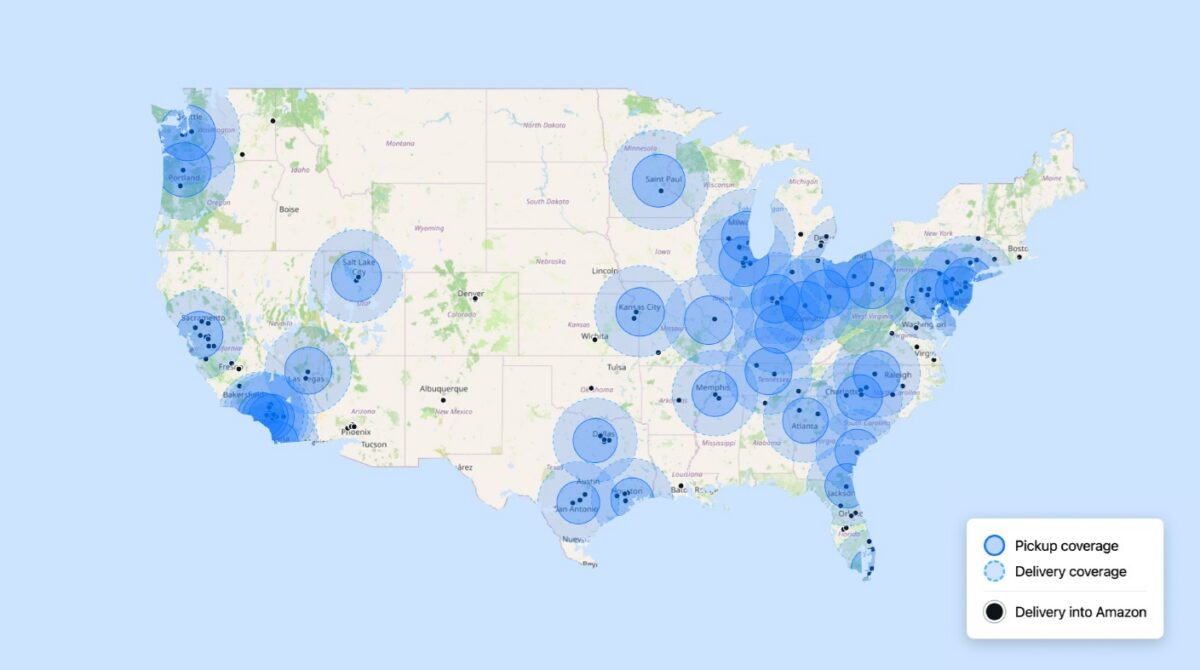
An Amazon Freight LTL coverage map shows decent density in the Eastern U.S., with a few select metros in the West. (Most national carrier networks have 200 to 300 service centers, serving nearly all U.S. zip codes.)
Amazon Freight had previously been offering an inbound-only LTL model with palletized freight being broken up at one of the company’s facilities and then delivered to final destinations (mostly consumer households) through its package-delivery network. However, Amazon was rumored to be approaching shippers earlier this year to gauge interest in a more traditional LTL offering in select markets, where loaded pallets would remain intact through transfer.
The company touted positive feedback from customers in its Wednesday announcement as the reason for the full rollout, noting that tens of thousands of sellers have been shipping freight by pallet across its network since 2019.
“The feedback from Amazon selling partners using our LTL service was clear: the technology, visibility, and reliability were exactly what they needed—and they wanted to use it more broadly,” said Jim Ruiz, director of Amazon Freight, in a news release explaining the company’s “cost-effective freight shipping.”
Ruiz elaborated in a separate statement to FreightWaves: “For years, customers told us their LTL freight never matched the reliability and visibility of their full-truckload shipments. We built an asset-backed LTL service that closes that gap—flexible same-day and next-day pickup, real-time shipment tracking from dock to door, and dedicated LTL-trained drivers.”
This new launch follows the company’s May update, announcing it unified and expanded its third-party logistics solutions. Operating under the ASCS brand, the service provides end-to-end freight transportation, distribution, fulfillment and parcel shipping.
Amazon Freight offers full truckload, LTL and intermodal service with a fleet of over 80,000 trailers and 24,000 intermodal containers. Amazon Freight is part of ASCS.
LTL industry has high barriers to entry
The LTL market is mostly consolidated with less than a dozen true national carriers. The top-five companies historically account for a little more than half of the revenue.
The space has high barriers to entry. It takes a significant capital outlay to acquire and maintain a national network of cross-dock terminals and a large fleet with multiple truck and trailer types. It also requires heavy tech investments to create customer interfaces and to optimize linehaul and dock operations. Many carriers rely on veteran leadership to run a successful hub-and-spoke network.
For decades, legacy carriers have prioritized service by reinvesting in their networks to build a powerful flywheel effect. Targeted improvements in service lead to increased yields and enhanced margins, which ultimately produce the capital necessary for further service-centric network improvements.
A comprehensive annual shipper survey establishes carrier rankings across 28 distinct service metrics. The results are significant as they can impact how shippers allocate freight. An asset-light approach, using third-party carriers, typically means a carrier loses the ability to control service and ultimately pricing.
Morgan Stanley’s (NYSE: MS) Ravi Shanker was a dissenter on Wednesday, saying that even a third-party, asset-light LTL model could be a disruptor.
“While LTL likely represents only a small component of AMZN’s overall logistics footprint, we reiterate that AMZN has repeatedly demonstrated an ability to gain traction in transportation markets through a flexible and iterative operating model,” Shanker said. “As a result, we believe the Company may be able to capture meaningful market share even if they are unable to offer best-in-class service levels immediately. This could strike at the perceived ‘moat’ of real estate footprint and service that form the central pillar of the LTL thesis today.”
LTL competitive landscape is changing
While public carriers contend terminal counts—the true sign of industry capacity—haven’t expanded over the past decade, the competitive landscape has changed.
FedEx Freight (NYSE: FDXF), the nation’s largest LTL carrier, spun off from parent FedEx Corp. (NYSE: FDX) earlier this month. It now has over 500 dedicated LTL sales reps looking to fill its 365-terminal network with freight.
Walmart (NASDAQ: WMT) recently announced an upgrade to its LTL consolidation program, allowing shippers to combine inbound LTL shipments into full truckloads destined for one of its 42 regional distribution centers using a single national purchase order.
Knight-Swift Transportation (NYSE: KNX) entered the LTL arena in 2021 with the acquisition of AAA Cooper Transportation. The company has since expanded its footprint through the purchase of additional regional carriers and the organic addition of approximately 60 terminals, including sites formerly operated by the now-defunct Yellow Corp.
TFI International (NYSE: TFII) has aspirations of establishing a mostly pure-play LTL entity by spinning off its TL businesses into a separate publicly traded company. However, those plans have been pushed back as it works to improve U.S. LTL margins and grow market cap before proceeding with a corporate split.
In early 2025, Amazon was rumored to be pursuing Old Dominion Freight Line (NASDAQ: ODFL), but management from that carrier said at the time it was not in talks to be acquired by Amazon.
Shares of AMZN closed Wednesday down 2.5% compared to the S&P 500, which was down 1.6%.
Brokerage Compliance Symposium
The day before F3. Every compliance issue you face - fraud exposure, carrier liability, FMCSA rules, cargo theft, insurance gaps - navigated by attorneys and operators defining best practices in a changing industry.
F3 Awards Dinner
The night before F3. FreightTech100 companies honored. FreightTech 25 and Shipper of Choice winners revealed live. Cocktail reception into dinner and live music - 300 industry leaders in one purpose-built room.
F3: Future of Freight Festival
Industry-defining keynotes, rapid-fire technology demos, and industry leaders networking in experiences across Chattanooga - plus the inaugural F3 Awards Dinner featuring the FreightTech and Shipper of Choice reveals.
The day before F3. Every compliance issue you face - fraud exposure, carrier liability, FMCSA rules, cargo theft, insurance gaps - navigated by attorneys and operators defining best practices in a changing industry.
The Signal at Chattanooga Choo Choo • Chattanooga, TN Register NowThe night before F3. FreightTech100 companies honored. FreightTech 25 and Shipper of Choice winners revealed live. Cocktail reception into dinner and live music - 300 industry leaders in one purpose-built room.
The Signal at Chattanooga Choo Choo • Chattanooga, TN Register NowIndustry-defining keynotes, rapid-fire technology demos, and industry leaders networking in experiences across Chattanooga - plus the inaugural F3 Awards Dinner featuring the FreightTech and Shipper of Choice reveals.
The Signal at Chattanooga Choo Choo • Chattanooga, TN Register Now