




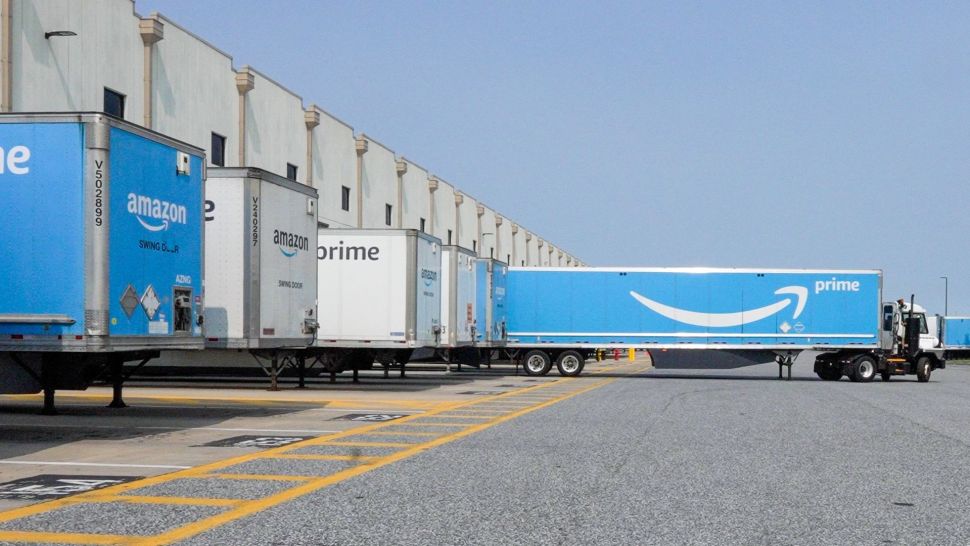
Amazon on Monday invited third-party businesses to access the full suite of logistics services it uses internally to support e-commerce orders on its platform, officially packaging the discrete shipping and delivery services it has been offering for years under the umbrella brand of Amazon Supply Chain Services.
The announcement essentially declared that third-party logistics services is now a main business line, along with retail, cloud computing services and grocery.
Amazon (NASDAQ: AMZN) said it is extending its portfolio of freight, distribution, fulfillment and parcel shipping services to all businesses, effectively making available the excess capacity in its network to non-Amazon sellers. Companies across industries from automotive, to healthcare and retail will be able to ship anything from raw materials to finished goods.
Analysts said Amazon would need to invest in much more infrastructure to directly compete across the board with large ocean freight wholesalers, freight forwarders, trucking companies, and integrated logistics providers like FedEx and UPS.
“It’s a playbook Amazon has run for years. Build world-class capabilities to meet internal needs, productize and make it available commercially,” said Nate Skiver, founder of LPF Spend Management, on LinkedIn.
Amazon has been evolving for years into an integrated freight and logistics provider, externalizing portions of its logistics operation and offering wholesale capacity to shippers.
Fulfillment by Amazon has been around for nearly 20 years and now also allows small merchants selling on Amazon’s platform to use Amazon for inventory management and last-mile delivery. In early 2023, Amazon opened eligibility for Buy with Prime to all e-commerce merchants, instead of by invite only. The program allows online sellers, including those that do not sell on the company’s website, to offer Prime fulfillment services through their own online stores. Also in 2023, Amazon rolled out a stand-alone shipping service under which the retail-tech giant uses its independent drivers to provide pickups at warehouses and handle the shipments to final delivery.
In 2024, Amazon launched Amazon Air Cargo, allowing shippers to buy space on its private cargo airline. Meanwhile, Supply Chain by Amazon leverages the company’s position as a bulk buyer of ocean freight capacity. As an ocean consolidator for cargo from Asia to the United States, Amazon is responsible for picking up inventory from manufacturing facilities worldwide, booking the shipment with an ocean carrier, handling customs clearance and ground transportation, managing inventory replenishment, and delivering to its warehouse. And Amazon offers nationwide parcel delivery.
The final piece of the full logistics equation came in January when Amazon began offering less-than-truckload service through its Amazon Freight platform for inbound delivery to Amazon facilities, where the goods are stored and later shipped through the company’s regular package delivery. Many large shippers use already use Amazon to connect multiple parts of their supply chain, noted Derek Lossing, a former Amazon logistics executive and founder of Cirrus Global Advisors, in a blog post.
“The launch of ASCS represents an incremental step forward in a risk that has existed for years (Amazon’s encroachment on logistics), but we must be cautious to not overstate this risk. The transportation and logistics industry has always been competitive, and Amazon does not have the scale or physical network to displace all competitors. Companies with hard assets, quality offerings, and entrenched customer relationships will remain competitive, with the biggest risk to asset-light logistics providers,” said Citibank equity analyst Ariel Rosa in a client note.
Amazon on Monday said the debut of Amazon Supply Chain Services builds on the momentum from transporting, storing and delivering hundreds of millions of packages for outside shippers over the past three years.
“Amazon is bringing the infrastructure, intelligence, and scale of its supply chain services — proven over decades — to businesses everywhere, much like Amazon Web Services did for cloud computing,” said Peter Larsen, vice president of Amazon Supply Chain Services. “Supply chain wasn’t just a function at Amazon — it was core to providing an exceptional shopping experience. Our differentiator. The reason we could offer fast, dependable delivery that nobody else could. And with the launch of ASCS, we’re confident we can give any other business access to the same cost efficiency, reliability, and speed that we’ve built for Amazon customers.”
Early users of Amazon’s end-to-end-logistics operation include Procter & Gamble, 3M, Land’s End and American Eagle Outfitters.
“Amazon is one of our key e-commerce partners, and we’re excited to leverage Amazon Supply Chain Services to position inventory closer to customers so we can reach them even faster,” said Andrew McLean, CEO of Lands’ End, in the news release. “This consistency is central to our solutions-based approach, enabling us to serve customers with confidence and agility, especially during peak seasons.”
Procter & Gamble is using Amazon’s freight services to transport raw materials to production facilities and move finished goods across its distribution network, Amazon said. 3M is leveraging Amazon’s freight services to move products from its manufacturing sites to distribution centers worldwide; Lands’ End is using a unified inventory pool within Amazon’s network to fulfill orders across multiple sales channels; and American Eagle Outfitters is using Amazon’s parcel shipping network to deliver online orders from its American Eagle and Aerie website directly to customers nationwide.
Amazon’s freight network is supported by a fleet of more than 80,000 trailers, 24,000 intermodal containers and 100 freighter aircraft. Amazon said customers also benefit from Amazon’s AI forecasting models and vast supply chain data set, which help optimize inventory placement.
Starting Monday, businesses can access a centralized console to search, select, and sign up for the various ASCS services, according to the news release.
“Amazon has been offering logistics services for at least three years. This just draws new attention to those capabilities, which have been tested and proven to work with case studies” of large shippers, said Satish Jindel, a prominent supply chain analyst and president of ShipMatrix, in an interview.
Freight brokers and forwarders should take Amazon’s announcement seriously if they support small retail customers, he warned. Those operators will have to demonstrate how they can provide better personalized shipping support than a tech behemoth, which will be targeting their customers.
Meanwhile, FedEx and UPS, which have pivoted to focus on B2B and premium B2C packages, “need to realize that Amazon is not just a B2C parcel guy because 18% of deliveries from Amazon online orders are delivered to businesses. A lot of small businesses are buying things online from Amazon now,” Jindel said.
The true significance of Amazon’s new marketing strategy isn’t the physical network, but supply chain management, Lossing argued.
“Its retail business depends on predicting demand, positioning inventory ahead of that demand, and executing delivery with precision. Over time, Amazon built not just a logistics network, but an interconnected system that links forecasting, inbound transportation, inventory placement, fulfillment, and final mile delivery into a single operating model. This is the holy grail of supply chain. That is where this announcement becomes meaningfully different. When control exists across the entire system, the conversation shifts.
“A traditional carrier competes on a Zone 6 rate. A freight forwarder competes on cost per kilo from Shenzhen to Los Angeles. Amazon reframes the question entirely by asking what happens if Zone 6 is no longer necessary. When inventory is positioned correctly, closer to demand and informed by real time data, the cost, speed, and complexity of downstream transportation change fundamentally. Optimization moves upstream into network design rather than downstream into parcel pricing. This is not an incremental improvement on existing logistics models. It is a different operating philosophy,” he wrote.
Wall Street is punishing freight transportation stocks in midday trading, with UPS down 9.5%, on concerns that Amazon news represents a major threat to their business, but several industry observers suggest the reaction is overblown because Amazon already competes in the logistics space.
(This story was updated on May 5 with commentary from Lossing).
Click here for more FreightWaves/American Shipper stories by Eric Kulisch.
Write to Eric Kulisch at ekulisch@freightwaves.com.
RELATED STORIES:
DHL Forwarding to expand Asia-US air cargo capacity in June
Amazon Air extends third-party cargo service to Dominican Republic
Amazon promises equal priority for third-party air cargo, own parcels
Brokerage Compliance Symposium
The day before F3. Every compliance issue you face - fraud exposure, carrier liability, FMCSA rules, cargo theft, insurance gaps - navigated by attorneys and operators defining best practices in a changing industry.
F3 Awards Dinner
The night before F3. FreightTech100 companies honored. FreightTech 25 and Shipper of Choice winners revealed live. Cocktail reception into dinner and live music - 300 industry leaders in one purpose-built room.
F3: Future of Freight Festival
Industry-defining keynotes, rapid-fire technology demos, and industry leaders networking in experiences across Chattanooga - plus the inaugural F3 Awards Dinner featuring the FreightTech and Shipper of Choice reveals.
The day before F3. Every compliance issue you face - fraud exposure, carrier liability, FMCSA rules, cargo theft, insurance gaps - navigated by attorneys and operators defining best practices in a changing industry.
The Signal at Chattanooga Choo Choo • Chattanooga, TN Register NowThe night before F3. FreightTech100 companies honored. FreightTech 25 and Shipper of Choice winners revealed live. Cocktail reception into dinner and live music - 300 industry leaders in one purpose-built room.
The Signal at Chattanooga Choo Choo • Chattanooga, TN Register NowIndustry-defining keynotes, rapid-fire technology demos, and industry leaders networking in experiences across Chattanooga - plus the inaugural F3 Awards Dinner featuring the FreightTech and Shipper of Choice reveals.
The Signal at Chattanooga Choo Choo • Chattanooga, TN Register Now