




(UPDATED with analyst reactions and Amazon statements)
Amazon announced on Wednesday the expansion of its less-than-truckload service beyond its current inbound-only model to all destinations, including third-party warehouses, distribution centers and retail stores, adding another piece to a new initiative offering end-to-end logistics services to all businesses.
Exactly how the network will operate remains unclear as Amazon has a limited number of cross-dock terminals for moving heavy freight. Industry analysts said the scale of Amazon’s network will initially be limited, but that Amazon likely will continue growing its terminal and delivery footprint to serve more customers.
The news about externalizing Amazon’s partial-load service for transporting Amazon and marketplace sellers’ inventory follows last month’s opening of freight, distribution, fulfillment, and parcel shipping to non-Amazon sellers, under the umbrella of the new Amazon Supply Chain Services.
Amazon (NASDAQ: AMZN) launched an LTL offering in April 2025 for shippers that don’t require a full trailer, but it was only available for inbound delivery to Amazon facilities, where goods were stored after breaking apart large pallets and later individually shipped through the company’s regular package delivery network. Amazon has offered other limited LTL capacity since 2019.
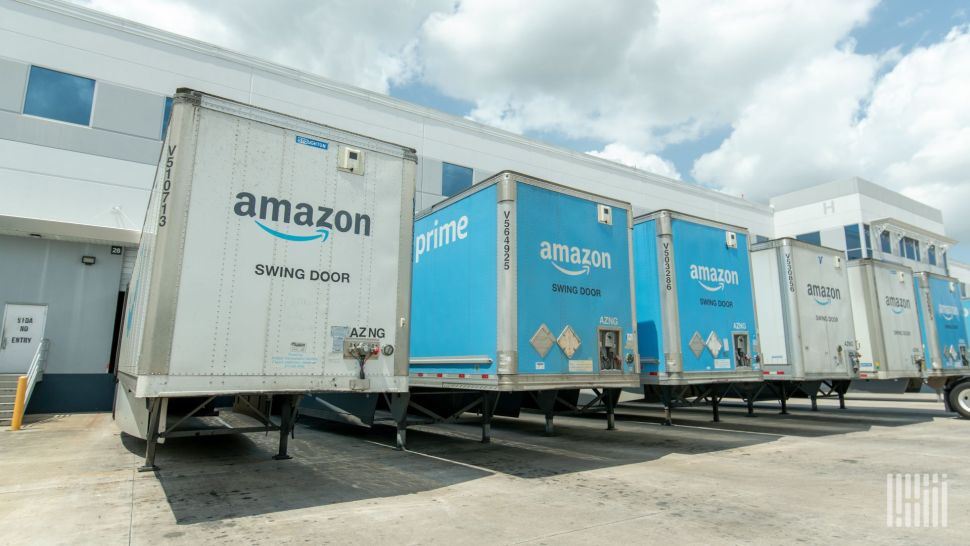
The retail giant says it is now offering a more traditional hub-and-spoke LTL network in which palletized shipments are picked up, transferred at a nearby terminal and delivered to a final destination still on a pallet at a lower cost than available from legacy LTL carriers. It touts a fleet of 80,000 trailers and 24,000 intermodal containers.
“For years, customers told us their LTL freight never matched the reliability and visibility of their full-truckload shipments. We built an asset-backed LTL service that closes that gap—flexible same-day and next-day pickup, real-time shipment tracking from dock to door, and dedicated LTL-trained drivers. Tens of thousands of selling partners have used this service since 2019. Now it’s open for all businesses,” said Amazon Freight Director Jim Ruiz, in a statement.
Some analysts previously said that Amazon’s full-scale entry into the LTL business could significantly disrupt business for incumbent trucking companies, such as FedEx Freight, Old Dominion, Saia and Estes. How Amazon’s LTL network is configured is unclear.
But Satish Jindel, the president of ShipMatrix and an experienced industry consultant, said Amazon appears to be operating more like a freight broker, not an asset-based LTL carrier. That means their competition would be with companies like C.H. Robinson and Echo Global Logistics.
“They are trying to offer a brokerage service. They don’t have drivers. They don’t have trucks. They don’t have terminals to sort and load and deliver and pickup,” Jindel told FreightWaves. “They are looking to leverage their relationship as a large LTL inbound customer to offer lower rates for pickup and delivery of shipments that don’t touch an Amazon facility.”
Amazon’s position is that it owns a network with more than 100,000 pieces of equipment. That wording, however, doesn’t necessarily mean Amazon owns the assets. Many company’s operate own-controlled networks in which they market the capacity, designate routes and set the delivery frequency while using partner carriers to physically transport goods.
The service appears more skewed to economy lanes with three-to-four-day delivery windows, heavily relying on intermodal for middle-mile transport and with a smaller coverage footprint, said TD Cowen analyst Jason Seidl, in a research note. Amazon accepts inbound freight at about 115 facilities, but many of these are simply fulfillment centers without a full truck-to-truck transfer design. As of the first quarter of 2025, Amazon had about 74 cross-dock facilities, he said.
“We continue to believe Amazon’s expansions could take share from LTLs on the margins without driving en-masse share exodus. Amazon’s emphasis on utilizing the intermodal container pool for the service suggests the offering will primarily compete with the economy sub-segment of the LTL market, which is predominantly the turf of ArcBest, TFII and FedEx Freight.,” Seidl wrote.
Amazon said the expansion of LTL service is a response to market demand and customer feedback for a broader rollout.
“The feedback from Amazon selling partners using our LTL service was clear: the technology, visibility, and reliability were exactly what they needed — and they wanted to use it more broadly,” said Jim Ruiz, director of Amazon Freight, said in a news release. “Now Amazon LTL can move your freight wherever it needs to go, servicing destinations nationwide for businesses of all sizes.”
Businesses can ship one to six pallets, or between 150 to 15,000 pounds, into their warehouses, between their own facilities or to their retail partners and distributors, according to Amazon.
Features of the new service include ;next-day live pickup for orders placed by 5 p.m., same-day pickup using a drop-trailer method and standing daily pickups for high-volume shippers. The drop-trailer service involves a unified pool of trailers for LTL and truckload shipments that are dropped at customer facilities instead of being unloaded upon arrival.
LTL shippers receive real-time GPS tracking, automated appointment scheduling at receiving facilities, electronic proof-of-delivery and a sensor-equipped fleet for cargo security.
“While LTL likely represents only a small component of Amazon’s overall logistics footprint, we reiterate that Amazon has repeatedly demonstrated an ability to gain traction in transportation markets through a flexible and iterative operating model. As a result, we believe the company may be able to capture meaningful market share even if they are unable to offer best-in class service levels immediately,” said Morgan Stanley equity analyst Ravi Shanker in a client note.
Amazon Freight, part of Amazon Supply Chain Services, spans full truckload, less-than-truckload, and rail services.
Speculation about an expanded Amazon LTL offering has been brewing after Morgan Stanley reported in a research note early this year that Amazon was approaching shippers to gauge their interest in the service.
Click here for more FreightWaves/American Shipper stories by Eric Kulisch.
RECOMMENDED READING:
Robots drive $10B Amazon investment for European fulfillment centers
Brokerage Compliance Symposium
The day before F3. Every compliance issue you face - fraud exposure, carrier liability, FMCSA rules, cargo theft, insurance gaps - navigated by attorneys and operators defining best practices in a changing industry.
F3 Awards Dinner
The night before F3. FreightTech100 companies honored. FreightTech 25 and Shipper of Choice winners revealed live. Cocktail reception into dinner and live music - 300 industry leaders in one purpose-built room.
F3: Future of Freight Festival
Industry-defining keynotes, rapid-fire technology demos, and industry leaders networking in experiences across Chattanooga - plus the inaugural F3 Awards Dinner featuring the FreightTech and Shipper of Choice reveals.
The day before F3. Every compliance issue you face - fraud exposure, carrier liability, FMCSA rules, cargo theft, insurance gaps - navigated by attorneys and operators defining best practices in a changing industry.
The Signal at Chattanooga Choo Choo • Chattanooga, TN Register NowThe night before F3. FreightTech100 companies honored. FreightTech 25 and Shipper of Choice winners revealed live. Cocktail reception into dinner and live music - 300 industry leaders in one purpose-built room.
The Signal at Chattanooga Choo Choo • Chattanooga, TN Register NowIndustry-defining keynotes, rapid-fire technology demos, and industry leaders networking in experiences across Chattanooga - plus the inaugural F3 Awards Dinner featuring the FreightTech and Shipper of Choice reveals.
The Signal at Chattanooga Choo Choo • Chattanooga, TN Register Now