




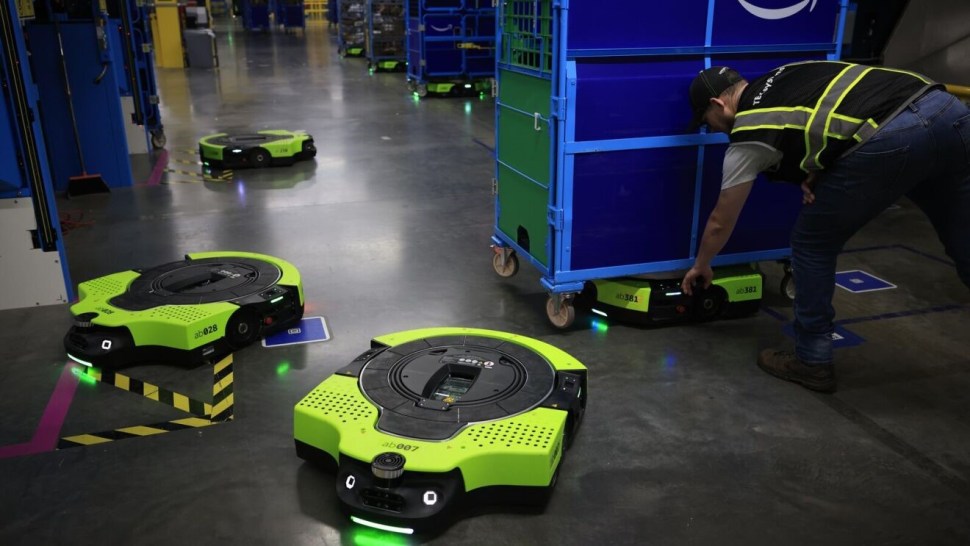
Amazon plans to deploy three types of new robots as part of a plan to invest more than $10 billion to expand and modernize fulfillment centers in Europe and grow its workforce by 25,000 by the end of the decade.
Amazon (NASDAQ: AMZN) relies on robots to make the work environment safer and easier for employees, while improving package processing speed. Amazon Robotics was founded in 2012 when Amazon acquired Massachusetts-based Kiva Systems. The original Kiva robots moved stacks of shelves within a warehouse. Now robots conduct a variety of tasks. Some zip around like motorized saucers, while others have mechanical arms for lifting.
Amazon recently surpassed 1 million robots developed, produced and deployed across its operations network.
At an event in London Thursday, the retail logistics behemoth introduced the next-generation Proteus autonomous robot. It is designed to do physically demanding tasks such as moving heavy carts with packages over long distances to the outbound loading dock so employees can reduce their risk of injury and focus on managing inventory flow, quality control and other high-skill work.
Proteus, introduced in Nashville, Tennessee, in 2022, is Amazon’s first fully autonomous mobile robot, meaning it can navigate freely throughout a warehouse using sensors to detect and avoid objects in front of it. The original version of the self-guided transporter works in conjunction with Cardinal, a robotic arm that tightly loads packages up to 50 pounds into carts in a Tetris-like manner. Cardinal uses advanced AI and computer vision to quickly select one package from a pile of packages delivered via a chute, lift it with air suction, read the label and precisely place it in the appropriate cart assigned to a specific truck.
One of the major changes, made possible by advances in artificial intelligence, involves how employees interact with the robot. Proteus, about the size of a 50-inch flat-screen TV, is capable of understanding instructions in plain, conversational language with no technical commands and no programming interface. That means warehouse workers can assign tasks to the robot the way they would communicate with a colleague.
The next-generation Proteus is also designed to travel much further than the original. Rather than operating only in dock areas, the new system can work anywhere items need to be moved. Amazon said this includes transporting containers as they arrive at a site, transferring them between workstations, and assisting employees across Amazon’s fulfillment centers and delivery sites.
“You tell it what needs to be done. It figures out the priority, the route, the timing,” said Scott Dresser, vice president of Amazon Robotics, in an article on the company’s website. “It becomes your assistant for material movement.”
Proteus 2.0 is currently being tested in Amazon labs, with deployment in Europe expected in the first half of 2027.
Broader robotics roadmap
The scaling of these systems reached a new peak with the 2024 launch of Amazon’s next-generation fulfillment center in Shreveport, Louisiana. The site uses eight different robotics systems that work in harmony to support package fulfillment and delivery, according to another blog post.
Alongside advancements in mobile robots, Amazon is also developing new collaborative technology and robotic manipulation — the ability to handle individual objects with precision.
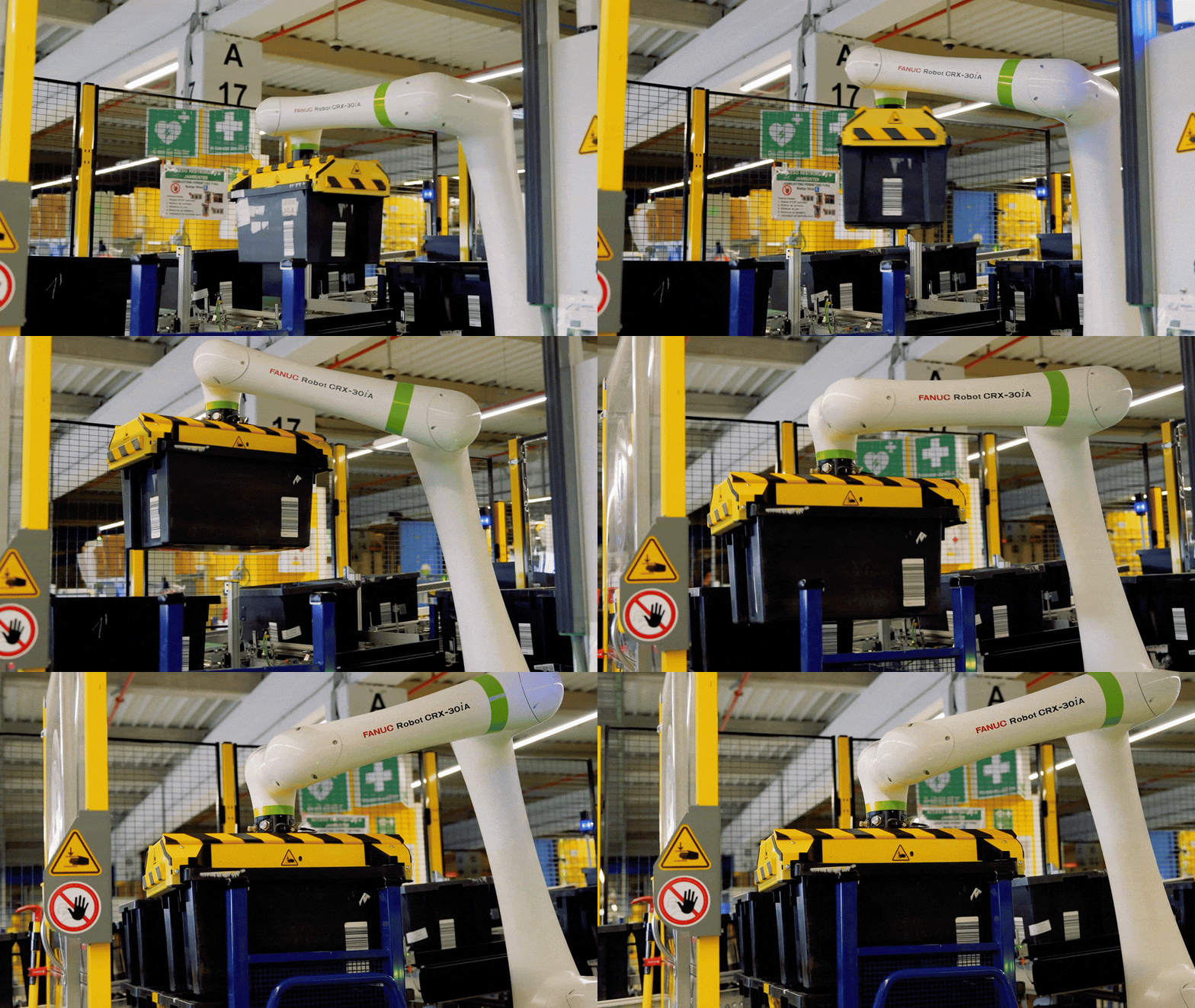
This includes STARK, a new collaborative robotic tote-handling system. The brainchild of an operations employee, STARK picks full totes from conveyors and places them on carts — work that otherwise requires repetitive heavy lifting. First piloted in Barcelona, Spain, STARK is planned to expand to 15 sites across Europe by 2027, Amazon said.
Amazon said it will also expand the use of Vulcan, the company’s first robot with a sense of touch. Vulcan uses sensors to pick and stow at the top-and-bottom rows of inventory pods at fulfillment centers. The grab tooling can see and feel objects simultaneously to navigate densely packed environments and understand how much force to apply. Originally developed for a facility in Spokane, Washington, Vulcan expanded last year to handle more complex picking tasks at Amazon’s Hamburg facility in Germany and will be installed at more sites.
“Europe is at the center of how we’re building our operations for the future,” Dresser said.
Legacy robots
Amazon actually has two Vulcan robots. The pick version can grab items up to five pounds and 14 inches in length. Each robot reaches nine feet tall. In total, a system uses 10 robot arms in a 350-square foot area.
The stow version can grab items up to eight pounds, but nothing that can roll. This system links three robot stations together in a 500-square foot area and weighs nearly 10,000 pounds. Vulcan Stow uses an arm that carries a camera and a suction cup. The camera looks at the compartment and picks out the item to be grabbed, along with the best spot to hold it by. While the suction cup grabs it, the camera watches to make sure it took the right item. It also has the smarts to identify when it can’t move a specific item, and can ask a human partner to assist.
Sequoia, launched in Houston in 2023, is a robotic system that uses AI and computer vision systems to consolidate inventory and free up storage at the site to facilitate faster order transactions.

Amazon says Sequoia enables it to identify and store inventory up to 75% faster at fulfillment centers. It works by having mobile robots transport inventory directly to a containerized storage system or to an employee picking out items for a customer order. Inventory is transported directly to employees at a workstation ergonomically situated for their power zone (between mid-thigh and mid-chest height), mitigating the need for employees to reach above their heads or squat down, which can lead to common workplace injuries.
Sequoia takes up four 500,000-square foot floors per building, equivalent to about 35 football fields. The Shreveport facility is five stories tall.
While Proteus is fully self-guided, other mobile robots such as Titan and Hercules, are confined to areas where only authorized robotic specialists can enter, and read barcodes that are stickered to the floor as navigation coordinates.
Hercules is a drive unit that finds and transports pods of items from areas of the fulfillment center to employees picking items for customer orders before they are packaged. It can lift up to 1,250 pounds and travel across 1 million square feet. Hercules makes key decisions about how it moves independently, but takes overall direction from centralized planning software. It then uses a forward-facing 3D camera to differentiate between people, pods, other robots, and other objects in its path to make safer decisions, the Amazon article said.
Similar to Hercules, Titan is another drive unit that uses encoded markers on the floor to bring items from across Amazon’s fulfillment centers directly to employees as they assemble customer orders. It can lift twice as much as Hercules, meaning it focuses on larger and/or bulkier items like small household appliances or pallets of food.
Sparrow is another robotic system that supports employees who aggregate items for customer orders. This robotic arm picks up and moves individual items from containers into specific totes to send off to employees before they’re packaged. It can lift packages up to 12 pounds. Sparrow uses computer vision and AI to identify the correct item and add it to the tote on its delivery journey.
Once all the items for a customer order are selected, Amazon uses a variety of automated packaging systems to pack orders in the smallest conveyance possible to reduce waste. One machine, for example, originally created plastic bags, but was retrofitted to create made-to-fit paper bags using curbside recycled materials. It uses sensors to measure an order’s dimensions and then creates a correctly sized, protective bag using a more durable, weather-resistant paper and heat-sealing technology. Amazon has retrofitted more than 120 of these machines across the U.S. in more than 20 fulfillment centers, helping to avoid more than 130 million plastic bags this year, according to Amazon.
Robin was the first robotic arm ever deployed by Amazon Robotics. It is made to sort packages before they’re brought to the outbound dock to be placed on a truck. Robin grabs packages from conveyor belts and puts them onto robotic drive units to be moved to the next part of the facility. It also transfers damaged packages to ensure optimal quality control.
Amazon insists the robotics expansion isn’t costing jobs. Since introducing robotics into its operations years ago, Amazon says it has continued to hire hundreds of thousands of employees globally and created new job categories, including reliability, maintenance and engineering roles. But most job hires are seasonal workers. The Wall Street Journal last year reported that Amazon has fewer employees per facility than at any time in the past 16 years and that experts believe Amazon wants facilities that can mostly run on their own with only a handful of managers. And CEO Andy Jassey has said the company will need fewer employees over time because of AI.
Click here for more FreightWaves/American Shipper stories by Eric Kulisch.
RECOMMENDED READING:
Brokerage Compliance Symposium
The day before F3. Every compliance issue you face - fraud exposure, carrier liability, FMCSA rules, cargo theft, insurance gaps - navigated by attorneys and operators defining best practices in a changing industry.
F3 Awards Dinner
The night before F3. FreightTech100 companies honored. FreightTech 25 and Shipper of Choice winners revealed live. Cocktail reception into dinner and live music - 300 industry leaders in one purpose-built room.
F3: Future of Freight Festival
Industry-defining keynotes, rapid-fire technology demos, and industry leaders networking in experiences across Chattanooga - plus the inaugural F3 Awards Dinner featuring the FreightTech and Shipper of Choice reveals.
The day before F3. Every compliance issue you face - fraud exposure, carrier liability, FMCSA rules, cargo theft, insurance gaps - navigated by attorneys and operators defining best practices in a changing industry.
The Signal at Chattanooga Choo Choo • Chattanooga, TN Register NowThe night before F3. FreightTech100 companies honored. FreightTech 25 and Shipper of Choice winners revealed live. Cocktail reception into dinner and live music - 300 industry leaders in one purpose-built room.
The Signal at Chattanooga Choo Choo • Chattanooga, TN Register NowIndustry-defining keynotes, rapid-fire technology demos, and industry leaders networking in experiences across Chattanooga - plus the inaugural F3 Awards Dinner featuring the FreightTech and Shipper of Choice reveals.
The Signal at Chattanooga Choo Choo • Chattanooga, TN Register Now