




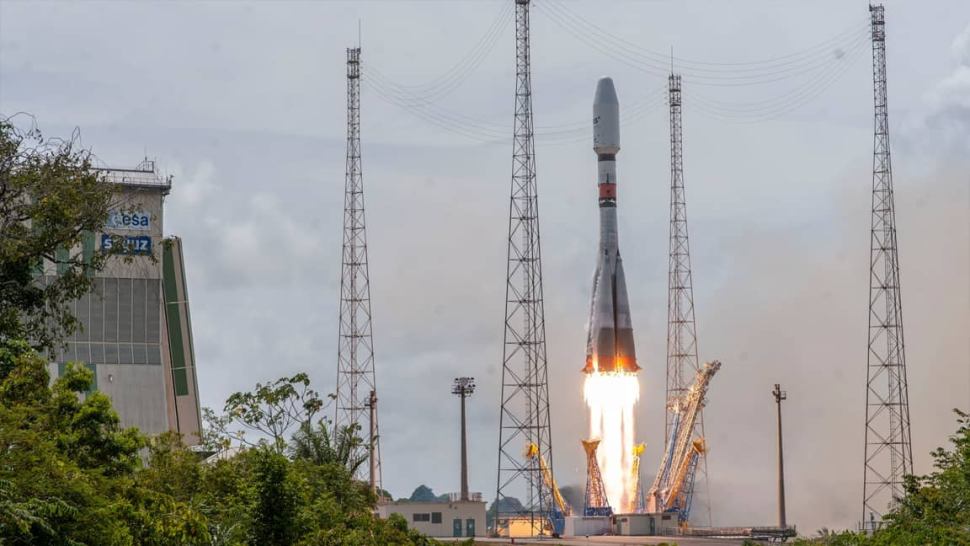
At precisely 2:03 pm local time the Soyuz ST-B launch rocket on flight VS22 carrying four O3b satellites left the CSG space centre in Kourou, French Guiana. These four satellites will complete an array of 20 units orbiting the equator at nearly 5,000 miles (8,000 kilometers) above the Earth.
The new satellites each weigh more than 1,500 pounds (700 kilograms) and provide more than 10 gigabits per second of capacity. With the increase in the size of the constellation from 16 to 20 units SES will be able to offer greater coverage and increased service availability and reliability.
Luxembourg-based SES is a communications satellite owner and operator providing video and data connectivity worldwide to broadcasters, content and internet service providers, mobile and fixed network operators, governments and institutions.
It is a critical moment for the industry which has struggled to convince many transport operators that the cost of the service is palatable, offering wifi connections at multiples of the cost of land-based providers.
Prices for satellite communications are decreasing for the end users for a number of reasons; the first-generation satellites offered comparatively narrow bandwidth compared to those launched today. But it is the third-generation units that will really change the game.
In 2021 SES is due to launch its third-generation satellites built by Boeing. The 03b mPower constellation will increase the steerable beams from 10 per satellite to 5,000, with the constellation of 7 MEO mPower units offering 30,000 steerable beams, opening the possibility of more users, spreading the cost of the service and therefore reducing the cost to each user.
John-Paul Hemingway, CEO at SES, told FreightWaves “MEO [Medium Earth Orbit] hits the sweet spot.” Current Geostationary (GEO) satellites orbit at more than 22,000 miles (36,000 kilometers) above Earth; the cost to launch is high and the latency (the time it takes to activate the system on your phone), is about four times slower than satellites orbiting closer to the Earth.
The MEO units have a latency of 150 milliseconds delay. “There’s no application I know of that cannot work with that and we can still see much of the Earth [from that distance],” Hemingway said.
He went on to say that the SES network of MEO satellites currently supply about 15 million users. There is a particular focus on Africa where land-based solutions can suffer from security difficulties, particularly in remote areas.
Hemingway gave an example of how the communications satellites have enabled the development of new programs – the United Nations is currently running a logistics program to supply food and other necessary supplies to those that require it using the O3b network to identify key locations and requirements.
The latest satellites launched will add a further 26 percent to the array’s capacity and the aim is to offer a system that will work as well in New York as it does in Africa or on board a ship, Hemingway said.
Hemingway explained that the closer the satellites are to Earth the smaller the coverage, so Low Earth Orbiting (LEO) satellites can see a smaller area and they travel much faster, but the latency could increase as the signal needs to be relayed to other points and that causes delays.
The MEO units can see a wider area, from about 50 degrees north to 50 degrees south, and do not need to relay signals. Even though the system is more expensive to launch (the further up the satellites are stationed, the more fuel necessary to get them there), the systems are improving with new significantly lighter fuel and power systems. Therefore, satellites’ overall payload weight is reduced and costs are also lowered using with what Hemingway termed “scalable architecture” (design replication that reduces production costs).
By reducing the costs the company can broaden the potential market and one area that is particularly interesting for SES is Africa. Vice President for Sales Carole Kamaitha told FreightWaves that while fiber is the preferred option, increasingly businesses are turning to satellite options because the connectivity is more reliable.
“Fiber cables can be delivered to the shore but it is the last mile that is the most costly and many African countries are landlocked and there are infrastructure difficulties, security issues and reliability issues,” said Kamaitha.
Kamaitha explained that fiber reliability is a problem and with the demand for reliability the demand for satellite connections as a back-up to fiber has also grown. She believes that trend will likely continue into the future.
Brokerage Compliance Symposium
The day before F3. Every compliance issue you face - fraud exposure, carrier liability, FMCSA rules, cargo theft, insurance gaps - navigated by attorneys and operators defining best practices in a changing industry.
F3 Awards Dinner
The night before F3. FreightTech100 companies honored. FreightTech 25 and Shipper of Choice winners revealed live. Cocktail reception into dinner and live music - 300 industry leaders in one purpose-built room.
F3: Future of Freight Festival
Industry-defining keynotes, rapid-fire technology demos, and industry leaders networking in experiences across Chattanooga - plus the inaugural F3 Awards Dinner featuring the FreightTech and Shipper of Choice reveals.
The day before F3. Every compliance issue you face - fraud exposure, carrier liability, FMCSA rules, cargo theft, insurance gaps - navigated by attorneys and operators defining best practices in a changing industry.
The Signal at Chattanooga Choo Choo • Chattanooga, TN Register NowThe night before F3. FreightTech100 companies honored. FreightTech 25 and Shipper of Choice winners revealed live. Cocktail reception into dinner and live music - 300 industry leaders in one purpose-built room.
The Signal at Chattanooga Choo Choo • Chattanooga, TN Register NowIndustry-defining keynotes, rapid-fire technology demos, and industry leaders networking in experiences across Chattanooga - plus the inaugural F3 Awards Dinner featuring the FreightTech and Shipper of Choice reveals.
The Signal at Chattanooga Choo Choo • Chattanooga, TN Register Now