




By Jon Ross
Gauging growth in the uncertain 2013 domestic trucking and air cargo market depends a bit on who is doing the predicting.
There are minor shades of variation in the outlook for domestic trucking, while analysts all agree domestic air cargo will continue to lose out to surface transportation.
At FTR Associates, the company forecasts trucking growth of 2 percent to 3 percent in 2013, which officials have said is a “pretty reasonable” determination in the current market, while a Stifel Nicolaus forecast pegs trucking growth on the lower end of that range, but finds the domestic trucking market will continue to show growth next year.
One activity bump for the cargo industry will come from tragedy. Last year, Hurricane Sandy laid waste to 300,000 homes in the state of New York, damaging an initial 30,000 homes in New Jersey. According to FTR’s December Shippers Update, expedited freight moves will give the air transport industry a bump this spring. The rebuilding effort from the storm is primarily expected, though, to fuel activity in the domestic trucking market in the first half of this year.
“That’s going to be short-haul moves of bulk goods and lumber and things like that, and so it’s going to be a bit more localized to just the Northeast,” FTR’s Jonathan Starks said. “But there will still be other shipments that are moving that way with all the reconstruction that they’re going to have to do.”
Bob Costello, chief economist at the American Trucking Associations, also sees very slow growth in the domestic trucking market this year. He thinks volumes will fall a little short of 2012’s growth mark of 2.5 percent, but will take off in 2014 and 2015. If there’s a recession triggered by a debacle in the debt-ceiling debate, though, all bets are off.
“The good news is housing starts are improving, auto sales are decent, and the rebuilding from Sandy starting in the spring will help offset lower factory output and lower consumer spending,” he said. “But it won’t completely offset it.”
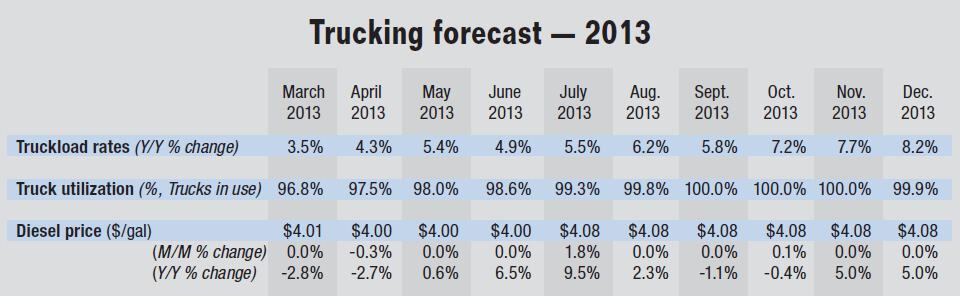
Truck freight has been decelerating for quite some time, growing at a slower pace than in previous years. In 2010 and 2011, the ATA’s tonnage index was up by 5.8 percent. That growth fell to the predicted 2.5 percent for 2012, and Costello expects growth in 2013 will fall closer to 2 percent.
Costello’s thinking is tied to the economy because that is what’s still driving most shippers’ decisions. There is overwhelming uncertainty in the market, and that’s making carriers wary of adding capacity and other activities they would do in a healthy environment. In 2007, the industry operated more trucks than it does today, and Costello sees that trend continuing. The higher costs of new trucks and the prices of maintenance on older vehicles will drive capacity from an already short-handed industry. The impending shortage of truck drivers and the omnipresent worry of fuel prices will also complicate the picture.
“Because many of them can’t afford new trucks or the higher maintenance costs, we may see some people exit the industry,” he said.
FTR remains “modestly optimistic” about the trucking landscape in 2013, he said, but the environment heavily favors trucking carriers over shippers. The firm’s rate outlook is at 2 percent currently, but that year-over-year increase is expected to reach into the double-digits by the end of the year.
Trucking regulatory measures will add another complication to the puzzle. Barring a delay, the U.S. Transportation Department’s new hours of service regulation will have taken effect Feb. 27, with a compliance date set for July 1. On that date, drivers will have to work 12 hours less a week and add in breaks during long shifts.
Starks said the hours of service issue will tighten the trucking market considerably and put a bit of pressure on shippers. When the new regulations take effect, he predicts a 3-percent capacity hit. Carriers will also be facing increased costs, trying to recruit more drivers and finding ways to make up for those losses. But even with carriers doing a bit of scrambling, they will still be in the driver’s seat in 2013.
“The margin might not be increasing as much as the rates are, but there should still be some decent margin activity for the carriers as the capacity situation gets tight,” Starks said. He added the carrier’s advantage might mirror what happened in the market in 2004, when the carriers had a lot of power. For now, he characterizes the trucking world as a modestly carrier-centric environment, and the scale will slowly tip toward the carrier as the year progresses.
Stifel’s managing director, David Ross, said shippers should try to lock in rates to prevent unsettling surprises due to any upcoming truck capacity tightening. The change in the hours of service regulations has the potential, he agreed, to take a lot of capacity from the domestic market.
|
Related Magazine Content
|
The global air freight market is poised to see growth of 1.4 percent in 2013, according to recent figures released by the International Air Transport Association. Domestically, air freight seems to be improving, with North American carriers reporting a 1.7-percent increase in activity, year-over-year, for November on a 0.6-percent decline in capacity. These are relatively small increases, but compared to how the industry has been faring in recent memory, these numbers could signal a slight domestic air freight turnaround.
These increases, however small, will be welcome after a disappointing year. While there was hope that air cargo would rebound in 2012 after a strong first few months, that early promise never played out.
“For 2012, I would say air freight was weak, disappointing, poor, negative — those would be the words that I would use,” Ross said.
Air carriers are hopeful for a global turnaround. “The outlook in 2013 is more positive, with the reduction of capacity by some freighter carriers, and the eventual financial stabilization in Europe and the U.S.,” Shawn McWhorter of Nippon Cargo Airlines recently said of the worldwide market.
Some air freight lanes are gaining strength. The domestic market, however, remains sluggish, at best.
As with the trucking question, how the domestic industry unfolds is open to debate, with most analysts seeing the continuing trend of freight leaving the skies in favor of trucks.
Ross pointed out that ground transport times have improved even as air freight rates have gone higher. Shippers transporting goods domestically will stop trying to gain a few pennies worth of an advantage on air shipments and simply transfer to the much cheaper alternative.
“Putting the right freight in the right network with the right carrier is still a challenge for shippers,” Ross said. “They’ll continue trying to figure it out, and when they figure it out, that generally leads to less air and more ground.“
Chris Connell, president of Commodity Forwarders Inc., a perishables logistics specialist based in Los Angeles, has seen a steady decline in his domestic air freight use over the past 10 years. In the current market, he rarely ships goods by air, except the occasional seafood or sushi shipment traveling from coast to coast. Even if trucking regulations put a squeeze on capacity and rates go up, he can’t see turning to air freight as the answer.
“The gap between the costs of moving product by air cargo versus truck that has been widening over the years might tighten as truck costs increase due to driver shortages, but not enough to cover the difference,” he said.
The move toward smaller domestic passenger planes with limited cargo holds has also made air cargo a less than attractive option to many shippers. Smaller holds means shippers with large shipments might have to break them up across a few flights, creating a bigger logistical headache and adding costs than simply using trucks.
Domestic air carriers are at an obvious disadvantage when competing with trucking — planes don’t have as great of a speed edge over domestic trucks as they do when compared to international ocean freight — and that doesn’t seem likely to change any time soon. Connell suggested, however, air carriers can take some steps to avoid losing even more business to trucking companies this year.
“(Air carriers need to) have a realistic approach to profit and make sure they are investing in service-quality initiatives to prevent delays,” he said. “Delays in cargo completely kill the value proposition of quality versus price.”
Smart shippers, he maintained, will simply use trucking for most of their supply-chain needs, only turning to air freight to fill emergency gaps. In a capacity-constrained trucking market, this will take a bit of advanced planning and desire to optimize a shipper’s supply chain.
“If you can plan better, you’re going to go by truck because it’s such a huge savings. You’re going to fill inventory gaps by air, but it all comes down to pre-planning,” he said, adding that simply deciding to switch to trucking isn’t good enough in the current market.
“Someone who asks for eight trucks at the last second is going to be more disappointed than someone who is strategically planning what’s going to happen,” he said, noting he’s already seen truck capacity start to tighten up.
At Air Cargo Management Group, analyst Alan Hedge expects the air cargo market in 2013 to stay the course, saying that even though the economy may get better, that doesn’t mean air cargo will bounce back immediately.
“While there’s cause for optimism if you look at the economic drivers — the industry doesn’t set demand; the industry responds to demand for shipping — we don’t see anything particularly dire like the start of another recession, but we don’t see any particularly good news either,” he said. “We don’t see anything that looks like robust growth in 2013. We are hoping that we’re bottoming out.”
It will take about six months to see how the economy is going to boil down, Costello said, and so this uncertain climate, which he called somewhat unique, will continue at least until the summer. Uncertainty, historic growth patterns in the trucking industry and his current reading of a down market have lead him to believe the only certainty is that shippers need to plan ahead for all contingencies.
“We’re in a spot in the economic cycle where there’s a good chance that we could start seeing some real strong growth. Unfortunately, there’s almost as good a chance that we could continue to see very weak growth for the majority of 2013,” he said. “There has to be a lot of good planning from both carriers and shippers.”
|
Shipper takeaways
|
Brokerage Compliance Symposium
The day before F3. Every compliance issue you face - fraud exposure, carrier liability, FMCSA rules, cargo theft, insurance gaps - navigated by attorneys and operators defining best practices in a changing industry.
F3 Awards Dinner
The night before F3. FreightTech100 companies honored. FreightTech 25 and Shipper of Choice winners revealed live. Cocktail reception into dinner and live music - 300 industry leaders in one purpose-built room.
F3: Future of Freight Festival
Industry-defining keynotes, rapid-fire technology demos, and industry leaders networking in experiences across Chattanooga - plus the inaugural F3 Awards Dinner featuring the FreightTech and Shipper of Choice reveals.
The day before F3. Every compliance issue you face - fraud exposure, carrier liability, FMCSA rules, cargo theft, insurance gaps - navigated by attorneys and operators defining best practices in a changing industry.
The Signal at Chattanooga Choo Choo • Chattanooga, TN Register NowThe night before F3. FreightTech100 companies honored. FreightTech 25 and Shipper of Choice winners revealed live. Cocktail reception into dinner and live music - 300 industry leaders in one purpose-built room.
The Signal at Chattanooga Choo Choo • Chattanooga, TN Register NowIndustry-defining keynotes, rapid-fire technology demos, and industry leaders networking in experiences across Chattanooga - plus the inaugural F3 Awards Dinner featuring the FreightTech and Shipper of Choice reveals.
The Signal at Chattanooga Choo Choo • Chattanooga, TN Register Now