On September 16, the Federal Open Market Committee (FOMC) raised the federal funds target range by 25 basis points to 3.75%–4.00%, its first hike after a run of cuts, citing inflation that Fed Chair Kevin Warsh called “too high and has been for too long.” Effective September 17, the Fed also moved its full set of administered rates in lockstep, per its implementation note: interest on reserve balances (IORB) rose from 3.65% to 3.90%, the overnight reverse repo (ON RRP) rate rose from 3.50% to 3.75%, and both the primary credit (discount) rate and the Standing Repo Facility (SRF) rate moved to 4.00%. For an industry that runs on financed equipment, revolving credit, and consumer demand for the goods it hauls, this is worth unpacking end to end, from the committee that made the call, to the plumbing that carries it through markets, to what it actually does to freight.
The dual mandate and the FOMC
The Fed operates under a dual mandate from Congress: price stability and maximum sustainable employment. The FOMC (12 voting members made up of the seven Governors and five of the twelve regional Reserve Bank presidents on a rotating basis) meets roughly eight times a year to set the target range for the federal funds rate, the rate banks charge each other for overnight loans of reserves. When inflation, as measured by the Personal Consumption Expenditures Price Index (PCE), the Fed’s preferred inflation gauge, runs above the 2% target while labor markets stay resilient, as the Fed judged this week, the dual mandate tilts toward prioritizing price stability, even at the cost of some growth.
How one target range becomes a traded rate
The FOMC doesn’t set the fed funds rate directly; it sets a target range and then uses four administered rates to hold the actual market rate inside it, split between banks and non-banks. IORB is the floor for banks: since a bank can always earn 3.90% risk-free at the Fed, it won’t lend to anyone else overnight for less. ON RRP is the floor for non-banks: entities that can’t hold reserve accounts and so can’t earn IORB directly, such as government-sponsored enterprises (GSEs), money market funds, and primary dealers. Examples include GSEs like Fannie Mae and the Federal Home Loan Banks (FHLBs), money market funds like Vanguard’s Treasury Money Market Fund and BlackRock’s Government Money Market Fund, and primary dealers like Goldman Sachs & Co. and J.P. Morgan Securities. ON RRP gives all of them a risk-free overnight option at 3.75% so cash doesn’t get lent below that rate outside the banking system either. On the ceiling side, the discount rate lets any bank borrow from the Fed at 4.00% rather than pay more elsewhere, and the SRF lets both banks and primary dealers borrow against Treasuries and agency debt at 4.00% if repo markets tighten up, the kind of backstop meant to head off the sort of bank run seen in It’s a Wonderful Life. Unlike the floor side, SRF eligibility isn’t split cleanly along the bank/non-bank line: the Fed built it to cover both depository institutions and primary dealers together.
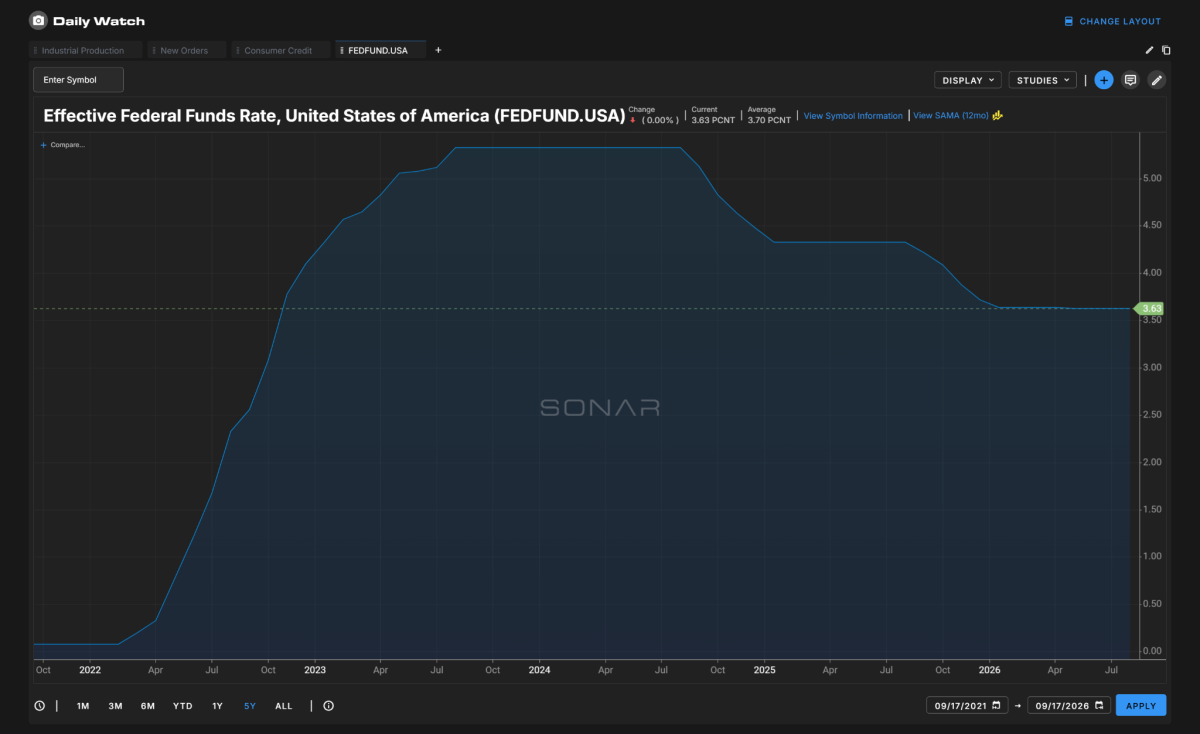
The number that actually matters day to day is the effective federal funds rate (EFFR), the volume-weighted median rate banks actually trade at, published by the New York Fed. It isn’t set directly; it emerges from supply and demand inside the corridor. EFFR typically trades closest to IORB but a few basis points under it, because not every active lender is IORB-eligible: the FHLBs, in particular, are large habitual fed funds lenders that can’t earn IORB themselves, so they’ll lend below it rather than not lend at all. On the last full day before this week’s hike, EFFR printed at 3.63% against an IORB of 3.65% and a target range of 3.50%–3.75%, right in line with that pattern. ON RRP exists precisely to stop that leakage from becoming a leak: without a risk-free floor open to non-banks, FHLB lending could chase rates down through the bottom of the range entirely. Post-hike, expect EFFR to resettle just under the new 3.90% IORB and comfortably above the new 3.75% ON RRP floor.
Interest as the price of time, and the market for loanable funds
All of these different rates are mechanical implementations of a broader concept: economic interest, what savers earn when they set aside money for others’ use, and what borrowers pay to use that money instead. Essentially, an interest rate is the price of time preference, what someone demands to give up access to their own money for a period of time. Left alone, this price is set in the market for loanable funds (LF), where the supply of savings meets the demand for borrowing to fund investment and consumption, clearing at an equilibrium rate just like every other price in the economy. The same logic governs supply and demand for LF: as the interest rate rises, people borrow less (quantity demanded falls) and more people free up money to invest (quantity supplied rises), and vice versa. The Fed doesn’t completely repeal that market; it overrides the price at the short end by making risk-free returns artificially available at whatever level it chooses through IORB and ON RRP. Because the entire term structure of credit (Treasury yields, mortgage rates, commercial paper, revolving credit lines) prices off that short-term risk-free rate, moving it ripples through every borrowing decision in the economy.
Why raising rates cools inflation
The transmission is straightforward: a higher policy rate raises banks’ cost of funds, which they pass through to loan rates. Higher borrowing costs raise the hurdle rate on both consumption and investment, so both slow. Tighter credit growth against a relatively fixed near-term supply of goods and services reduces upward pressure on prices, and higher U.S. rates tend to draw in foreign capital seeking that risk-free return, strengthening the dollar and lowering the price of imports and dollar-denominated commodities, a channel that matters a great deal right now given how much of the current inflation spike is energy-driven.
What this means for logistics
Every link in that chain eventually reaches freight. Higher rates raise the cost of carrying inventory, pushing shippers toward leaner, more frequent replenishment, a headwind for volumes initially, though it can produce sharper freight spikes later as buffers thin out. Housing and durable goods, both acutely rate-sensitive, are usually first to soften, hitting flatbed, building materials, and appliance-linked truckload demand before it shows up elsewhere. On the supply side, carriers financing tractors, trailers, and warehouse automation face a higher cost of capital, which can slow fleet renewal and capacity additions, a lagged tightening effect that shows up in spot rates well after the hike itself. Thinly capitalized small carriers, leaning on revolving credit for fuel float and payroll, feel this fastest, and higher rates can accelerate the capacity exits already common in freight downturns. A stronger dollar cuts both ways for ocean and cross-border freight: cheaper imports for U.S. buyers can support container volumes, while pricier U.S. exports abroad work the other way.
Put together, this hike leans against inflation partly by cooling the same demand that moves freight, while simultaneously raising the cost of financing the capacity that hauls it. Rates and freight cycles rarely move at the same speed, which is exactly why the lag matters for anyone planning capacity twelve months out.
For more info on SONAR, visit gosonar.com
Brokerage Compliance Symposium
The day before F3. Every compliance issue you face - fraud exposure, carrier liability, FMCSA rules, cargo theft, insurance gaps - navigated by attorneys and operators defining best practices in a changing industry.
F3 Awards Dinner
The night before F3. FreightTech100 companies honored. FreightTech 25 and Shipper of Choice winners revealed live. Cocktail reception into dinner and live music - 300 industry leaders in one purpose-built room.
F3: Future of Freight Festival
Industry-defining keynotes, rapid-fire technology demos, and industry leaders networking in experiences across Chattanooga - plus the inaugural F3 Awards Dinner featuring the FreightTech and Shipper of Choice reveals.
The day before F3. Every compliance issue you face - fraud exposure, carrier liability, FMCSA rules, cargo theft, insurance gaps - navigated by attorneys and operators defining best practices in a changing industry.
The Signal at Chattanooga Choo Choo • Chattanooga, TN Register NowThe night before F3. FreightTech100 companies honored. FreightTech 25 and Shipper of Choice winners revealed live. Cocktail reception into dinner and live music - 300 industry leaders in one purpose-built room.
The Signal at Chattanooga Choo Choo • Chattanooga, TN Register NowIndustry-defining keynotes, rapid-fire technology demos, and industry leaders networking in experiences across Chattanooga - plus the inaugural F3 Awards Dinner featuring the FreightTech and Shipper of Choice reveals.
The Signal at Chattanooga Choo Choo • Chattanooga, TN Register Now