




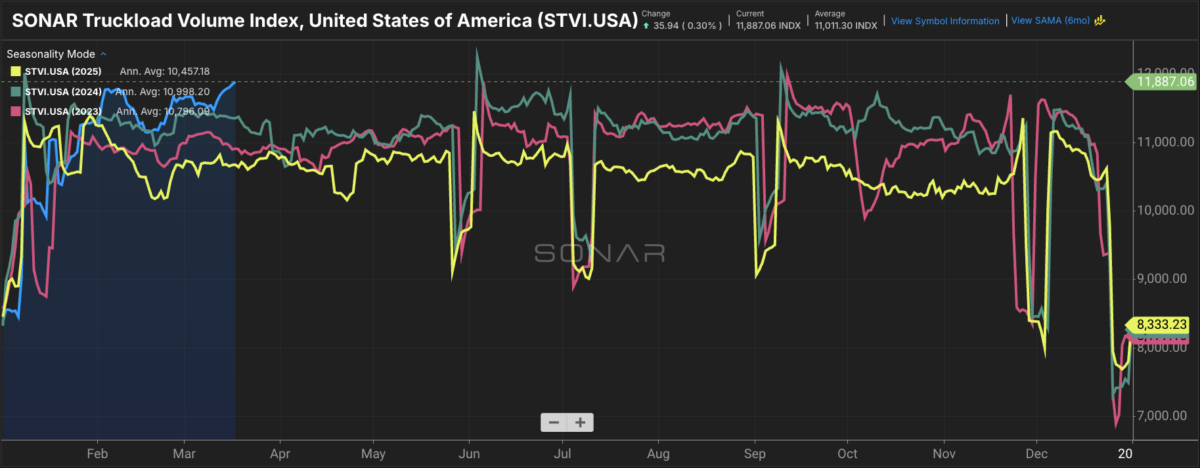
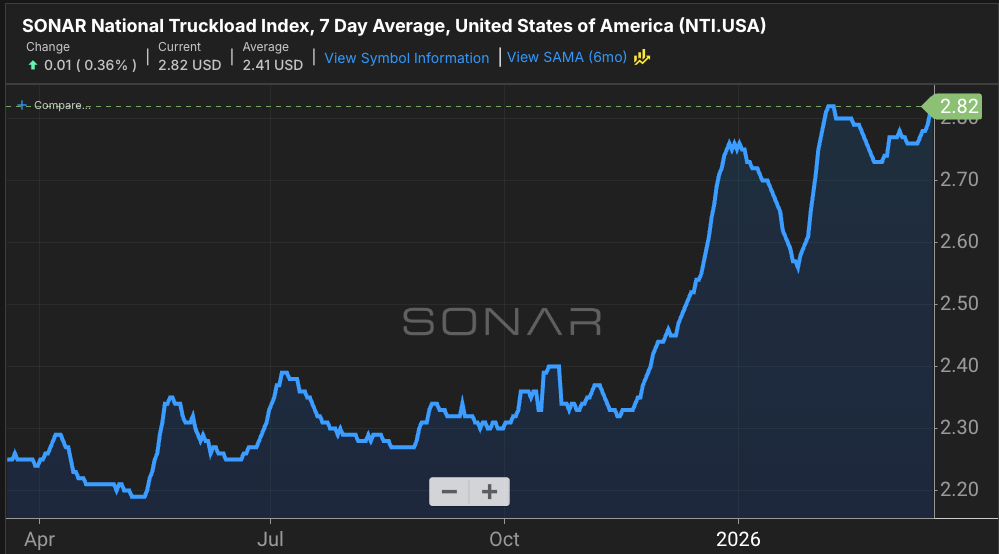
The U.S. truckload spot market just hit a new cycle high at $2.82 per mile on the National Truckload Index (NTI.USA)—that’s the 7-day moving average of booked dry van spot rates, fuel included. Volumes are holding firm at multi-year peaks we haven’t seen since late 2022.
The chart shows the steady climb of trucking spot rates through early 2026, breaking out with real conviction after hovering in the $2.30s not long ago.
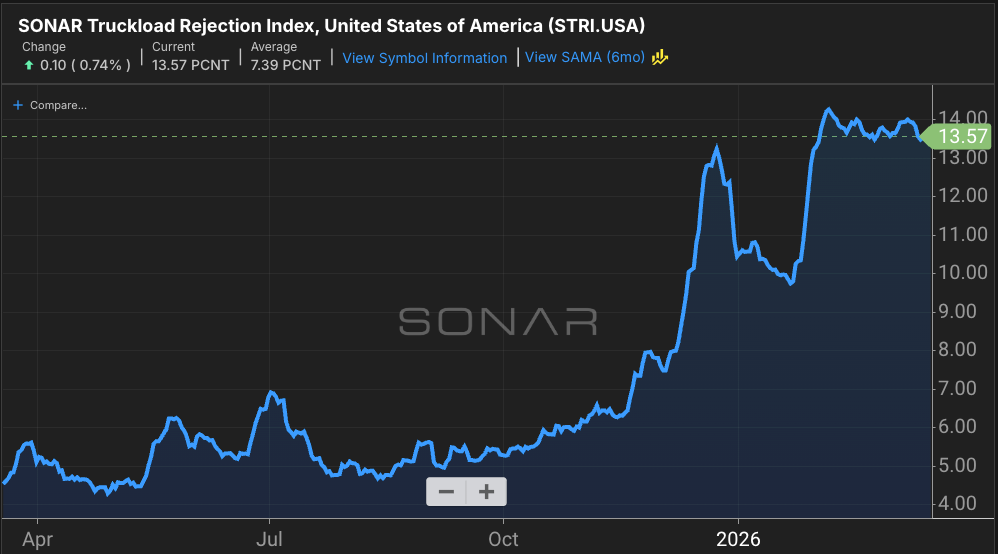
This isn’t random noise. Outbound tender rejections nationally are near 13%—highest since early 2022—meaning carriers are rejecting loads because they can. When rejections spike alongside sustained volumes, it’s classic tightness: capacity meeting demand head-on.
On the regulatory front, the compliance crackdown began last summer (around mid-2025) with FMCSA audits of state CDL issuance, training provider registries, and non-domiciled licenses, and it’s now starting to show real, measurable impacts on available capacity—just as the freight market appears to be turning up.
Early actions included removing or warning thousands of noncompliant CDL training providers (hundreds purged from the registry by fall 2025), stricter enforcement of English language proficiency (with violations leading to out-of-service orders), and reviews that flagged improper non-domiciled CDLs in states like California, Pennsylvania, and others.
This groundwork set the stage for the sharper moves in early 2026, including the non-domiciled CDL final rule (effective March 16) that severely limited eligibility and phased out many existing holders, plus Dalilah’s Law (H.R. 5688) advancing through the House Transportation and Infrastructure Committee in a 35-26 vote on March 18.
Dalilah’s Law, named after Dalilah Coleman (the young girl seriously injured in a 2024 crash involving an unqualified driver), is a sharp turn from prior approaches.
Key pieces include:
- Aggressive phase-out of non-domiciled CDLs for non-citizens/non-permanent residents— within a year of enactment. This would be a demonstrative change for the current FMCSA rule that allows for a five-year phase in.
- Strict English proficiency enforcement: out-of-service violation, English-only testing.
- Crackdown on foreign dispatch services and major reforms to CDL training self-certification, closing loopholes that fed low-oversight “CDL mills.”
- Revocation of ineligible existing CDLs and tougher standards overall.
If this moves forward in strong form (and it looks like it will), combined with the ongoing enforcement from last summer’s audits, it will meaningfully shrink available driver capacity—especially in segments that leaned on non-domiciled or under-vetted drivers. This is bullish for truckload.
Spot rates have gained about $0.50 per mile net of fuel over the past six months (fuel itself only up $0.22), giving carriers real recapture after the deflationary grind that bottomed us in the low $2.00s in 2023–2024. We’re seeing 20–25% year-over-year recovery in key metrics in many lanes.
Carriers finally have pricing power and better margins after a long stretch of pain. Shippers and brokers are dealing with higher costs, routing guide pushback, and the need to watch real-time indicators closely.
One wildcard hanging over everything right now is the ongoing war in Iran, which kicked off with U.S. and Israeli strikes on February 28 and has escalated into sustained air campaigns, retaliatory missile barrages, and attacks on energy infrastructure in the Persian Gulf—including strikes on facilities like South Pars and Ras Laffan. Oil and gas prices have surged amid the disruptions, with threats to the Strait of Hormuz and broader supply routes. It’s a major geopolitical risk that could keep energy volatility high and add uncertainty to freight demand and costs.
That said, if the conflict drags on or intensifies, it could stimulate significant investments in U.S. defense production (ramping up manufacturing and logistics for military equipment) and domestic oil and gas drilling/refining (as the U.S. looks to boost energy independence and offset global supply risks). That kind of capital inflow and activity would likely translate to more truckload demand in key sectors—defense-related freight, energy equipment hauls, and refined products movements—which could provide additional tailwinds to this upcycle.
The cycle has turned. This isn’t the 2021–2022 frenzy returning overnight, but resilient demand, elevated rejections, volume strength, and now policy-driven capacity removal—building from last summer’s crackdown—are aligning to give carriers the edge. The Iran situation adds layers of unpredictability, but the potential upside for U.S.-centric energy and defense could offset some of that risk.
Watch these signals: tender rejections, volume trends, contract negotiations, how Dalilah’s Law progresses, and any Congressional funding for defense spending. If they hold or build, this upcycle has real legs.
Brokerage Compliance Symposium
The day before F3. Every compliance issue you face - fraud exposure, carrier liability, FMCSA rules, cargo theft, insurance gaps - navigated by attorneys and operators defining best practices in a changing industry.
F3 Awards Dinner
The night before F3. FreightTech100 companies honored. FreightTech 25 and Shipper of Choice winners revealed live. Cocktail reception into dinner and live music - 300 industry leaders in one purpose-built room.
F3: Future of Freight Festival
Industry-defining keynotes, rapid-fire technology demos, and industry leaders networking in experiences across Chattanooga - plus the inaugural F3 Awards Dinner featuring the FreightTech and Shipper of Choice reveals.
The day before F3. Every compliance issue you face - fraud exposure, carrier liability, FMCSA rules, cargo theft, insurance gaps - navigated by attorneys and operators defining best practices in a changing industry.
The Signal at Chattanooga Choo Choo • Chattanooga, TN Register NowThe night before F3. FreightTech100 companies honored. FreightTech 25 and Shipper of Choice winners revealed live. Cocktail reception into dinner and live music - 300 industry leaders in one purpose-built room.
The Signal at Chattanooga Choo Choo • Chattanooga, TN Register NowIndustry-defining keynotes, rapid-fire technology demos, and industry leaders networking in experiences across Chattanooga - plus the inaugural F3 Awards Dinner featuring the FreightTech and Shipper of Choice reveals.
The Signal at Chattanooga Choo Choo • Chattanooga, TN Register Now