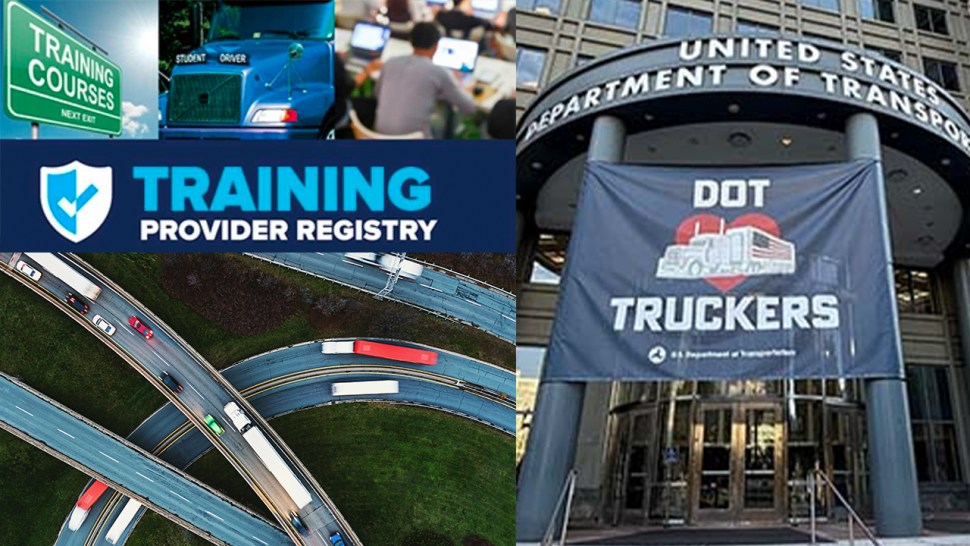
Transportation Secretary Sean P. Duffy announced Monday the removal of nearly 3,000 commercial driver’s license training providers from the Federal Motor Carrier Safety Administration’s Training Provider Registry for failing to meet federal standards. Another 4,500 training providers were placed on notice for potential noncompliance.
The purge represents the most aggressive enforcement action against CDL training fraud in agency history. It also exposes the fundamental weakness of a registry system designed to standardize CDL training but gutted before implementation, leaving approximately 36,000 providers still operating without federal validation beyond self-certification and the honor system.
“This administration is cracking down on every link in the illegal trucking chain,” Duffy stated in the announcement. “Under Joe Biden and Pete Buttigieg, bad actors were able to game the system and let unqualified drivers flood our roadways.”
What the announcement doesn’t mention is that this fraud has been documented, prosecuted and largely ignored through multiple administrations of both parties dating back to the 1990s. And that the Entry Level Driver Training rule itself, which created the Training Provider Registry, was systematically weakened before becoming law, removing the very standards that might have prevented the fraud it was designed to stop.
How ELDT Got Gutted
The Entry Level Driver Training rule was conceived as a solution to inconsistent and often inadequate CDL training across the country. The goal was straightforward: create federal minimum standards for training duration, curriculum requirements and instructor qualifications to ensure every new CDL holder met baseline competency before operating an 80,000-pound vehicle on public roads.
By the time ELDT became law and was implemented in February 2022, it had been gutted to remove mandatory minimum training durations and times. The final rule eliminated specific hour requirements that would have established uniform training standards. Anyone can register for the Training Provider Registry with no credential validation, no verification of instructor qualifications, and no federal inspection of facilities.
The system relies entirely on honesty. Training providers must meet state school guidelines for operations and instructor qualifications, but those state guidelines vary wildly. What passes for adequate training in one state might be considered criminally negligent in another. ELDT became anything but standard or consistent.
Here’s what that means in practice. A training provider can register with the TPR by completing an online form. FMCSA doesn’t verify the information. They don’t inspect the facility. They don’t validate instructor credentials. They don’t check whether the provider actually has trucks, classrooms or even a physical location.
The registry operates on an honor system in an industry where federal investigators have documented two decades of systematic dishonesty. We’re trusting the same people who ran Operation Safe Road, Larex Incorporated, and the Massachusetts golden handshake scheme to honestly self-report their compliance with standards that aren’t even federally defined.
As of today, with 7,500 providers removed or placed on notice, there are still approximately 36,000 providers in the registry, unvalidated by the feds. Nobody has inspected them. Nobody has verified their instructor qualifications. Nobody has confirmed they’re actually providing the training they claim to provide.
What’s the recourse when FMCSA discovers fraud? They remove the provider from the registry. That’s it. No criminal referrals for the most egregious cases. No systematic investigation of how many unqualified drivers the provider graduated. No tracking of where those fraudulently trained drivers ended up or whether they’re still on the road.
The Monday announcement is a great start. But it’s also an admission that the foundational system is broken.
The Two-Decade Fraud Machine That Preceded ELDT
Between 2001 and 2025, federal DOT Office of Inspector General investigations documented systematic corruption in America’s CDL licensing system, resulting in a conservative estimate of over 6,000 fraudulent licenses issued to unqualified drivers. Many couldn’t speak English, had never driven a truck, or, in some cases, had never even taken a road test.
The actual number is almost certainly higher when considering undiscovered schemes and cases that never reached prosecution. The documented death toll stands at least 13 killed and hundreds injured in crashes directly linked to fraudulent CDL holders.
The worst single incident involved Adem Salihovic, who triggered a 74-vehicle pileup in California that killed two people and wounded 51 others. His CDL was obtained through a scheme in which former Watkins Truck Line supervisor Frank Catanzarite admitted to accepting $10,000 in bribes from unqualified truck drivers. Catanzarite pleaded guilty in 2003 and was sentenced to 17 months in prison. He’s been out for over 20 years now. Where is he? Working in transportation again? We don’t know. The system doesn’t track that.
This is the context in which ELDT was developed. Federal regulators knew the training system was corrupted. They knew fraudulent schools were operating as diploma mills. They knew unqualified drivers were obtaining licenses through systematic bribery and testing fraud. ELDT was supposed to fix this.
Instead, industry lobbying gutted the rule before it was implemented, removing the very standards that would have made it effective.
The Big Three Operations
The geographic and operational patterns of CDL fraud reveal how deeply corruption had become embedded in the training system years before ELDT existed.
Operation Safe Road in Illinois and Florida from 2001 to 2003 resulted in an estimated 1,000-plus fraudulent CDLs and 41 convictions. The scheme was breathtaking in scope. Illinois driving schools recruited Eastern European and Russian immigrants who couldn’t pass legitimate tests. Middlemen charged $800 to $2,000 to transport these applicants to Florida, where corrupt testers at 3S Trucking would pass them without testing. Many applicants never got behind the wheel during testing.
Back in Illinois, Secretary of State employees sold fake CDLs for $500 to $1,500 and used the proceeds to buy raffle tickets for Governor George Ryan’s political campaign. At least $170,000 in illegal CDL money flowed directly into Ryan’s campaign coffers. George Ryan served 6.5 years in federal prison and died at home in 2025. The other 38 individuals convicted in Operation Safe Road? We have no idea where most of them are.
Larex Incorporated in Florida from 2014 to 2016 resulted in an estimated 400 to 500 fraudulent CDLs and four convictions. Owner Ellariy Medvednik ran a Russian-language trucking school that charged students $1,800 to $5,000 for guaranteed CDLs. The operation used covert cameras and wireless earpieces that fed answers during written tests, fake residency documents, and a cooperative third-party tester who passed everyone regardless of ability.
Florida ultimately sent letters to over 2,000 CDL holders who had used compromised testers, requiring them to retake the test within 60 days or face cancellation. There’s no follow-up data on how many of those 2,000 drivers actually retested, how many simply abandoned their CDLs, and how many continued driving anyway.
TTT Truck Driver’s School in Georgia from 1998 to 2004 resulted in 623 fraudulent CDLs and two convictions. Owner Thomas Duke and third-party examiner Terence Haley falsified the skills tests for 623 students over six years. Georgia required all affected drivers to retest. Of those who showed up for legitimate testing, only 142 passed. That’s a 77 percent failure rate.
481 unqualified drivers had been operating commercial vehicles on American highways, some for years, before they were caught.
ELDT was supposed to prevent this. Instead, the gutted version of the rule simply created another registry that operates on the same honor system that enabled these frauds in the first place.
The Recent Cases Prove Nothing Changed After ELDT
The Massachusetts State Police CDL scandal from 2019 to 2025 demonstrates that the same schemes continue operating today, both before and after ELDT implementation. Former State Police Sergeant Gary Cederquist was convicted in May 2025 of 48 counts after running the State Police CDL Unit and arranging for at least three dozen applicants to receive passing scores regardless of whether they passed or even took the test.
ELDT went into effect in February 2022. The Massachusetts scheme continued operating right through implementation and for another year afterward. The golden handshake conspirators used the code word to identify applicants receiving special treatment. Text messages showed Cederquist describing applicants as “horrible,” “brain dead,” “an idiot,” and “should have failed about 10 times already,” yet he still gave them passing scores.
What did Cederquist get in exchange? A new driveway valued at over $10,000, a snowblower worth nearly $2,000, a $750 granite post and mailbox, and thousands of dollars worth of premium bottled water, coffee, tea and candy delivered by Eric Mathison, who worked for a water company that needed CDLs for its delivery drivers.
In Louisiana, a federal grand jury indicted multiple Office of Motor Vehicles employees and third-party testers in August 2025 for conspiracy to commit honest services wire fraud and bribery. The indictment alleges that, between approximately August 2020 and February 2024, the defendants conspired to defraud Louisiana’s CDL program by soliciting and accepting bribes.
This scheme operated through ELDT implementation and continued for two years afterward. Four years total. Right under regulators’ noses. ELDT didn’t stop it. The Training Provider Registry didn’t detect it. The honor system failed exactly as critics predicted.
Who’s Been Selling Out
Analysis of two decades of DOT-OIG investigations reveals consistent patterns of corruption that ELDT was supposed to address but didn’t.
Third-party examiners represent the weakest link, with 35-plus documented cases. Private contractors authorized to conduct CDL skills tests repeatedly accepted bribes ranging from $70 to $2,000 per applicant. Some examiners never even showed up at test sites. They just pre-signed score sheets.
DMV and state employees account for 25-plus cases. Government workers with database access sold passing scores, altered records and issued licenses to people who never tested. California DMV employees were particularly prolific, with some responsible for hundreds of fraudulent licenses each.
Driving schools represent 20-plus cases. Commercial driving schools operated as fraud factories, guaranteeing CDLs regardless of ability. They provided cheating equipment, fake residency documents and coordinated with corrupt testers.
These are exactly the operations ELDT was designed to eliminate. Instead, the gutted version of the rule just gave them a new registry to game.
The Fatal Consequences We Know About
The Willis Children in 1994. Six children, Benjamin, Joseph, Samuel, Hank, Elizabeth and Peter, burned to death when their van exploded after being struck by debris from a truck. Driver Ricardo Guzman’s CDL was allegedly obtained through the corrupt Illinois system that later brought down Governor George Ryan.
The 74-vehicle pileup in 1998. Adem Salihovic triggered a massive chain-reaction crash that killed two people and injured 51. Salihovic had obtained his CDL through Frank Catanzarite at Watkins Motor Lines, who admitted to taking bribes from unqualified drivers. Catanzarite served 17 months. Two people are dead.
The family of four in 2004. Nasko Nazov, an Illinois resident holding a fraudulent Wisconsin CDL, caused an accident in Tennessee that killed a family of four. When questioned by federal grand jury investigators about the Wisconsin CDL fraud scheme, Nazov lied under oath. He was sentenced to 10 months in prison for lying to investigators. Where is Nazov now? Unknown.
The Alabama prison guards in 2008. Devasko Lewis was placed under an Imminent Hazard Order to cease all operations due to serious violations discovered after a fatality crash that killed seven State of Alabama prison guards. Lewis continued operating in violation of the order. Where is Lewis now? Unknown.
These are the deaths that prompted calls for standardized training. These are the tragedies that ELDT was supposed to prevent. But by the time the rule was implemented, it had been stripped of the mandatory minimums and federal validation that might have actually worked.
Why This Keeps Happening
This isn’t about individual bad actors. It’s about a broken system with insufficient oversight and perverse incentives that guarantee continued corruption.
Third-party testing failed because states outsourced testing to cut costs but created an industry with every incentive to pass applicants and no meaningful oversight. When your business model depends on satisfied customers and repeat referrals from driving schools, failure becomes bad for business.
ELDT was supposed to fix this by creating federal standards for training providers. Instead, the gutted version just created another layer of self-certification. Training providers register on the TPR by attesting they meet state requirements. FMCSA doesn’t verify. States have wildly different requirements. The system relies on honesty in an industry where dishonesty has been systematically documented for 25 years.
DMV employees sold out because low pay, database access and minimal supervision created opportunities for corruption. A DMV clerk making $35,000 annually could earn that much in bribes in a few months. The risk-reward calculation made fraud rational.
Driving schools became fraud factories because when you charge $5,000 for CDL training and students expect guaranteed results, the pressure to deliver becomes intense. Legitimate training couldn’t guarantee passage. Some students cannot drive safely, but corruption could guarantee passage, creating a competitive advantage for dishonest schools.
ELDT doesn’t address any of these structural problems. It just requires that training come from a registered provider. But if the provider registration process relies on self-certification with no federal validation, we’ve just moved the fraud from one place to another.
What Monday’s Announcement Actually Does
The Training Provider Registry lists all providers authorized to offer federally required Entry-Level Driver Training for CDL students. FMCSA stated this is the first step in reviewing training providers to identify and remove noncompliant providers.
CDL training providers are being removed from the TPR for falsifying or manipulating training data, neglecting to meet required curriculum standards, facility conditions or instructor qualifications, and failing to maintain accurate, complete documentation or refusing to provide records during federal audits or investigations.
This is aggressive enforcement that should have been standard operating procedure from the day ELDT launched in February 2022. The announcement represents the Trump administration doing what should have been done from the outset, creating accountability in a system designed to operate on the honor system.
FMCSA Administrator Derek Barrs stated, “If you are unwilling to follow the rules, you have no place training America’s commercial drivers. We will not tolerate negligence.”
Strong words. If FMCSA is now removing 3,000 providers for noncompliance and placing another 4,500 on notice, what does that say about the validation that occurred before these providers were listed? The answer is obvious. There was no validation. The TPR operated exactly as designed, as a self-certification system with no federal verification.
What Monday’s Announcement Doesn’t Do
The purge addresses training provider compliance with current standards. What it doesn’t address is that those current standards are inadequate by design because the rule got gutted before implementation.
ELDT still has no mandatory minimum training durations. A provider can offer 40 hours of training or 400 hours of training and both meet federal requirements as long as they cover the curriculum topics, but curriculum coverage means nothing if students aren’t given adequate time to develop actual skills.
There’s still no federal validation of provider credentials before listing in the registry. FMCSA is now auditing providers after the fact, discovering many don’t meet even the minimal standards that exist. But they were listed in the first place because nobody checked.
There’s still no federal definition of instructor qualifications. Providers must meet state requirements, but state requirements vary from rigorous to essentially nonexistent. An instructor who wouldn’t qualify in one state can operate freely in another.
There’s still no tracking of student outcomes. Do graduates of Provider A have higher crash rates than graduates of Provider B? Do they fail skills tests at higher rates? Do they wash out of the industry faster? We have no data because FMCSA doesn’t track this.
There’s no national database of CDL fraud convictions. Of the 100-plus individuals convicted of CDL-related fraud over the past two decades, the whereabouts of most are currently unknown. There’s no system preventing convicted fraudsters from opening new training schools, registering on the TPR and continuing their operations under new names.
The 36,000 Unvalidated Providers
Here’s the scale of the problem. After removing 3,000 providers and placing 4,500 on notice, approximately 36,000 providers remain on the Training Provider Registry, unvalidated by federal authorities.
Nobody has inspected their facilities. Nobody has verified their instructor qualifications. Nobody has confirmed they’re actually providing the training they claim to provide. Nobody has checked whether the business even exists at the address listed.
These providers are authorized to train entry-level CDL students solely based on their self-certification that they meet state requirements. Some of those providers are undoubtedly legitimate operations providing quality training. Some are marginal operations that cut corners to maximize profit. And some, based on 25 years of documented history, are actively fraudulent.
We have no way to tell which is which until FMCSA audits them. And what happens to the providers they don’t review? They continue operating under federal authorization based solely on their own attestation of compliance.
This is the honor system applied to an industry where federal investigators have documented systematic dishonesty for a quarter century.
What’s the Recourse?
When FMCSA discovers a provider is fraudulent or noncompliant, what happens? They remove the provider from the registry. That’s the extent of federal enforcement action in most cases.
No criminal referrals unless the fraud is egregious and well-documented. No systematic investigation of how many unqualified drivers the provider graduated. No tracking of where those fraudulently trained drivers ended up or whether they’re still on the road. No coordination with state authorities to revoke the licenses of students who received fraudulent training.
The provider gets delisted. Students who trained there keep their CDLs unless someone specifically investigates their individual cases. And nothing prevents the provider from opening a new business under a new name and registering again on the TPR, because there’s no fraud conviction database to flag repeat offenders.
What Should Exist But Doesn’t
The FMCSA Drug and Alcohol Clearinghouse, launched in 2020, demonstrates that national tracking systems are possible and practical. The Clearinghouse is a secure online database that provides real-time information about CDL holders’ drug and alcohol violations. Employers must query the database before hiring and annually for current employees.
It works. The system prevents problem drivers from state-hopping to avoid consequences.
We need an equivalent clearinghouse for convictions for training provider fraud. Track examiners convicted of fraud. Track DMV and motor vehicle employees convicted of fraud. Track driving school owners and operators convicted of fraud. Track state employees convicted of licensing fraud. Track individuals convicted of identity theft related to CDLs.
Require DMVs to check the database before approving third-party examiners. Require states to verify no fraud history before issuing examiner certifications. Require trucking schools to check before hiring instructors. Create lifetime bans for specific fraud categories. Make the database publicly searchable so students can verify their training provider hasn’t been convicted of fraud.
We need federal validation of TPR providers before listing, not after. Verify the business exists at the listed address. Verify instructors meet baseline qualifications. Inspect facilities to confirm they have adequate equipment. Review curriculum to ensure it meets standards. This should happen before providers are authorized to train students, not years later when FMCSA finally gets around to auditing them.
We need mandatory minimum training durations in ELDT. Research clearly shows skill development requires time. You can’t adequately train a CDL student in 40 hours. But without federal minimums, schools compete on price by cutting training time. Race-to-the-bottom dynamics guarantee that inadequate training becomes the industry standard.
We need federal tracking of student outcomes. Link CDL holders to their training providers in federal databases. Track which providers produce graduates with higher crash, violation, and dropout rates. Make this data public so students can make informed decisions and enforcement can target problematic providers proactively instead of reactively.
The technology exists. The model is available on the Drug and Alcohol Clearinghouse. What’s missing is the political will to impose standards that industry lobbying successfully gutted before ELDT implementation.
The Trump administration’s purge of 3,000 CDL training providers from the federal registry represents the most aggressive enforcement action in agency history. Secretary Duffy and Administrator Barrs deserve credit for taking action that previous administrations avoided. This is overdue accountability that should have started the day ELDT launched.
This is reactive enforcement, discovering that thousands of providers on the TPR don’t meet even the minimal standards that exist. This isn’t a comprehensive reform of a system that was gutted before implementation.
With 7,500 providers removed or on notice, approximately 36,000 providers remain on the registry, unvalidated by federal authorities. Nobody has inspected them. Nobody has verified their credentials. They’re authorized to train entry-level CDL students solely on self-certification that they meet state requirements that vary widely by jurisdiction.
ELDT was conceived to create standardized, consistent CDL training with mandatory minimums and federal oversight. By the time it became law, industry lobbying had stripped out the required minimums, the federal validation, and the enforcement mechanisms that would have made it effective. What we got instead was another honor system registry in an industry where federal investigators have documented systematic dishonesty for 25 years.
The same structural vulnerabilities that enabled Operation Safe Road, Larex Incorporated, and the Massachusetts State Police golden handshake scheme still exist today. Training providers operate with the same perverse incentives. State reciprocity still enables license laundering. No national database tracks convicted fraudsters who can open new schools under new names.
Until we restore the mandatory minimums that were stripped from ELDT, implement federal validation of providers before they’re listed in the registry, create a fraud conviction database modeled after the Drug and Alcohol Clearinghouse, and impose meaningful consequences, including lifetime industry bans, we’re just playing whack-a-mole with fraud operations.
George Ryan died at home after living as a free man for 12 years following his release from prison. The Willis children are still dead. Frank Catanzarite, Ellariy Medvednik, Terence Haley and dozens of other convicted CDL fraudsters are somewhere out there with no tracking, no monitoring and no system to prevent them from opening new training schools and registering on the TPR.
The fraud factory is still running. Monday’s announcement shut down 3,000 storefronts while 36,000 others remain unvalidated. The distribution network remains intact. And the honor system that enabled 25 years of documented fraud continues operating exactly as designed.
Brokerage Compliance Symposium
The day before F3. Every compliance issue you face - fraud exposure, carrier liability, FMCSA rules, cargo theft, insurance gaps - navigated by attorneys and operators defining best practices in a changing industry.
F3 Awards Dinner
The night before F3. FreightTech100 companies honored. FreightTech 25 and Shipper of Choice winners revealed live. Cocktail reception into dinner and live music - 300 industry leaders in one purpose-built room.
F3: Future of Freight Festival
Industry-defining keynotes, rapid-fire technology demos, and industry leaders networking in experiences across Chattanooga - plus the inaugural F3 Awards Dinner featuring the FreightTech and Shipper of Choice reveals.
The day before F3. Every compliance issue you face - fraud exposure, carrier liability, FMCSA rules, cargo theft, insurance gaps - navigated by attorneys and operators defining best practices in a changing industry.
The Signal at Chattanooga Choo Choo • Chattanooga, TN Register NowThe night before F3. FreightTech100 companies honored. FreightTech 25 and Shipper of Choice winners revealed live. Cocktail reception into dinner and live music - 300 industry leaders in one purpose-built room.
The Signal at Chattanooga Choo Choo • Chattanooga, TN Register NowIndustry-defining keynotes, rapid-fire technology demos, and industry leaders networking in experiences across Chattanooga - plus the inaugural F3 Awards Dinner featuring the FreightTech and Shipper of Choice reveals.
The Signal at Chattanooga Choo Choo • Chattanooga, TN Register Now