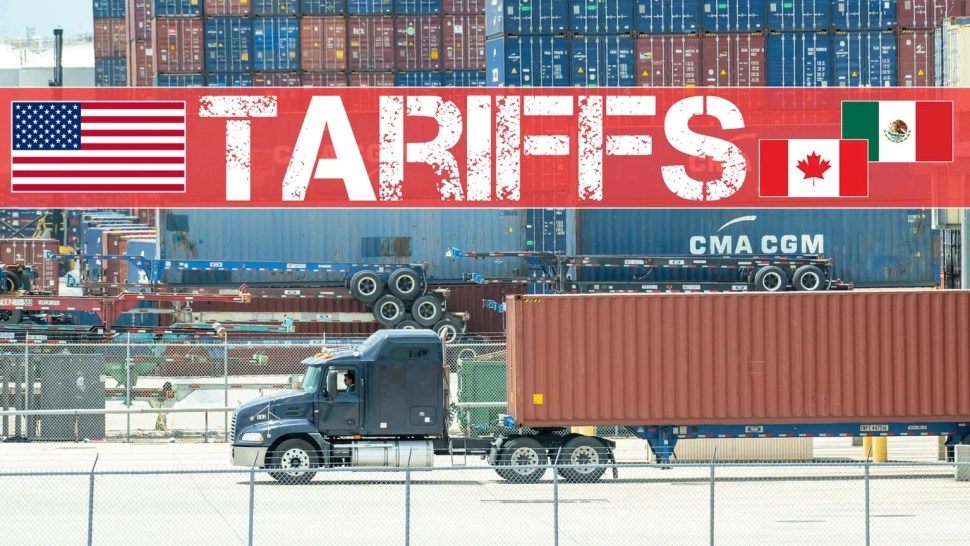
President Donald Trump said on Monday that he will impose a 25% tariff on medium- and heavy-duty trucks next month.
“Beginning November 1st, 2025, all Medium and Heavy Duty Trucks coming into the United States from other Countries will be Tariffed at the Rate of 25%,” Trump wrote in a Truth Social post.
The decision also follows a federal probe launched in April by the Commerce Department under Section 232 of the Trade Expansion Act, which allows the government to impose import taxes on goods considered vital to national security.
The 25% tariff is aimed at protecting U.S. manufacturers like Peterbilt and Kenworth parent company PACCAR, according to an earlier social media post from Trump. This development led to a rise in PACCAR’s (NASDAQ: PCAR) stock price and a more modest boost for Ford (NYSE: F), as domestic producers are expected to gain a competitive advantage from the tariffs
Trump had earlier indicated that new duties on heavy truck imports would take effect on Oct. 1. The new announcement marks the latest step in his broader tariff agenda aimed at boosting domestic manufacturing.
Join the leaders shaping freight’s future at
F3: Future of Freight Festival, Oct 21-22.
Network with the industry’s best and discover what’s next.
The U.S. imports the majority of its medium- and heavy-duty trucks from Mexico, which has become a key manufacturing hub for North American automakers under the United States–Mexico–Canada Agreement (USMCA) trade framework.
In 2024, Mexico exported a total of 159,466 heavy-duty trucks, of which 95.5% were destined for the U.S., according to the country’s National Association of Bus, Truck and Tractor-Trailer Producers (Anpact).
The 16 members of Anpact in Mexico are Freightliner, Kenworth, Navistar, Hino, International, DINA, MAN SE, Mercedes-Benz, Isuzu, Scania, Shacman Trucks, Foton, Cummins, Detroit Diesel, Daimler Buses Mexico and Volkswagen Buses.
Under the USMCA, medium- and heavy-duty trucks can move across North America tariff-free if they meet strict origin rules requiring that at least 64% of a truck’s value — rising to 70% in coming years — originates within the region.
The pact also mandates that key components such as engines, axles, and transmissions contain at least 75% North American content, and that manufacturers source 70% of their steel and aluminum domestically.
Trucks that fail to meet these thresholds are subject to standard import duties, meaning Trump’s new 25% tariff could apply to non-qualifying vehicles even from USMCA partners like Mexico and Canada.
Related: Trump sets 25% tariff on imported trucks, raising supply chain stakes
Brokerage Compliance Symposium
The day before F3. Every compliance issue you face - fraud exposure, carrier liability, FMCSA rules, cargo theft, insurance gaps - navigated by attorneys and operators defining best practices in a changing industry.
F3 Awards Dinner
The night before F3. FreightTech100 companies honored. FreightTech 25 and Shipper of Choice winners revealed live. Cocktail reception into dinner and live music - 300 industry leaders in one purpose-built room.
F3: Future of Freight Festival
Industry-defining keynotes, rapid-fire technology demos, and industry leaders networking in experiences across Chattanooga - plus the inaugural F3 Awards Dinner featuring the FreightTech and Shipper of Choice reveals.
The day before F3. Every compliance issue you face - fraud exposure, carrier liability, FMCSA rules, cargo theft, insurance gaps - navigated by attorneys and operators defining best practices in a changing industry.
The Signal at Chattanooga Choo Choo • Chattanooga, TN Register NowThe night before F3. FreightTech100 companies honored. FreightTech 25 and Shipper of Choice winners revealed live. Cocktail reception into dinner and live music - 300 industry leaders in one purpose-built room.
The Signal at Chattanooga Choo Choo • Chattanooga, TN Register NowIndustry-defining keynotes, rapid-fire technology demos, and industry leaders networking in experiences across Chattanooga - plus the inaugural F3 Awards Dinner featuring the FreightTech and Shipper of Choice reveals.
The Signal at Chattanooga Choo Choo • Chattanooga, TN Register Now