




Year-to-date U.S. rail volumes remain lower compared with the same period in 2018 as trade uncertainty and looser truck capacity weigh on the market.
U.S. freight railroads originated 3.7% less traffic than the same period a year ago, at 19.2 million carloads and intermodal units, the Association of American Railroads said. The year-to-date data runs through Sept. 14.
Of that, year-to-date U.S. rail carloads are down 3.5% to nearly 9.4 million carloads, while U.S. intermodal units are down 4% to 9.8 million intermodal containers and trailers.
On a weekly basis, U.S. rail traffic was down 4.8% compared to the same week in 2018, at 526,734 carloads and intermodal units.
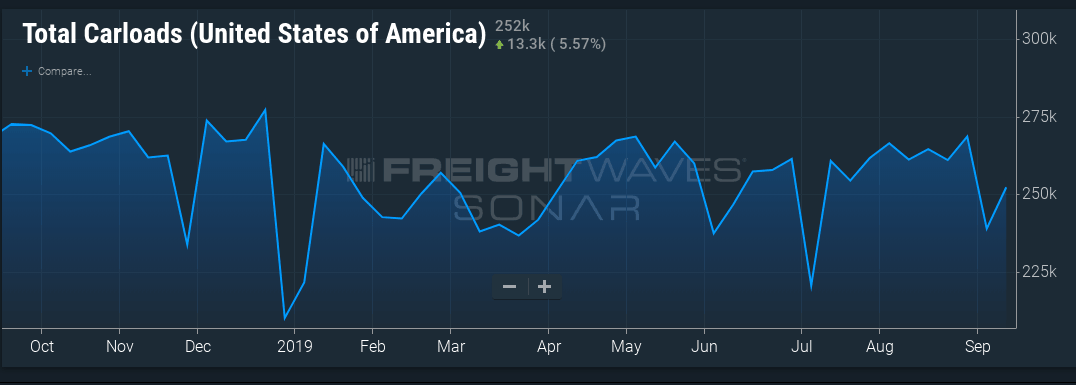
Meanwhile, overall North American rail traffic was also down on a year-to-date and weekly basis. North American rail volumes fell 2.6% to 26.2 million carloads and intermodal units, while weekly volumes fell 3.3% to 723,344 carloads and intermodal units.
Economic uncertainty and looser truck capacity have been some of the reasons cited by railroad executives as possible causes for the lower volumes this year.
“You’ve got a lot of noise affecting our domestic and international intermodal: the trade issues, the tariffs,” Union Pacific chief financial officer Rob Knight said at a Morgan Stanley conference on Sept. 12. On Sept. 4, the company lowered its volume guidance for the year. “You’ve got loose truck capacity right now, although we’re starting to hear and see some signs of that bottoming out.”
But “on the flip side, we are still hearing from our customers…that there will be a peak season that will show up in our intermodal business. I doubt that it will be a historically large spike, but at this point we’ll take a speed bump in terms of a peak season for this year,” Knight said.
While macroeconomic factors might influence rail volume trends, isolated events like weather disruptions or current events have the potential to affect rail volumes in the short term.
For instance, changes in the price of crude oil might not sway rail volumes immediately, but they could have some influence on rail volume movements should the price of crude oil sustain a spike — or dip — in pricing.
Attacks on oil refineries in Saudi Arabia on Sept. 14 had caused crude oil prices to spike due to concerns over oil production, but market prices eased after the Saudi government assured customers that it would be able to meet projected monthly production levels.
“For rail diesel fuel prices, any crude oil pricing impacts on the railroads would depend on how long oil prices stay up and how far up they go,” a transportation consultant said. “If oil prices drive up the Energy Information Administration’s HDF [retail on-highway diesel fuel] price, it will drive up fuel surcharge revenue.”
He continued, “It is possible that, in the short term, that this could be a positive for railroads. But if the railroads’ fuel costs also rise, then it could impact them negatively later on.”
The other factor to consider when determining how changes in crude oil prices — and subsequent changes in diesel fuel prices — could impact the railroads is to factor in how much volume share can shift back to rail from truck, according to Cowen managing director Jason Seidl.
“Shippers will be looking at total landed costs between trucks and rail. You’re not going to shift all your freight to rail. Spot rail intermodal generally represents between 5% to 10% of total business. That’s what can move around,” Seidl said.
If higher diesel prices increase trucking costs and accelerate bankruptcies, then the railroads could benefit, Seidl said.
Brokerage Compliance Symposium
The day before F3. Every compliance issue you face - fraud exposure, carrier liability, FMCSA rules, cargo theft, insurance gaps - navigated by attorneys and operators defining best practices in a changing industry.
F3 Awards Dinner
The night before F3. FreightTech100 companies honored. FreightTech 25 and Shipper of Choice winners revealed live. Cocktail reception into dinner and live music - 300 industry leaders in one purpose-built room.
F3: Future of Freight Festival
Industry-defining keynotes, rapid-fire technology demos, and industry leaders networking in experiences across Chattanooga - plus the inaugural F3 Awards Dinner featuring the FreightTech and Shipper of Choice reveals.
The day before F3. Every compliance issue you face - fraud exposure, carrier liability, FMCSA rules, cargo theft, insurance gaps - navigated by attorneys and operators defining best practices in a changing industry.
The Signal at Chattanooga Choo Choo • Chattanooga, TN Register NowThe night before F3. FreightTech100 companies honored. FreightTech 25 and Shipper of Choice winners revealed live. Cocktail reception into dinner and live music - 300 industry leaders in one purpose-built room.
The Signal at Chattanooga Choo Choo • Chattanooga, TN Register NowIndustry-defining keynotes, rapid-fire technology demos, and industry leaders networking in experiences across Chattanooga - plus the inaugural F3 Awards Dinner featuring the FreightTech and Shipper of Choice reveals.
The Signal at Chattanooga Choo Choo • Chattanooga, TN Register Now