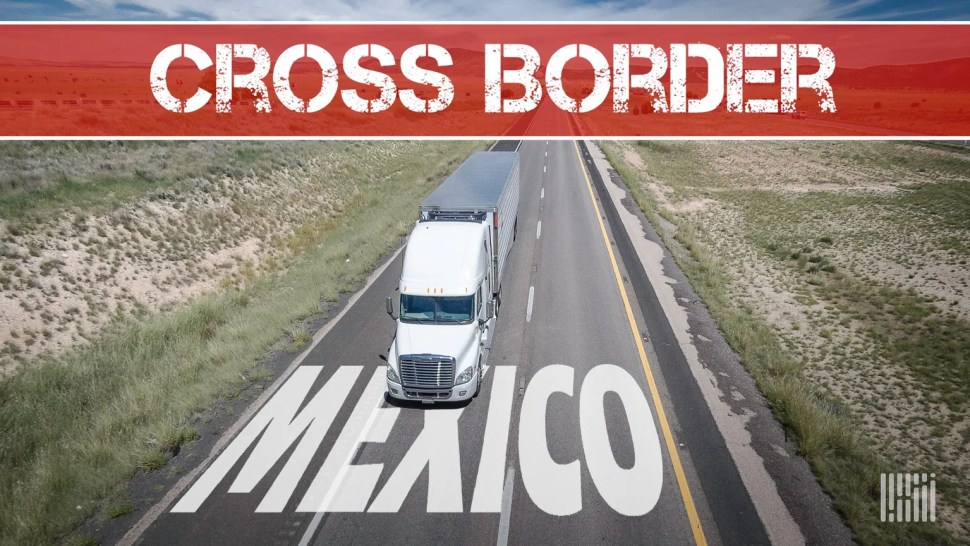
Nearshoring, Mexico investment and tightening truck capacity could reshape North American freight flows next year.
Uber Freight’s latest market outlook points to a U.S. freight market that is quietly stabilizing and setting up for tighter conditions in 2026, with cross-border trade with Mexico emerging as one of the most important structural drivers.
Uber Freight is a part of San Francisco-based Uber Technologies Inc. (NYSE: UBER), which operates three platforms: Uber (ride-hailing), Uber Eats (food and goods delivery) and Uber Freight (logistics).
In its “Q4 2025 Market Update & Outlook,” released on Thursday, Uber Freight said resilient consumer spending, nearshoring activity and capacity discipline among carriers are helping stabilize demand after a prolonged freight downturn — even as manufacturing remains under pressure and geopolitical risks persist.
Mexico strengthens position as top U.S. trading partner
Uber Freight highlighted Mexico’s expanding role in North American supply chains, driven by nearshoring and reshoring activity across automotive, industrial machinery and advanced manufacturing.
Mexico increased its share of U.S. imports to 15.5%, up from 14.5% previously, cementing its position as the largest U.S. trading partner, according to the report.
Foreign direct investment into Mexico reached $34.3 billion in the first half of 2025, up 10.2% year over year, with the U.S. remaining the country’s top investor.
Uber Freight said export growth from Mexico has been particularly strong in vehicles, auto parts, industrial machinery, furniture and medical instruments — categories that generate steady truckload and cross-border freight demand.
Despite ongoing U.S. tariffs on steel, aluminum and copper, Mexico has largely maintained export volumes, albeit at higher production costs, reinforcing its importance in North American manufacturing supply chains.
Related: Customs overhaul may reshape cross-border manufacturing, expert says
Border risks and regulatory headwinds remain
While the long-term outlook for U.S.–Mexico trade remains constructive, Uber Freight flagged several risks that could disrupt cross-border freight flows in 2026.
The report pointed to road blockades across Mexico’s Bajío region, led by labor groups such as the country’s National Union of Workers, that have disrupted more than 8,000 truckloads, causing delays and congestion on key Mexico-U.S. corridors.
Security concerns, including cargo theft, continue to drive shipper investment in advanced tracking, geofencing and in-cab monitoring technologies.
On the regulatory front, Uber Freight noted that stricter U.S. enforcement of English-language proficiency and commercial driver licensing rules, combined with pauses in certain U.S. visa processing programs, could further tighten cross-border driver availability.
Industry groups in Mexico warn that a significant share of B-visa drivers may not meet evolving U.S. language standards, potentially exacerbating capacity constraints.
Related: Blockades choke Mexico’s border trade as farmers, truckers escalate unrest
Freight rates expected to rise as capacity tightens
Across the broader U.S. freight market, Uber Freight said capacity reductions — driven by weak tractor orders and ongoing fleet discipline — are likely to push rates higher in 2026.
Dry van spot rates rose 1.2% year over year in November, while route guide acceptance remained strong at 93%, signaling a balanced but tightening market. Uber Freight expects spot rates to soften seasonally in early 2026 before rising in the second half of the year as capacity exits accelerate.
If pending federal action on non-domiciled CDL holders moves forward, Uber Freight said the market could experience significant tightening, potentially leading to double-digit spot rate growth.
Outlook: cautious optimism for North American trade
Looking ahead, Uber Freight said the 2026 United States-Mexico-Canada-Agreement review, scheduled for July, will be a pivotal moment for North American trade. Automakers are already increasing local sourcing in Mexico to prepare for stricter rules of origin and closer scrutiny of Asian content.
Major global events, including the 2026 FIFA World Cup, which will be hosted in Mexico, could also introduce temporary logistics challenges across major metros such as Monterrey, Guadalajara and Mexico City.
Despite these risks, Uber Freight said the long-term trajectory for U.S.–Mexico freight remains positive, underpinned by nearshoring, resilient consumer demand and continued investment in North American manufacturing capacity.
Brokerage Compliance Symposium
The day before F3. Every compliance issue you face - fraud exposure, carrier liability, FMCSA rules, cargo theft, insurance gaps - navigated by attorneys and operators defining best practices in a changing industry.
F3 Awards Dinner
The night before F3. FreightTech100 companies honored. FreightTech 25 and Shipper of Choice winners revealed live. Cocktail reception into dinner and live music - 300 industry leaders in one purpose-built room.
F3: Future of Freight Festival
Industry-defining keynotes, rapid-fire technology demos, and industry leaders networking in experiences across Chattanooga - plus the inaugural F3 Awards Dinner featuring the FreightTech and Shipper of Choice reveals.
The day before F3. Every compliance issue you face - fraud exposure, carrier liability, FMCSA rules, cargo theft, insurance gaps - navigated by attorneys and operators defining best practices in a changing industry.
The Signal at Chattanooga Choo Choo • Chattanooga, TN Register NowThe night before F3. FreightTech100 companies honored. FreightTech 25 and Shipper of Choice winners revealed live. Cocktail reception into dinner and live music - 300 industry leaders in one purpose-built room.
The Signal at Chattanooga Choo Choo • Chattanooga, TN Register NowIndustry-defining keynotes, rapid-fire technology demos, and industry leaders networking in experiences across Chattanooga - plus the inaugural F3 Awards Dinner featuring the FreightTech and Shipper of Choice reveals.
The Signal at Chattanooga Choo Choo • Chattanooga, TN Register Now