The U.S. Department of the Treasury sanctioned two Mexican nationals and nine companies on Tuesday accused of helping the Jalisco New Generation Cartel (CJNG) run a multimillion-dollar cross-border fuel-smuggling operation.
The actions by the Treasury Department’s Office of Foreign Assets Control (OFAC) and the Financial Crimes Enforcement Network (FinCEN) target what officials describe as an increasingly important source of cartel revenue beyond narcotics trafficking.
“Today’s action highlights the extent to which Mexico’s cartels are expanding beyond traditional drug trafficking to generate revenue for their criminal organizations,” Treasury Secretary Scott Bessent said in a news release.
U.S. authorities also issued a warning to banks and businesses about financial red flags associated with fuel-smuggling and Mexican tax-evasion schemes.
Fuel theft now among cartels’ biggest revenue streams
Treasury officials said CJNG and other Mexican cartels have increasingly diversified into hydrocarbon theft and fuel smuggling, known in Mexico as huachicol, transforming the practice into one of their most lucrative businesses.
According to Treasury, the schemes encompass three primary activities:
- Stealing crude oil and fuel from Mexico’s state-owned Petróleos Mexicanos (Pemex).
- Smuggling stolen crude oil into the U.S., often mislabeled as waste oil.
- Smuggling gasoline, diesel and other refined fuels from the U.S. into Mexico while evading Mexico’s fuel import taxes through fraudulent customs declarations.
A recent Joint Counterterrorism Assessment Team bulletin issued by the U.S. National Counterterrorism Center described fuel theft as the second-most profitable illicit revenue stream for Mexico-based foreign terrorist organizations after narcotics trafficking and their largest non-drug source of income.
The assessment estimated that fuel theft cost the Mexican government about $9 billion in lost tax revenue during 2024 and said as much as one-third of fuel sold in Mexico may be illegally sourced or adulterated.
A separate analysis by the New Lines Institute said illicit fuel now accounts for roughly one-third of Mexico’s domestic fuel market, fueled by the growth of “huachicol fiscal” — a white-collar scheme involving cross-border shipments and tax fraud.
Related: Cartel boss killing jolts US-Mexico freight corridors
Accountant allegedly orchestrated scheme
Among those sanctioned is Oscar Guillermo Juraidini Silva, whom the Treasury department identified as a key financial facilitator for CJNG.
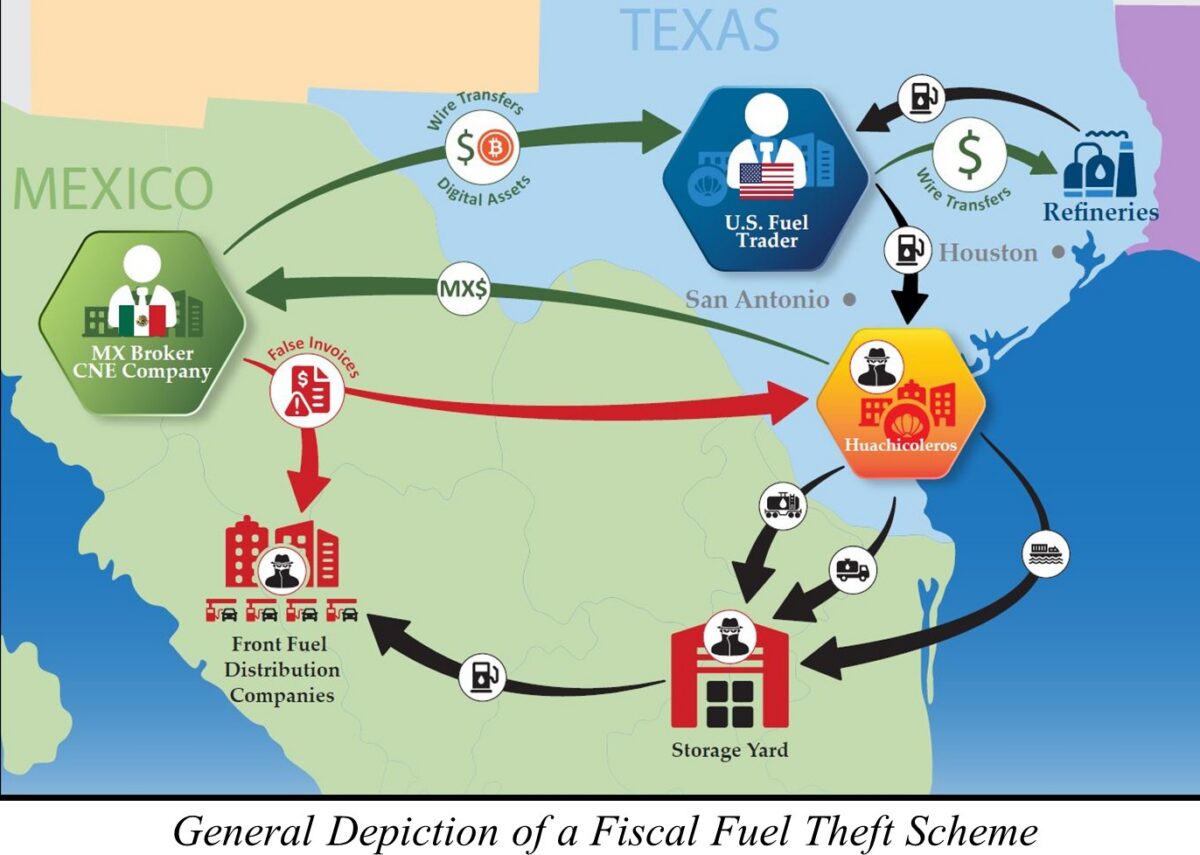
Officials allege Juraidini operated shell companies, falsified customs documentation and coordinated fuel imports from the United States into Mexico that were intentionally mislabeled to avoid Mexico’s Special Tax on Production and Services (IEPS).
U.S. Treasury officials said the operation generated tens of millions of dollars annually while benefiting CJNG.
Authorities also designated six companies allegedly owned by Juraidini operating in transportation, financial services and real estate, along with additional businesses connected to the fuel-smuggling network.
U.S. Treasury also designated J. Refugio Ruiz Villagomez, who is linked to Jomadi Logistics & Cargo and Ahavat Logistics Solution. Treasury said Ruiz Villagomez knowingly smuggled fuel from the U.S. into Mexico without proper permits, paid fees to cartels controlling ports of entry, and used the U.S. financial system for tens of millions of dollars in transactions tied to CJNG-linked huachicol activity.
Texas remains focal point
U.S. Treasury officials said the latest action builds on previous sanctions targeting CJNG’s crude-oil smuggling networks in 2024 and 2025.
The agency said it received more than 160 suspicious activity reports during the year, identifying more than $7 billion in suspicious financial activity primarily involving transactions between the U.S. and Mexico. Texas and Florida generated the largest number of reports.
In Texas, investigators identified activity centered in border communities including Brownsville, Mission, Eagle Pass and McAllen, with many subjects tied to the oil and natural gas and transportation industries.
The sanctions come months after cartel violence linked to CJNG disrupted freight corridors in western Mexico following the death of cartel leader Nemesio “El Mencho” Oseguera Cervantes.
Although major Texas border crossings continued operating, violence temporarily affected the Port of Manzanillo, Guadalajara’s airport and inland trucking routes serving western Mexico, highlighting the growing intersection between organized crime and North American supply chains.
Shell companies, trucking and logistics networks
Authorities said cartels rely on interconnected shell companies operating in transportation, logistics and financial services to move fuel across the border.
According to FinCEN, cartel-linked trading companies purchase fuel from complicit U.S. distributors before moving it through freight companies, tanker trucks, railcars and maritime vessels into Mexico.
The fuel is then sold through cartel-controlled gas stations or unregulated roadside vendors after customs paperwork is falsified to avoid Mexico’s fuel taxes.
Sanction implications
The sanctions freeze any U.S.-based property or assets belonging to Oscar Guillermo Juraidini Silva, J. Refugio Ruiz Villagomez and the nine designated companies, while generally prohibiting U.S. individuals and businesses from conducting transactions with them.
The restrictions also extend to any entities owned 50% or more by sanctioned parties, and foreign financial institutions that knowingly facilitate significant transactions involving the designated individuals or companies could face secondary U.S. sanctions, including restrictions on access to the U.S. financial system.
Brokerage Compliance Symposium
The day before F3. Every compliance issue you face - fraud exposure, carrier liability, FMCSA rules, cargo theft, insurance gaps - navigated by attorneys and operators defining best practices in a changing industry.
F3 Awards Dinner
The night before F3. FreightTech100 companies honored. FreightTech 25 and Shipper of Choice winners revealed live. Cocktail reception into dinner and live music - 300 industry leaders in one purpose-built room.
F3: Future of Freight Festival
Industry-defining keynotes, rapid-fire technology demos, and industry leaders networking in experiences across Chattanooga - plus the inaugural F3 Awards Dinner featuring the FreightTech and Shipper of Choice reveals.
The day before F3. Every compliance issue you face - fraud exposure, carrier liability, FMCSA rules, cargo theft, insurance gaps - navigated by attorneys and operators defining best practices in a changing industry.
The Signal at Chattanooga Choo Choo • Chattanooga, TN Register NowThe night before F3. FreightTech100 companies honored. FreightTech 25 and Shipper of Choice winners revealed live. Cocktail reception into dinner and live music - 300 industry leaders in one purpose-built room.
The Signal at Chattanooga Choo Choo • Chattanooga, TN Register NowIndustry-defining keynotes, rapid-fire technology demos, and industry leaders networking in experiences across Chattanooga - plus the inaugural F3 Awards Dinner featuring the FreightTech and Shipper of Choice reveals.
The Signal at Chattanooga Choo Choo • Chattanooga, TN Register Now