




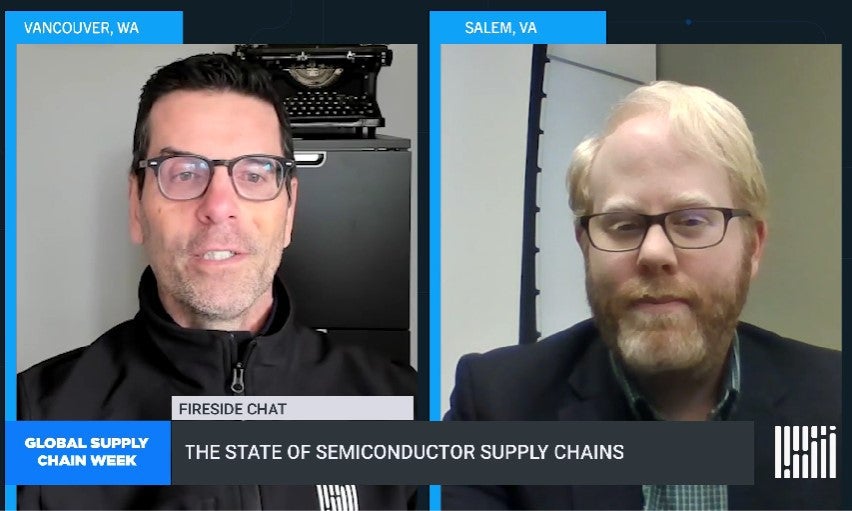
This recap is from Thursday, the third day of FreightWaves’ Global Supply Chain Week.
FIRESIDE CHAT TOPIC: The state of the semiconductor supply chain.
DETAILS: Radford University’s Zach Collier discusses the state of the semiconductor industry with FreightWaves’ Eric Kulisch after chip shortages roiled the global economy during the pandemic. They discuss new U.S. policies that were implemented to better control this key technology and avoid future shortages.
KEY QUOTES FROM COLLIER:
On the fragmented supply chain: “The life cycle of a chip is really complex. So there are people that design the chips, and then typically, the people that design the chips are different than the ones that end up manufacturing the chips, and that’s due to a number of reasons. But the supply chain is very fragmented for chips. So one group designs them and then another group might manufacture them and then other people might then assemble them and package them and test them, and so these chips go all across the United States, all across the world, before they end up in the things like our smartphones and laptops and whatnot.
On factors that led to the chip shortage: “When the pandemic happened and all the lockdowns started, there was a spike in the demand for chips and the demand was already going up for chips before the lockdowns occurred. And so that’s an important part of this. Part of the story is that things like electric vehicles and the Internet of Things was already causing an increase in demand for these chips. And then, when everybody had to work from home, the demand just spiked from there, which led to some shortages are things like automotive and pretty much all across the board for chips.
On the CHIPS and Science Act: “The CHIPS Act that passed last year was sort of an answer to some of these questions about bringing back some of the manufacturing and other parts of the supply chain domestically here in the States. We only produce, in terms of the manufacturing side of things, about 12% of the world’s chips, even though we demand anywhere between a quarter and a third depending on who you talk to. So that imbalance means that we are in some sense vulnerable or sort of at the mercy of the supply chain.”
Brokerage Compliance Symposium
The day before F3. Every compliance issue you face - fraud exposure, carrier liability, FMCSA rules, cargo theft, insurance gaps - navigated by attorneys and operators defining best practices in a changing industry.
F3 Awards Dinner
The night before F3. FreightTech100 companies honored. FreightTech 25 and Shipper of Choice winners revealed live. Cocktail reception into dinner and live music - 300 industry leaders in one purpose-built room.
F3: Future of Freight Festival
Industry-defining keynotes, rapid-fire technology demos, and industry leaders networking in experiences across Chattanooga - plus the inaugural F3 Awards Dinner featuring the FreightTech and Shipper of Choice reveals.
The day before F3. Every compliance issue you face - fraud exposure, carrier liability, FMCSA rules, cargo theft, insurance gaps - navigated by attorneys and operators defining best practices in a changing industry.
The Signal at Chattanooga Choo Choo • Chattanooga, TN Register NowThe night before F3. FreightTech100 companies honored. FreightTech 25 and Shipper of Choice winners revealed live. Cocktail reception into dinner and live music - 300 industry leaders in one purpose-built room.
The Signal at Chattanooga Choo Choo • Chattanooga, TN Register NowIndustry-defining keynotes, rapid-fire technology demos, and industry leaders networking in experiences across Chattanooga - plus the inaugural F3 Awards Dinner featuring the FreightTech and Shipper of Choice reveals.
The Signal at Chattanooga Choo Choo • Chattanooga, TN Register Now