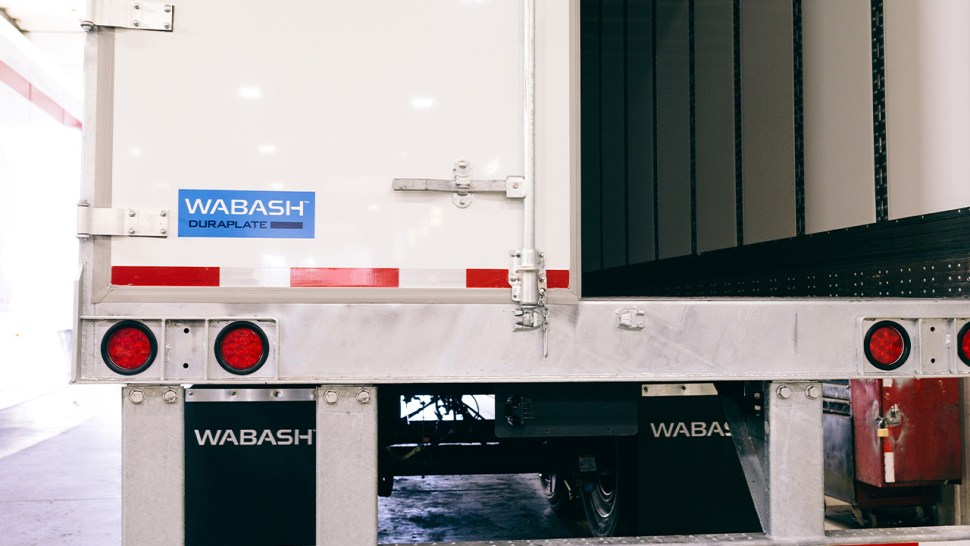
Trailer builder Wabash National, whose stock went from about $30 per share in March 2024 to less than $7 last month, has seen a surge of investor interest on the back of a bullish analyst report.
Wabash (NYSE: WNC) is not a company that draws a great deal of interest from sell-side analysts. But on Wednesday, the team of Michael Shlisky and Linda Umwali from DA Davidson, after a meeting with Wabash management and investors, upgraded its rating on Wabash stock to buy from neutral.
The reaction was immediate and huge.
Wabash stock already had been trending higher, with a recent bottom of about $7.15 per share on June 5. It closed Tuesday at $9.28.
But on Wednesday, after the Davidson report circulated through the market, Wabash stock rose 16.38%, a gain of $1.52 to $10.80. The trend continued Thursday. At approximately 12:30 PM EDT, Wabash stock was up 43 cts, 4.03%, to $11.24.
Wednesday’s gain, and the smaller ones in the days leading up to Thursday, has combined to result in Wabash stock being up just over 5% in the last 52 weeks after months of being down by double digits percentage. As of the close of trade Wednesday, Wabash stock was up approximately 56.7% in the last month and 34.7% in the last three months.
DA Davidson set its price target on the company at $20.
“Wabash expressed increasing confidence that trailer demand can return to replacement levels in 2027, following recent conversations with customers and the exit of some capacity from the freight market,” Davidson wrote.
A second boost to its outlook
It’s the second piece of significant good news for Wabash in recent weeks.
Earlier this month, the Commerce Department announced a determination that China had “unfairly” subsidized their trailer industries. It recommended countervailing duties to be applied to Chinese imports ranging from 82.3% to 128.7%.
Smaller duties were also to be levied against Mexican imports.
And while some of the increase in Wabash’s stock price prior to the DA Davidson report might have been related to the Commerce Department finding, it paled compared to what happened Wednesday.
Coincidentally, on the same day as the DA Davidson report, ACT Research reported preliminary net trailer orders for May of 20,700 units. That was up from April’s 19,400 units. But the more staggering number is that preliminary net trailers orders for May were up 237% from the corresponding months a year earlier.
The DA Davidson report said Wabash management said in their meeting that the trade decision “could become a meaningful tailwind.”
“Management noted that recent rulings came in better than expected,” DA Davidson wrote.
The size of the market to be affected by the Chinese duties would be about 5% to 10% of the U.S. dry van market, the research firm wrote.
If Wabash were to capture 5% to 10% of that market, according to DA Davidson, that could be a $20 million positive impact to its EBITDA, added to a current estimate for the year of $185 million in EBITDA.
Market is strengthening
Broader macro trends are also a key reason for company optimism, according to DA Davidson.
Management’s confidence in the market “returning to replacement-level demand” has risen, the report said. “This is largely due to stronger freight trends: spot rates are up, capacity has exited the market and dealer inventories are down,” according to DA Davidson.
It added that Wabash management said replacement demand is about 120,000 to 140,000 dry vans per year, but the current level is near 100,000.
Exiting capacity is likely to be retired, Wabash management believes.
“Wabash noted that most of the assets exiting the market are simply the oldest and least-likely to compete with new units,” DA Davidson wrote. “”Wabash’s extensive network of used-trailer outlets has not seen any type of surge of supply.”
“That said, we got the sense that management is not calling for a sudden market boom,” the report said. “Instead, WNC’s view is that fleets have delayed purchases for several years and will eventually need to replace aging equipment.”
Wabash CEO Brent Yeagy, in a comment supplied to FreightWaves, said the company “is encouraged by a growing set of dry van, reefer van and platform freight and macroeconomic indicators that indicate a supply led recovery driven in large part by industry-wide driver capacity reductions and numerous other regulatory driven supply pressures that have substantially impacted the current spot market and ultimately the contract rate landscape.”
He noted the “significant aging of fleets over the past few years” as a factor in the market.
Combined with the countervailing duties, Yeagy said “Against this backdrop, Wabash expects to deliver sequential improvements in profitability in line with strengthening demand.”
The report contained several other takeaways that helped lead to its more bullish outlook on Wabash.
One key point Wabash management believes: dry van purchases will not be a zero-sum game with tractor acquisition.
“Wabash addressed the long-held concern that whenever fleets start spending again on capex, they will turn to the tractor units first before addressing trailer shortages,” DA Davidson wrote. “Wabash believes that fleets have under-replaced on both and will have to purchase both.”
Confidence in balance sheet
Wabash’s balance sheet was raised as an issue in the recent downgrade of its debt by Moody’s, the third in about a year.
“Balance sheet is an issue, but improving backlogs could go a long way” is how DA Davidson put it discussing that issue.
Wabash management, the report said, is confident in its ability to extend a $350 million asset backed line of credit that expires late next year. Management is also confident that it can pay off or refinance $400 million of senior notes due October 2028.
“The company’s goal is to address its debt this summer, before it is less than one year from expiration,” the DA Davidson report said.
More articles by John Kingston
California’s meal break rule for bus drivers shot down by federal court
Carrier Nussbaum sets driver pay increase; others popping up more quietly
C.H. Robinson a defendant in post-Montgomery Florida broker liability case
Brokerage Compliance Symposium
The day before F3. Every compliance issue you face - fraud exposure, carrier liability, FMCSA rules, cargo theft, insurance gaps - navigated by attorneys and operators defining best practices in a changing industry.
F3 Awards Dinner
The night before F3. FreightTech100 companies honored. FreightTech 25 and Shipper of Choice winners revealed live. Cocktail reception into dinner and live music - 300 industry leaders in one purpose-built room.
F3: Future of Freight Festival
Industry-defining keynotes, rapid-fire technology demos, and industry leaders networking in experiences across Chattanooga - plus the inaugural F3 Awards Dinner featuring the FreightTech and Shipper of Choice reveals.
The day before F3. Every compliance issue you face - fraud exposure, carrier liability, FMCSA rules, cargo theft, insurance gaps - navigated by attorneys and operators defining best practices in a changing industry.
The Signal at Chattanooga Choo Choo • Chattanooga, TN Register NowThe night before F3. FreightTech100 companies honored. FreightTech 25 and Shipper of Choice winners revealed live. Cocktail reception into dinner and live music - 300 industry leaders in one purpose-built room.
The Signal at Chattanooga Choo Choo • Chattanooga, TN Register NowIndustry-defining keynotes, rapid-fire technology demos, and industry leaders networking in experiences across Chattanooga - plus the inaugural F3 Awards Dinner featuring the FreightTech and Shipper of Choice reveals.
The Signal at Chattanooga Choo Choo • Chattanooga, TN Register Now