Ryan Joyce’s world for more than 15 years as a CIA operations officer conducting counterterrorism operations likely consisted of sitting in a basement, looking for one guy with a beard in the mountains of a Middle Eastern country. He helped disrupt terrorist networks using what the intelligence community calls “all-source intelligence”, fusing data from distributed sensors, satellite imagery, and human sources to pinpoint targets and prevent attacks.
This week, the company Joyce co-founded announced a $60 million Series B funding round. The target now isn’t terrorists. It’s trucks. If you follow me, Danielle Chaffin, Justin Martin, Gord Magill, or the other Freight X’ers on X, you know it’s a real issue.
“We used to track terrorists,” Joyce has said. “Now we track trucks.”
GenLogs closed its latest round led by Battery Ventures, with participation from IVP, Cathay Innovation, 9Yards, and existing investors Venrock, Steel Atlas, HOF Capital, TitletownTech, and Autotech Ventures. The raise brings total funding to $81 million since the company’s founding in 2023, a remarkable trajectory for a startup attacking one of the most fragmented, opaque, and fraud-ridden sectors of the American economy.
The Numbers
The trucking industry moved 11.27 billion tons of freight in 2024 and generated $906 billion in revenue, according to the American Trucking Associations. The global freight trucking market is valued at roughly $3 trillion and is projected to reach $4.3 trillion by 2034.
Trucks move more than 70 percent of all freight in the United States. Every sector of the economy, manufacturing, retail, healthcare, energy, and agriculture, depends on the reliable movement of goods by road.
And yet, unlike airplanes tracked by ADS-B transponders or ships tracked by AIS beacons, trucks have never had ubiquitous, real-time location data. The industry has operated largely on self-reported information, handshake agreements, and trust.
That trust is being exploited at scale.
Verisk CargoNet’s 2025 annual report, released last month, documented 3,594 supply chain crime events across the United States and Canada, essentially flat from the prior year. But estimated losses surged 60 percent to nearly $725 million. Confirmed cargo theft incidents rose 18 percent, climbing from 2,243 to 2,646. The average value per theft increased 36 percent to $273,990.
Food and beverage theft spiked 47 percent, with 708 reported incidents. Metal theft surged 77 percent, driven by demand for copper. Criminals increasingly target enterprise computing hardware and cryptocurrency mining equipment rather than consumer electronics. These aren’t opportunistic crimes. CargoNet characterizes the operations as strategic, calculated, and increasingly sophisticated.
The barrier to entry for fraud is alarmingly low. You can become a licensed freight broker or motor carrier in the United States for less than $2,000 and be hauling freight in under three weeks. Until recently, you didn’t even have to verify your own identity to establish the company. Operators based in Serbia, Afghanistan, or anywhere else could present themselves as legitimate American trucking companies.
GenLogs estimates the industry loses $35 billion annually to fraud and theft combined.
From Counter-Terrorism to Freight Intelligence
The GenLogs founding story reads like something from a spy novel, largely because it is.
Joyce met Blake Balch while both were deployed overseas working for the U.S. government. Balch, a good-natured East Texan with a background in the State Department’s Foreign Service, shared Joyce’s vision for using distributed sensor networks and disparate datasets to solve complex problems. Over the next decade, they deployed to far-flung locations, gathering intelligence and disrupting terrorist activities.
“We were fast friends,” Balch has said, “with a united vision of combatting terrorism together.”
Their eventual co-founder, Joe Sherman, was working a different angle entirely. A data scientist and Virginia Tech researcher who had done stints at Anduril Industries and Anno.ai, Sherman was calculating the potential impact of chemical attacks while Joyce and Balch were hunting the networks planning them.
The three met around 2020 while working at an early-stage startup in the Washington, D.C., area. Together, they developed and patented technology to passively track individuals across camera networks without using facial or gait recognition, a capability inspired by the 2013 Boston Marathon bombing, where investigators had to manually review hundreds of camera feeds because the Tsarnaev brothers’ hats and glasses defeated facial recognition systems.
“We built technology that allowed one analyst to do in seconds what used to take a hundred analysts a few weeks or months,” Sherman noted.
That technology found a home in retail analytics. Major malls worldwide now use it. But Joyce, Balch, and Sherman realized they hadn’t set foot in a mall in years. The technology needed a bigger problem.
The COVID-19 supply chain crisis provided the catalyst. Joyce watched the bottlenecks and realized something obvious but overlooked: unlike planes and ships, trucks had no ubiquitous tracking network. Every player in the industry complained about the lack of good data. One early customer told them that the first company to successfully collect comprehensive data on all trucks on American roads would become a $100 billion company overnight.
GenLogs was born.
What the Platform Does
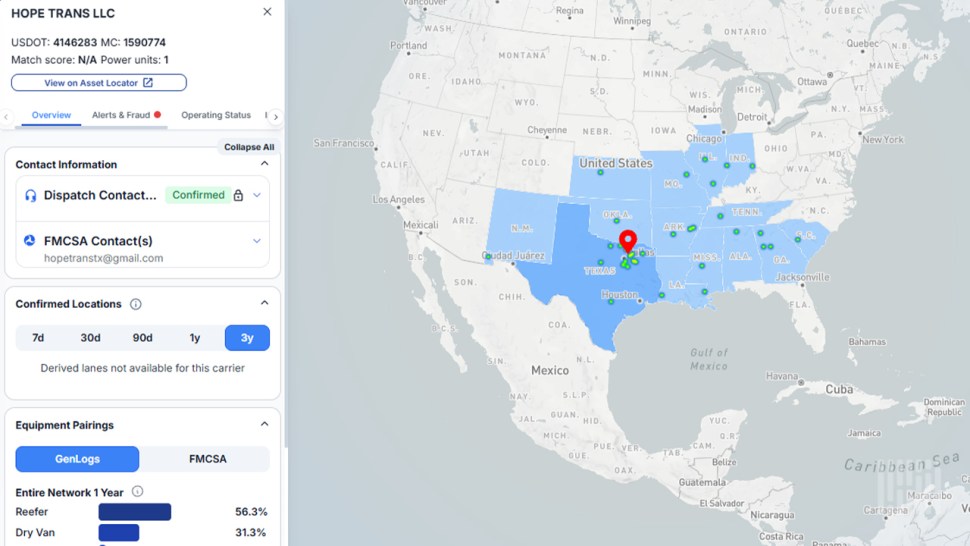
The company deploys a nationwide network of sensors, mounted on billboards, private facilities, ports, and roadside infrastructure, that captures real-time data on commercial vehicle movements. The system collects trillions of data points from millions of sensors and satellites, then applies proprietary AI to identify patterns.
A three-step privacy filter ensures only commercial vehicles are tracked: footage of private vehicles is deleted immediately, commercial markings like USDOT numbers are screened, and vehicle windows are blurred to prevent biometric identification.
Joyce calls the methodology “Find-Fix-Finish,” a term borrowed directly from counterterrorism operations.
The platform now collects more than 50,000 truck images every five minutes. GenLogs has amassed over a billion records of truck location data spanning two years. Since November 2024, the company has identified 264,743 carriers through its sensor network, nearly double the 136,836 carriers the Federal Motor Carrier Safety Administration inspected during the same period. GenLogs has recorded over 500 million unique truck detections, more than 100 times the FMCSA’s 367,920 truck inspections.
As of late January, the GenLogs sensor network had observed 13,029 carriers that had never had an FMCSA inspection.
The FMCSA Data Problem
In a few weeks, I’ll be on 60 Minutes discussing chameleon carriers, the shell companies that pop up after being shut down for safety violations, operating under new names with the same dangerous practices. What I’ve learned across nearly three decades of trucking compliance, carrier risk assessment, and highway crash litigation is that every investigation, every assessment, every decision about who moves freight comes down to one thing: data quality.
Right now, much of the data in the federal system isn’t quality.
The FMCSA maintains the primary regulatory database for interstate trucking. Brokers, shippers, insurers, and enforcement agencies rely on it to determine whether a carrier is legitimate, safe, and compliant.
Except that much of that data is self-attested or subjective. Officers are often listed as “Owner” or not named at all. We’ve seen names like “Mickey Mouse” in official filings. Mileage figures, driver counts, and vehicle totals are often inaccurate, making it nearly impossible to calculate meaningful safety metrics such as crashes per driver or incidents per vehicle mile traveled.
For enforcement agencies trying to prioritize inspections, this creates a targeting problem. With limited resources, how do you decide which carriers warrant scrutiny when the underlying data is unreliable? If you can’t trust the driver count, you can’t calculate crash rates per driver. If you can’t trust the mileage, you can’t calculate incidents per mile.
ELDs were intended to clarify hours-of-service compliance. Instead, we’ve discovered they can be manipulated, and supporting documents can be fabricated. The tools meant to create transparency have, in some cases, become new vectors for fraud.
The Legal Pressure on Brokers
The Supreme Court is currently hearing Montgomery v. Caribe Transport II, LLC, a case that could reshape broker liability nationwide. At issue is whether federal law preempts state-level negligent selection claims against brokers who hire carriers that cause crashes.
The case arose from a 2017 incident in Illinois where a truck operated by Caribe Transport, a carrier the plaintiff’s attorneys described as having a “remarkably poor safety record”, veered off the road and struck Shawn Montgomery’s parked truck, leaving him severely injured. The broker that hired Caribe was C.H. Robinson.
Oral arguments are scheduled for March 4. If the court rules that brokers can be held liable under state tort law for negligently selecting carriers, the industry’s vetting requirements will change overnight. Brokers will need to demonstrate due diligence beyond checking FMCSA records. They’ll need verifiable, objective evidence that the carrier they selected was legitimate and safe.
Whether brokers ultimately face expanded liability or not, the practical reality is clear: if you’re moving freight and something goes wrong, you’d better be able to prove you did your homework.
Don Everhart, head of partnerships and strategy at Transflo, put it bluntly: “Five years from now, there will be two types of freight brokers: those that use GenLogs and those that go out of business.”
The Visual Source of Truth
Here’s what makes GenLogs fundamentally different from every other vetting tool in the market: it’s not just aggregating data from FMCSA and other sources. It’s providing a visual, objective source of truth.
You can put your eyes on what this truck is actually doing. What this carrier is actually doing. Where they’ve been. When they last hauled freight. Whether they ever hauled freight. And if they did, for whom, when, and on what lanes?
This distinction matters because the entire freight ecosystem has been built on self-reported information. A carrier tells FMCSA how many trucks they operate. A carrier tells FMCSA how many miles they drive. A carrier informs the FMCSA of its officers. And everyone downstream, brokers, shippers, insurers, and enforcement agencies, makes decisions based on that self-attested information.
GenLogs flips that model. Instead of asking carriers what they claim to do, it shows you what they actually do.
The company says it has all FMCSA data, including BASICs and CSA scores, plus 3,000 percent more data on fleets extracted from its nationwide sensor network. Over 600 million truck images captured. Over 500 million unique truck detections. A historical record of where equipment has been, when, in what condition, and paired with what other equipment.
The Questions Visual Truth Can Answer
Think about the questions that matter when you’re deciding who moves your freight:
Is this carrier real? Not “do they have authority on paper”, do they actually have trucks on the road? GenLogs has identified more than 13,000 carriers that have never had an FMCSA inspection. Some of those are legitimate small operators flying under the radar. Some are shell companies that exist only to commit fraud.
Do their trucks match their claims? A carrier says they operate 50 trucks. How many have you actually seen? A carrier says they run the Northeast corridor. Have they ever been spotted west of the Mississippi? GenLogs can tell you.
What’s the condition of their equipment? You can see timestamped images of a carrier’s trucks. Are the trailers beat to hell? Are DOT numbers clearly displayed? Are there obvious maintenance issues visible from the roadside? This is information you cannot get from a database.
Did they actually pick up your load, or did someone else? Double brokering and freight fraud often involve one carrier accepting a load and then passing it to another carrier. With visual intelligence, you can verify whether the truck that showed up at the shipper’s dock matches the carrier you contracted with.
Where has this equipment been? Historical location data lets you see patterns. A carrier claims they primarily run regional routes in Texas. But their trucks keep showing up in California, Arizona, and Nevada. Maybe that’s fine. Maybe it’s a red flag. Either way, you can see it.
When did they last haul freight? A carrier with authority that hasn’t been spotted hauling in six months might be dormant or a target for identity theft. Criminals acquire or hijack inactive authorities because they have clean compliance histories.
Use Cases Across the Ecosystem
I see the applications extending far beyond broker due diligence.
Insurance Underwriting: Insurers can assess motor carrier risk with complete profiles, not just BASIC scores. They can detect chameleon carriers instantly by identifying equipment that operated under previous DOT numbers. They can confirm real-world fleet composition against policy declarations and catch HazMat haulers operating without proper coverage. GenLogs offers alert-based logic for chameleon carrier activity, hours-of-service violations, high-risk behavior, and carriers exceeding their preset operational radius.
Claims Mitigation: When a crash occurs, insurers can investigate incidents with timestamped images, inspection history, and violation patterns. They can see where a truck was in the hours and days before an incident. They can verify whether the equipment involved matches policy declarations.
Highway Crash Litigation: As an expert witness in trucking accident cases, I find visual evidence of a carrier’s operational history invaluable. You can demonstrate patterns of behavior, equipment condition over time, and whether a carrier’s actual operations matched their compliance filings.
Hours-of-Service Verification: ELDs can be manipulated. Supporting documents can be fabricated. But if a carrier’s ELD shows the truck was parked in Tulsa and GenLogs has a timestamped image of the truck rolling through Memphis, you have objective evidence of a violation. Cross-referencing sensor sightings with claimed locations creates accountability that doesn’t exist with self-reported data alone.
Cargo Recovery: Your freight gets stolen. You have closed-circuit surveillance footage showing a truck’s markings or plate. GenLogs can search its database to identify where the vehicle was specifically marked, where it was spotted after the theft, and help law enforcement track it down. Traditional license plate recognition only gets you so far; GenLogs captures unique markings on commercial vehicles that LPR systems miss.
Law Enforcement Investigations: Beyond cargo theft, the platform has been used to track vehicles involved in sex trafficking, narcotics smuggling, and even a fatal hit-and-run in Wyoming. The ability to identify trucking companies and vehicles undetectable by traditional LPR systems opens investigative possibilities that didn’t exist before.
Due Diligence for M&A: If you’re acquiring a trucking company, you can verify that its actual operations match its representations. How many trucks do they really operate? Where do they actually run? Are the assets they claim to own actually on the road?
Asset-Based Lending and Factoring: Before extending credit to a carrier, financial institutions can verify the equipment actually exists and is operational. A carrier seeking factoring services states it operates 20 trucks. How many have been spotted in the last 90 days?
Commercial Real Estate: Understanding traffic patterns helps with site selection for distribution centers, truck stops, and industrial facilities. Where are trucks actually moving? What lanes have the highest density?
Contract Disputes: A shipper claims a carrier failed to pick up a load on time. The carrier claims they were there. GenLogs can provide timestamped evidence of whether the truck was actually at the claimed location.
Compliance Auditing: When auditing a carrier’s supporting documents, bills of lading, fuel receipts, and delivery confirmations, you can cross-reference claimed locations with actual sensor sightings. Documents can be fabricated. Physical presence at a location cannot.
Shipper Security Programs: For C-TPAT certification, pharmaceutical supply chain security, or other programs requiring carrier vetting, visual verification provides documentation that self-reported data cannot.
Since launching a free investigative service in November 2024, GenLogs has recovered more than 400 stolen or misused trailers. In one case, state law enforcement used the platform to track a truck engaged in interstate sex trafficking and ultimately recovered a female minor. In another, a federal counter-narcotics agency uncovered a drug smuggling network, resulting in raids on multiple safehouses and a dozen arrests.
Doing the Right Thing, for Free
What separates GenLogs from most tech companies is how it uses its capabilities when there’s no revenue attached.
In November 2024, after five consecutive years of rising cargo theft and with limited law enforcement resources to investigate, GenLogs announced it would help recover stolen equipment for the entire transportation industry, for free. Any shipper, carrier, or broker can report a stolen or missing asset to GenLogs, and the company’s investigations team will track it down using its sensor network without charge.
“Enough is enough,” CEO Ryan Joyce declared when announcing the program. “GenLogs is on a righteous mission to remove the bad actors from our supply chain so that the good guys can flourish.”
The reasoning was straightforward: 95 percent of trucking companies in the United States operate 10 or fewer trucks. If an owner-operator has a truck or trailer stolen, their entire livelihood is at risk. Co-founder Blake Balch put it simply: “You never kick someone when they are down. GenLogs will provide help in their greatest time of need without asking for anything in return. It’s just the right thing to do.”
The free service isn’t limited to small operators. One trucking company recovered over 200 stolen or missing trailers within two months of joining the platform. Werner Enterprises’ VP of Maintenance Ben Murphy said the technology “provided us with an advanced tool for locating the needle in the haystack, helping our team identify who is using our trailer and improving recovery time.”
The results have gone beyond simple asset recovery.
At the FreightWaves F3 conference in Chattanooga, Joyce described a case GenLogs reported to the Los Angeles County Sheriff’s Department’s Cargo CATs unit: they had uncovered a syndicate where multiple carriers were working together to steal trailers. The investigation led to arrests and the recovery of stolen equipment.
In September 2025, GenLogs’ LE Connect team worked with the San Bernardino and Los Angeles County Sheriff’s Departments on a cargo theft case, providing live sensor and tracking data to officers in the field. That intelligence enabled law enforcement to track a stolen truck loaded with $1.4 million in Acer computers into Los Angeles County and ultimately to Compton, where detectives served a search warrant. Eight suspects were arrested. Officers also seized an AK-47, a Smith & Wesson 9mm handgun, seven stolen vehicles, including a semi-truck and 53-foot trailer, and nearly two pounds of methamphetamine.
In Wyoming, GenLogs flagged a truck allegedly involved in a fatal hit-and-run, providing investigative leads that traditional methods couldn’t generate.
For active thefts in progress, GenLogs software sends real-time alerts whenever the asset is detected anywhere across its network, from Los Angeles to New York, Minneapolis to Laredo. For historical investigations, timestamped photographic evidence provides the kind of documentation that holds up in court.
The law enforcement partnership has grown from one-off investigations to formal data-sharing agreements with federal and state agencies. GenLogs’ website now includes a dedicated law enforcement portal for agencies investigating commercial-vehicle-related crimes, including cargo theft, human trafficking, and narcotics smuggling.
Don Everhart, head of partnerships and strategy at Transflo, made a bolder prediction: “Five years from now, there will be two types of freight brokers: those that use GenLogs and those that went out of business.”
Financing Your Risk
The security ecosystem around freight is evolving in parallel with intelligence platforms like GenLogs.
Last year, Truck Parking Club and GenLogs announced a partnership connecting Truck Parking Club’s data on hundreds of thousands of commercial vehicles with GenLogs’ sensor network. The collaboration supports law enforcement investigations and enhances security at participating parking locations.
This layered approach to risk management matters. CargoNet’s data shows California remains the largest theft and fraud hotspot, followed by Texas, Illinois, and Florida. At the county level, San Bernardino County, Los Angeles County, and Shelby County, Tennessee, experience the highest concentrations of activity. Vehicle-related commodities, tires, automotive parts, and motor oil remain frequent targets, along with alcoholic beverages and power tools.
Financing your risk through secure, monitored parking is one piece of the puzzle. Vetting your carriers with visual verification is another. Neither alone is sufficient; together, they represent the kind of systemic defense the industry needs.
The Industry Context
The trucking industry exits 2025 bruised but not broken. ACT Research describes it as one of the longest and most difficult downcycles in recent history, characterized by weak freight demand, elevated operating costs, tariff-driven uncertainty, and prolonged margin pressure.
According to FMCSA data, the number of property carriers with operating authority fell by more than 11 percent between December 2022 and December 2025. Carrier attrition continues. Capacity is tightening. Analysts expect the supply-demand balance to improve gradually through 2026, with a more durable recovery increasingly likely in the second half of the year.
They create pressure, and pressure creates opportunity for bad actors. When legitimate carriers exit the market, their operating authorities sometimes end up in the hands of criminal enterprises seeking to exploit clean compliance histories. When margins compress, corners get cut. When enforcement resources are stretched thin, fraud flourishes.
CargoNet is already monitoring the potential ripple effects of heightened non-domiciled CDL enforcement. In 2025, FMCSA recorded more than 12,000 driver out-of-service violations tied to English proficiency, compared with just 14 combined in 2023 and 2024. Increased enforcement may reduce available capacity while expanding the pool of distressed carriers for sale, potentially creating new opportunities for fraudulent takeovers.
The criminals are adapting. The question is whether the industry will adapt faster.
The Investment Thesis
GenLogs raised $60 million this week because the market has decided that an incorruptible ground truth of nationwide trucking operations is worth building.
Marcus Ryu, the Battery Ventures general partner who joined GenLogs’ board, put it plainly: “In a remarkably short time, GenLogs has developed a novel data set of great commercial and prosocial value. Informed by their intelligence training, Ryan and his co-founders recognized that mission-critical work across industries could be transformed by an incorruptible ground truth of nationwide trucking operations.”
Current customers include J.B. Hunt, Werner Enterprises, AIPSO, the Jacksonville Port Authority, and NFI Integrated Logistics. David Broering, president of NFI Integrated Logistics, called the GenLogs Freight Intelligence Platform “one of the most indispensable tools our teams are using daily to discover shippers and carriers we hadn’t known about previously.”
The company plans to use the new funding to continue building out its sensor network,including expansion into Mexico and Canada,and extend capabilities to shippers, insurers, governments, and financial institutions.
Whether you’re a broker deciding who gets your customer’s freight, an insurer deciding who gets coverage, a shipper protecting your supply chain, or an enforcement agency trying to prioritize limited resources, the question is the same: How do you know what you need to know?
Subjective data can lie. Documents can be fabricated. Federal databases can be gamed.
Visual truth, captured by sensors, verified by AI, accumulated across billions of observations, cannot be faked at scale.
That’s why $60 million went into GenLogs this week. That’s why three former intelligence professionals traded tracking terrorists for tracking trucks. And that’s why everyone moving freight should be paying attention.
By the Numbers:
- $81 million, Total funding raised by GenLogs since 2023
- $3 trillion, Global freight trucking market value
- $906 billion, U.S. trucking industry revenue in 2024
- 11.27 billion tons, Freight moved by trucks in 2024
- $725 million, estimated cargo theft losses in 2025 (up 60% from 2024)
- $35 billion, estimated annual industry losses from fraud and theft combined
- $273,990, Average value per cargo theft in 2025 (up 36%)
- 3,594, Supply chain crime events recorded in 2025
- 2,646, Confirmed cargo theft incidents in 2025 (up 18%)
- 708, Food and beverage thefts in 2025 (up 47%)
- 77%, an increase in metal theft in 2025
- 600+ million, Truck images captured by GenLogs
- 500+ million, Unique truck detections recorded by GenLogs
- 15 million, Images captured by GenLogs sensors daily
- 3 billion, Total images in GenLogs repository
- 50,000+, Truck images captured every five minutes
- 3,000%, More fleet data than FMCSA alone (per GenLogs)
- 264,743, Carriers identified by GenLogs sensor network since November 2024
- 136,836, Carriers inspected by FMCSA during the same period
- 13,029, Carriers observed by GenLogs that have never had an FMCSA inspection
- 400+, Stolen or misused trailers recovered through GenLogs’ free investigative service
- 200+ Trailers recovered by one carrier within two months of joining the platform
- $1.4 million, Value of stolen computers recovered in a single September 2025 case
- 8, Suspects arrested in that investigation
- 12,000+, Driver out-of-service violations for English proficiency in 2025 (vs. 14 combined in 2023-2024)
- 11%+, Decline in property carriers with operating authority (Dec 2022–Dec 2025)
- 70%+, Share of U.S. freight moved by truck
- 95%, Percentage of U.S. trucking companies operating 10 or fewer trucks
- <$2,000, Cost to become a licensed broker or carrier
- <3 weeks, Time to be hauling freight after obtaining authority
Brokerage Compliance Symposium
The day before F3. Every compliance issue you face - fraud exposure, carrier liability, FMCSA rules, cargo theft, insurance gaps - navigated by attorneys and operators defining best practices in a changing industry.
F3 Awards Dinner
The night before F3. FreightTech100 companies honored. FreightTech 25 and Shipper of Choice winners revealed live. Cocktail reception into dinner and live music - 300 industry leaders in one purpose-built room.
F3: Future of Freight Festival
Industry-defining keynotes, rapid-fire technology demos, and industry leaders networking in experiences across Chattanooga - plus the inaugural F3 Awards Dinner featuring the FreightTech and Shipper of Choice reveals.
The day before F3. Every compliance issue you face - fraud exposure, carrier liability, FMCSA rules, cargo theft, insurance gaps - navigated by attorneys and operators defining best practices in a changing industry.
The Signal at Chattanooga Choo Choo • Chattanooga, TN Register NowThe night before F3. FreightTech100 companies honored. FreightTech 25 and Shipper of Choice winners revealed live. Cocktail reception into dinner and live music - 300 industry leaders in one purpose-built room.
The Signal at Chattanooga Choo Choo • Chattanooga, TN Register NowIndustry-defining keynotes, rapid-fire technology demos, and industry leaders networking in experiences across Chattanooga - plus the inaugural F3 Awards Dinner featuring the FreightTech and Shipper of Choice reveals.
The Signal at Chattanooga Choo Choo • Chattanooga, TN Register Now