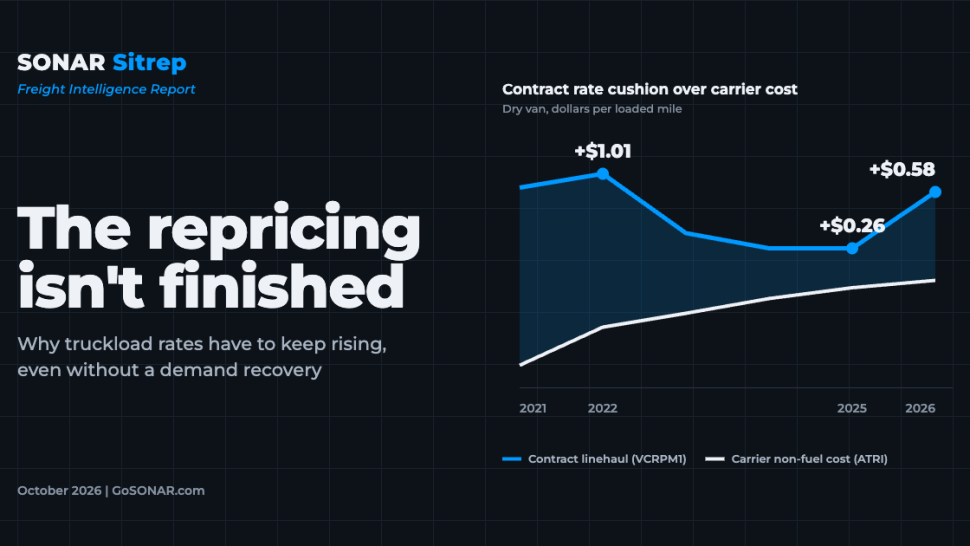
Truckload rates are rising in 2026 because trucks are leaving the market, not because freight is booming. Carriers spent three years hauling at rates that barely covered their costs, and in the spot market often didn’t. The 2026 increase is a correction, and SONAR’s new Sitrep, The Repricing Isn’t Finished, shows it is only about halfway done.
What does it cost to run a truck in 2026?
The American Transportation Research Institute’s 2026 Operational Costs of Trucking study puts the average cost of operating a truck at a record $2.336 per mile in 2025, up 3.4% from 2024. Excluding fuel, costs rose 4.2%, 1.5 points faster than inflation.
Nearly every cost line set a record. Tolls (+13.2%), repair and maintenance (+8.6%), driver benefits (+6.6%) and tires (+6.4%) led the increase. Early 2026 data shows insurance (+6.4%) and fuel (+5.9%) leading the next leg up, and SONAR’s diesel index (DTS) now sits at $6.38 a gallon.
How far did rates fall behind costs?
SONAR’s dry van contract linehaul rate (VCRPM1) averaged $2.81 a mile in 2022. By 2024 and 2025 it had fallen to $2.32, while truckload carriers’ non-fuel costs rose 30% from 2021 to 2025.
- In 2022, contract linehaul cleared non-fuel cost by about $1.01 per loaded mile.
- By 2025, that cushion had shrunk to $0.26.
- Spot linehaul (NTIL) sat below non-fuel cost every year from 2023 through 2025.
In Q3 2026, contract linehaul averaged $2.69. That is still below Q4 2021 and has rebuilt only about half the cushion carriers had in 2022.
If demand is flat, why are rates rising?
Capacity is leaving faster than freight. SONAR’s tender rejection index (STRI) is up 268% since October 2023, while tender volume (STVI) is up about 9%. For-hire tractor counts fell by about 51,000 in a single month, and ATRI found carriers cut effective capacity 5.5% in 2025. ATRI calls this a supply-side recovery, and SONAR’s data agrees.
Why can’t carriers just run more miles?
The Sitrep models a typical dry van truck at Q3 2026 benchmark rates. It covers its marginal costs but contributes only about 15% of revenue toward overhead, against roughly 26% that ATRI’s truckload carriers needed in 2025. Closing the gap takes rates about 14% higher. Even running near the hours-of-service ceiling, the truck still falls about 5% short.
That is why rates have to rise before carriers can responsibly add trucks. Capacity added at today’s rates would finance new equipment on margins that don’t yet cover overhead.
What’s inside the full Sitrep
The full report goes further, with:
- A mode-by-mode breakdown showing why reefer contract rates are furthest behind the market.
- Market-level rejection data showing where carriers are already repricing.
- A Chicago-to-Atlanta lane analysis with SONAR’s projection into 2027.
- An interactive calculator that tests contract/spot mix, miles, diesel and deadhead against carrier costs.
- Takeaways for shippers, carriers and brokers heading into 2027 bids.
All SONAR Sitreps and the data cited to support them can be found in the SONAR platform. Request a demo. Sitreps are also available with a subscription to FreightWaves Market Monitor. Get more info at getfreightdata.com.
Frequently asked questions
Why are truckload rates going up in 2026? Capacity is leaving the market faster than freight. Tender rejections have nearly quadrupled since late 2023 while volume is up only modestly, so fewer trucks are competing for roughly the same freight.
What is the cost of operating a truck per mile? ATRI’s 2026 study puts the 2025 average at $2.336 per mile, or $1.854 excluding fuel. Truckload carriers averaged $2.21 per mile.
Are trucking rates high right now? Not relative to costs. Dry van contract linehaul averaged $2.69 a mile in Q3 2026, below Q4 2021 levels, while carriers’ non-fuel costs are about 30% higher than in 2021.
Will truckload rates keep rising? The math says they need to. At benchmark rates, a typical dry van truck needs roughly 14% more to cover overhead, and SONAR’s lane projection for Chicago to Atlanta shows rates holding near current levels into 2027.
What is a tender rejection rate? It is the share of contracted loads that carriers turn down. SONAR’s STRI tracks it daily; a rising rate means carriers have better options than their contracted freight.
Sources: SONAR (VCRPM1, NTIL, NTI, STRI, STVI, DTS, TCFH); ATRI, Analysis of the Operational Costs of Trucking: 2026 Update (July 2026).
Brokerage Compliance Symposium
The day before F3. Every compliance issue you face - fraud exposure, carrier liability, FMCSA rules, cargo theft, insurance gaps - navigated by attorneys and operators defining best practices in a changing industry.
F3 Awards Dinner
The night before F3. FreightTech100 companies honored. FreightTech 25 and Shipper of Choice winners revealed live. Cocktail reception into dinner and live music - 300 industry leaders in one purpose-built room.
F3: Future of Freight Festival
Industry-defining keynotes, rapid-fire technology demos, and industry leaders networking in experiences across Chattanooga - plus the inaugural F3 Awards Dinner featuring the FreightTech and Shipper of Choice reveals.
The day before F3. Every compliance issue you face - fraud exposure, carrier liability, FMCSA rules, cargo theft, insurance gaps - navigated by attorneys and operators defining best practices in a changing industry.
The Signal at Chattanooga Choo Choo • Chattanooga, TN Register NowThe night before F3. FreightTech100 companies honored. FreightTech 25 and Shipper of Choice winners revealed live. Cocktail reception into dinner and live music - 300 industry leaders in one purpose-built room.
The Signal at Chattanooga Choo Choo • Chattanooga, TN Register NowIndustry-defining keynotes, rapid-fire technology demos, and industry leaders networking in experiences across Chattanooga - plus the inaugural F3 Awards Dinner featuring the FreightTech and Shipper of Choice reveals.
The Signal at Chattanooga Choo Choo • Chattanooga, TN Register Now