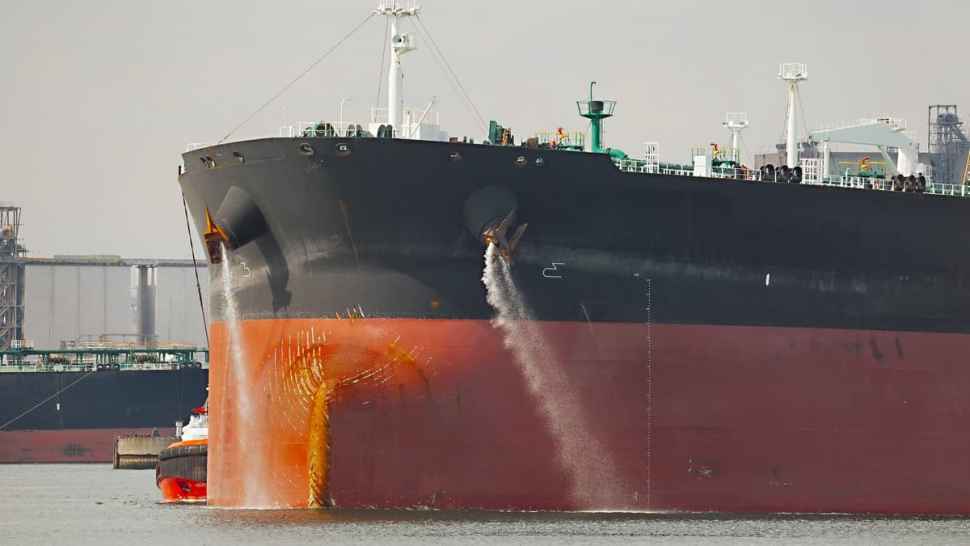
Panic drove crude-tanker rates up, very briefly, to mind-bogglingly high assessed levels of around $300,000 per day. Now, the fear factor has been contained. Charterers of very large crude carriers (VLCCs, tankers that carry 2 million barrels of crude) have said “enough” and are holding firm against sky-high prices. Rates, while still very high, are rapidly falling back.
According to assessments of VLCC spot rates issued by Clarksons Platou Securities, rates peaked on Oct. 11 at an average of $295,100 per day, fell slightly to $281,000 day on Oct. 14, then took a big dive – down 31% – to $194,900 per day on Oct. 15. According to just-posted fixture reports, they’ve now fallen lower still.
“Several fixtures failed to conclude yesterday evening [Oct. 15] as charterers push back on the high rate levels,” said Clarksons Platou Securities analyst Frode Mørkedal.
He continued, “The FFA [freight futures] curve is pricing November and December contracts at around $80,000 per day. Rates are thus expected to come materially down from inflationary levels, although we expect rates to stabilize in a strong range of $70,000-80,000 per day towards the end of the fourth quarter of 2019 and into the first quarter of 2020.”
Spot cargo deals are publicly posted by the Tankers International commercial pool via its free VLCC Fixtures app, which market participants and investors have been obsessively glued to for the past several days. On Oct. 15, VLCC Fixtures reported a deal “on subjects” (meaning that it has been agreed but not finalized) from West Africa to China at $206,237 per day, and a voyage from the Middle East to West India at $210,505 per day. On Oct. 16, a significantly lower rate was reported to be on subjects: $124,727 per day from the Middle East to China.
As of Oct. 16, VLCC Fixtures cited nine agreements that had been on subjects since Oct. 10 that have now been recategorized as “failed,” meaning that the preliminary agreements have been canceled. Among the fixtures now listed as “failed” is the one that made the headlines: the proposed $301,219 per day voyage charter of the VLCC Ingrid.
The rise of crude tanker rates …
The rise and fall of VLCC rates was a key focus at the shipping finance forum held in New York City on Oct. 15 by investor relations and advisory firm Capital Link. The Capital Link event brought together some of the top executives of public and private tanker companies, as well as the analysts who cover them.
Bob Burke, CEO of privately held Ridgebury Tankers, told attendees how a confluence of recent events pushed rates to exorbitant levels.
“All of these things we’ve seen happen have been accretive. The COSCO situation [the U.S. sanctions against a COSCO subsidiary] was really helpful. It was that last thing that sent things over the top and made the market really go. But it’s all part of a series – what’s happening in the Middle East, the scrubber installations, the restocking [of crude supplies] – it’s all of these things together.”
Lois Zabrocky, CEO of International Seaways (NYSE: INSW), added, “It also happened because the difference in demand between the third and fourth quarter is dramatic. The third quarter always has the lowest demand of the year. And you had all of those things like the COSCO sanctions – and then the decision by Exxon [and Unipec] to not charter any ships that had been to Venezuela in the past 12 months – all happening just as demand increased, which drove up the rates.”
According to Brian Gallagher, head of investor relations for Euronav (NYSE: EURN), “This all hasn’t come out of the clear blue sky. Yes, these events [COSCO sanctions, Middle East unrest, etc.] have been shocking, but remember, the base load of the market had already been pretty firm. These are short-term cumulative effects on top of what was a pretty good market anyway.”
… and the inevitable fall (and possible bounce back)
Speakers at the Capital Link forum also explained how and why the rates are falling back. According to Burke, “All of these issues created inefficiencies in the system. People don’t want ships for different reasons. They don’t want to fix ships over 15 years old. They don’t want ships on the Exxon and Unipec lists. And when the number of ships available for any one fixtures decreases, the market pops up.
“But if you squeeze in a couple of voyages at these rates, what happens is that all of a sudden, charterers find other ways [to move the oil] and they start accepting ships they didn’t accept last week,” said Burke. “People are not going to spend that much to move oil around the world. It doesn’t work that way, so the market comes back to Earth.”
Nicolay Dyvik, head of shipping research at DVB Markets, believes that the question is not whether VLCC rates will fall back, but where they’ll trough after they do. Gallagher believes rates will trough at $70,000-100,000 per day this quarter “and then go up again.”
Burke didn’t venture a guess, but he did emphasize that the market remains extremely sensitive to external shocks. “All it needs is one more little thing and the VLCC market will go back up again,” he affirmed.
Apostolos Tsitsirakis, corporate strategy director of Tsakos Energy Navigation (NYSE: TNP), said that it was more important to focus on the one-year time-charter rates than spot voyage rates. “We have seen a substantial increase in the one-year charter rate, to $65,000-70,000 per day for a ‘eco’ VLCC with no scrubber. If we see a number of transactions at this level, I think this market has legs.”
“Right now, rates are rocketing around like [the monitor signals on] a defibrillator,” added Zabrocky. “What you saw yesterday is not what you’re going to see when you run your numbers today. We’d like to see a steady, more sustained market – and I think we will.”
The upside of more modest gains
What’s lost in the clamor of headlines on $300,000-a-day rates is that if rates stabilize at $60,000-70,000 a day – less than a quarter of their recently assessed peak – it would be highly profitable for tanker owners. Today, this scenario seems relatively modest and eminently possible; six months ago, it seemed like wishful thinking.
During a conference call with analysts back on May 8, Trygve Munthe, co-CEO of DHT Holdings (NYSE: DHT), said that his company’s first-quarter average rate of $35,000 per day was “an acceptable rate, not a great rate, but even in that market, the company delivered $22 million of net income or $0.16 per share.”
“Running rate sensitivities on DHT is very simple, as we only have VLCCs. An increase in rates of $10,000 per day means $90 million in increased cash per year. To bring this down to an earnings-per-share level, if we get rates in the mid-$60,000s, which we saw in 2015, we should generate [full-year] earnings of not too far from $2.50 per share. That’s a big number.” More FreightWaves/American Shipper articles by Greg Miller
Brokerage Compliance Symposium
The day before F3. Every compliance issue you face - fraud exposure, carrier liability, FMCSA rules, cargo theft, insurance gaps - navigated by attorneys and operators defining best practices in a changing industry.
F3 Awards Dinner
The night before F3. FreightTech100 companies honored. FreightTech 25 and Shipper of Choice winners revealed live. Cocktail reception into dinner and live music - 300 industry leaders in one purpose-built room.
F3: Future of Freight Festival
Industry-defining keynotes, rapid-fire technology demos, and industry leaders networking in experiences across Chattanooga - plus the inaugural F3 Awards Dinner featuring the FreightTech and Shipper of Choice reveals.
The day before F3. Every compliance issue you face - fraud exposure, carrier liability, FMCSA rules, cargo theft, insurance gaps - navigated by attorneys and operators defining best practices in a changing industry.
The Signal at Chattanooga Choo Choo • Chattanooga, TN Register NowThe night before F3. FreightTech100 companies honored. FreightTech 25 and Shipper of Choice winners revealed live. Cocktail reception into dinner and live music - 300 industry leaders in one purpose-built room.
The Signal at Chattanooga Choo Choo • Chattanooga, TN Register NowIndustry-defining keynotes, rapid-fire technology demos, and industry leaders networking in experiences across Chattanooga - plus the inaugural F3 Awards Dinner featuring the FreightTech and Shipper of Choice reveals.
The Signal at Chattanooga Choo Choo • Chattanooga, TN Register Now