




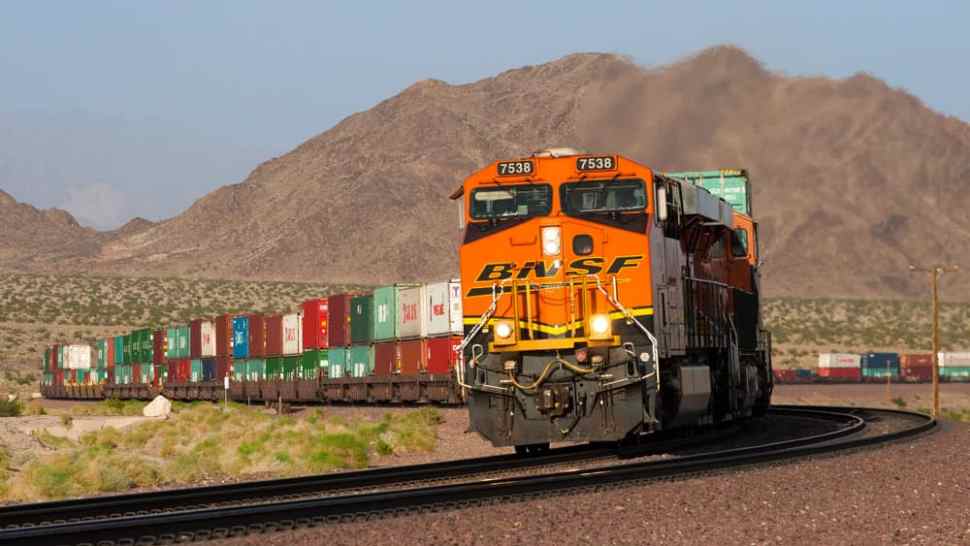
Railroads are the most efficient transportation mode for moving goods on the earth’s surface. Railroads are of particular importance for the movement of commodities that heavy and moved in bulk over long distances where the transportation spend represents a large portion of the total delivered cost. Just a few examples of commodities moved by railroad are coal, grain, fertilizer, chemicals, forest products, finished motor vehicles and metals, among many others. The railroads are no longer in the business of moving passengers, but approximately 70% of the miles that Amtrak runs travel over track owned by the freight railroads for a fee.
What advantages do railroads have as compared to other transportation modes?
Compared to truck, railroads are less expensive but also typically represent a lower level of service. In the railroad revenue segment that is most competitive with trucking (i.e., intermodal), shipments via railroad are typically priced at a 10%-15% discount as compared to trucking. On shipment of goods that are less competitive with trucking, the difference in rates can be much higher, or the trucking industry may be unable to profitably compete for the freight entirely.
Compared to transportation by barge on the inland waterway, railroads are a higher-cost, but a faster option. For many bulk railroad commodities that are less time-sensitive, such as grain, shipment via lower-cost barge would be preferable, but the constraint is the lack of a waterway in the needed location.
What do railroads haul?
Railroads haul a wide range of bulk commodities, chemicals, finished motor vehicles and intermodal containers, roughly approximated in the chart below. It is important to note that while intermodal units represent approximately half of railroad unit volume, intermodal represents roughly one-quarter of railroad revenue (shown below 20% in the chart below because some intermodal freight is captured in other categories). The railroads’ revenue per unit is lower for intermodal than carload traffic because one intermodal unit carries less tonnage than a carload and is also more competitive with the highway.
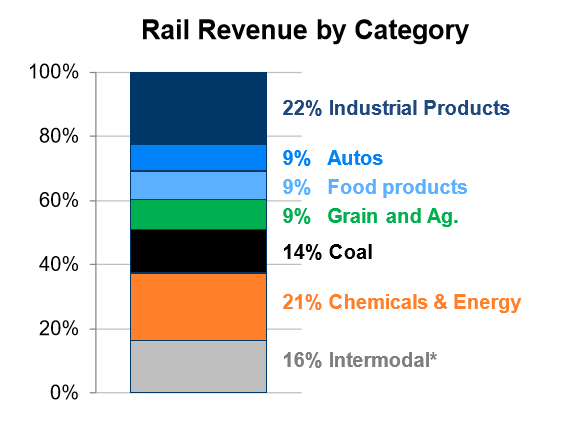
Source: Stifel Financial
How are railroads regulated?
The railroads were economically deregulated by the Staggers Act of 1980. The Staggers Act enabled the railroads to set rates determined by market conditions rather than by any collective rate-making structure. The railroads became free to ask for rates that they believed reflected market conditions provided that no alternative in the marketplace existed. The Staggers Act also allowed the railroads to abandon unused or less used rail lines which were important because of the capital-intensive nature of keeping railroad track maintained to adequate safety standards. The railroads remain economically deregulated (meaning they have the right to set rates) but are under the regulatory purview of the Surface Transportation Board (STB) of the U.S. Department of Transportation, the current iteration of what was formerly called the Interstate Commerce Commission. In lieu of oversight by the Department of Justice, the STB must approve all mergers and acquisitions and is responsible for overseeing rate cases that shippers bring against railroads where there is an accusation of abuse of market power.
Brokerage Compliance Symposium
The day before F3. Every compliance issue you face - fraud exposure, carrier liability, FMCSA rules, cargo theft, insurance gaps - navigated by attorneys and operators defining best practices in a changing industry.
F3 Awards Dinner
The night before F3. FreightTech100 companies honored. FreightTech 25 and Shipper of Choice winners revealed live. Cocktail reception into dinner and live music - 300 industry leaders in one purpose-built room.
F3: Future of Freight Festival
Industry-defining keynotes, rapid-fire technology demos, and industry leaders networking in experiences across Chattanooga - plus the inaugural F3 Awards Dinner featuring the FreightTech and Shipper of Choice reveals.
The day before F3. Every compliance issue you face - fraud exposure, carrier liability, FMCSA rules, cargo theft, insurance gaps - navigated by attorneys and operators defining best practices in a changing industry.
The Signal at Chattanooga Choo Choo • Chattanooga, TN Register NowThe night before F3. FreightTech100 companies honored. FreightTech 25 and Shipper of Choice winners revealed live. Cocktail reception into dinner and live music - 300 industry leaders in one purpose-built room.
The Signal at Chattanooga Choo Choo • Chattanooga, TN Register NowIndustry-defining keynotes, rapid-fire technology demos, and industry leaders networking in experiences across Chattanooga - plus the inaugural F3 Awards Dinner featuring the FreightTech and Shipper of Choice reveals.
The Signal at Chattanooga Choo Choo • Chattanooga, TN Register Now