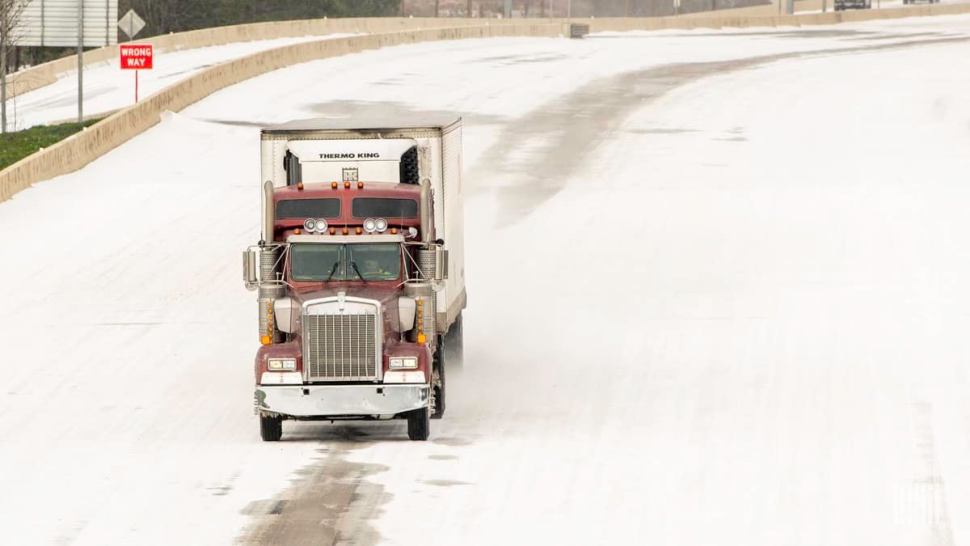
Just as Pat Riley trademarked the term “three-peat,” I’m considering trademarking “coin flip compliance.” That’s the state of the reefer market today with reefer carriers rejecting 50.3% of tendered loads, up from 40% in early February and up from 10% at this time last year. So, as concerning as tight transportation markets are for shippers that don’t need temperature controls, those that do are in far worse shape. That includes companies in food/beverage/cosmetics/pharma. In today’s The Stockout CPG-focused newsletter, I break down that 50.3% reefer tender rejection rate to let you know where the pain is most acute for shippers, in hopes that it will help you better manage your supply chain.
Reefer carriers are rejecting one out of two tendered loads while dry van carriers are rejecting about one tendered load out of four.

(Chart: FreightWaves SONAR. The white line shows the U.S. reefer outbound tender rejection rate, and the green line shows the U.S. dry van tender rejection rate.)
Darker blue = tighter reefer market
Carriers are rejecting a majority of reefer tenders throughout much of the Central time zone. While the winter storm in late February had the greatest impact in the central region, the West Coast has seen some of the largest increases in tender rejection rates due more to supply constraints than an early harvest. For instance, Ontario, California, (yellow marker in map below) has a reefer outbound tender rejection rate of 54.6%, and Jacksonville, Florida, has a reefer outbound tender rejection rate of 43.9%.

(Chart: FreightWaves SONAR. The darker blue areas are regions with higher reefer tender rejection rates, as shown in the key above.)
The Northeast, a backhaul region, is the only region of the U.S. where reefer carriers are rejecting fewer than 40% of tendered loads.

(Chart: FreightWaves SONAR. The nonbold numbers are the outbound tender rejection rates by region; the bolded percentages show the percent change in outbound tender rejection rate in the past month.)
As CPG companies are well aware, tight reefer markets are translating to higher reefer rates. Reefer spot rates are up 65% y/y to $3.86, including fuel surcharges, according to Truckstop.com data.

(Chart: FreightWaves SONAR. The white line shows the weekly Truckstop.com spot rate during the past year (2020-2021,) and the green line shows that data series for the 12 months prior (2019-2020).)
It’s easy to see why tender rejection rates are above 50% with reefer spot rates so far above reefer contract rates, on average. The Truckstop.com spot rates (white line) and the reefer contract rates (purple line) are further apart than they would be if they both included fuel surcharges. (Truckstop does and the contract rates do not.) But, while the comparison in the chart below is not truly apples to apples, the important point is that the gap between those two datasets has risen to new highs.
Shippers should, therefore, expect a difficult spring season for contract negotiations with carriers looking to bring contract rates up closer to spot rates. As Randy Marten, CEO of Marten Transportation, a major reefer carrier, put it, “We have been increasing and will continue to increase the compensation for our premium services within the tight freight market.”

(Chart: FreightWaves SONAR. The white line shows the weekly Truckstop.com spot rate during the past year (2020-2021), including fuel surcharges, and the purple line shows reefer contract rates, not including fuel and accessorials.)
Reefer carriers’ performance has improved amid the tight market backdrop. The SONAR charts below show how the tight market for refrigerated transportation has translated into improvement in carriers’ operating and financial performance. There is only one public “pure play” publicly traded reefer carrier (Marten Transportation) so, to get a more complete view of carriers’ performance, I review data from a benchmarking consortium of Truckload Carriers Association (TCA) members that is contained in the SONAR charts below.
Reefer carriers have taken advantage of the tight reefer market by improving their freight selection to focus on loads that are highly rated, keep their equipment moving and eliminate out-of-route miles. The impact of that can be seen in the charts below, which show revenue per driver per week for reefer carriers rising to late-2018 levels (below-left).
Operating ratios for reefer carriers favorably dropped from 98.4% in December to 94.9% in January, which is nearly as low as it was at any point during 2020 and, in January 2020, the reefer operating ratio was 98.3%. So, clearly, reefer carriers are performing better than what is typical for this time of year.

(Chart: FreightWaves SONAR. The left chart shows revenue per driver per week for reefer carriers, and the chart on the right shows consolidated reefer operating ratios.)
What these datasets show, in short, is that refrigerated shippers in some locations are experiencing a tighter market than others and shippers need to make themselves preferred shippers, not just with rates, but also by helping carriers reduce downtime and out-of-route miles. Reefer carriers have options and reefer shippers will have to take steps to be on the right side of the compliance coin flip.
What’s your perspective from the field — is the reefer market really as challenging for CPG companies as it appears to me? Need more detail on a specific reefer freight market? Let me know at mbaudendistel@www.freightwaves.com.
If you would like to receive The Stockout CPG-focused newsletter, please join us here: https://web.www.freightwaves.com/thestockout
For information on SONAR or to request a demo, please click here.
Brokerage Compliance Symposium
The day before F3. Every compliance issue you face - fraud exposure, carrier liability, FMCSA rules, cargo theft, insurance gaps - navigated by attorneys and operators defining best practices in a changing industry.
F3 Awards Dinner
The night before F3. FreightTech100 companies honored. FreightTech 25 and Shipper of Choice winners revealed live. Cocktail reception into dinner and live music - 300 industry leaders in one purpose-built room.
F3: Future of Freight Festival
Industry-defining keynotes, rapid-fire technology demos, and industry leaders networking in experiences across Chattanooga - plus the inaugural F3 Awards Dinner featuring the FreightTech and Shipper of Choice reveals.
The day before F3. Every compliance issue you face - fraud exposure, carrier liability, FMCSA rules, cargo theft, insurance gaps - navigated by attorneys and operators defining best practices in a changing industry.
The Signal at Chattanooga Choo Choo • Chattanooga, TN Register NowThe night before F3. FreightTech100 companies honored. FreightTech 25 and Shipper of Choice winners revealed live. Cocktail reception into dinner and live music - 300 industry leaders in one purpose-built room.
The Signal at Chattanooga Choo Choo • Chattanooga, TN Register NowIndustry-defining keynotes, rapid-fire technology demos, and industry leaders networking in experiences across Chattanooga - plus the inaugural F3 Awards Dinner featuring the FreightTech and Shipper of Choice reveals.
The Signal at Chattanooga Choo Choo • Chattanooga, TN Register Now