






Rail networks brace for severe weather
As you are aware, a major winter storm is forecast to impact the south-central and eastern U.S. late this week – regions that are generally less equipped to handle severe winter weather. As the National Weather Service describes it, “an expansive winter storm will start Friday in the Southern Rockies/Plains and Mid-South.” The resulting ice, […]

Container Atlas gets granular
Last week, SONAR released a new dashboard within the Container Atlas application, titled Maritime Trade Console. This is the latest of the dashboards added to SONAR and, like the others, is intended to enhance SONAR’s usability and is powered by Google Looker. It includes details on ocean data that haven’t been released elsewhere, as bookings […]
SONAR adds intermodal savings rates
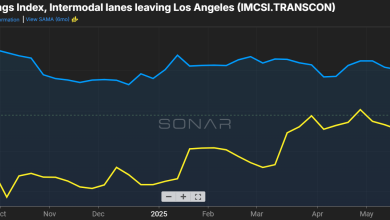
Building upon SONAR intermodal and dry van contract rate data already available in the platform, as of today, intermodal savings rates are now included in SONAR, as a national average, for 63 individual lanes, and two indices. The LA to Dallas lane is competitive between truckload and intermodal with a 9% average intermodal savings rate. […]

Shippers called the first half better than carriers
Echo surveyed 5,000 carriers and shippers on the freight market On Tuesday, Echo and FreightWaves co-hosted a webinar that featured Sean Burke, Echo chief commercial officer, and Jay Gustafson, Echo executive vice president of brokerage operations. The presentation discussed the results of a survey conducted at the end of last year, with more than 5,000 […]
TACO in container ship data
Ocean carriers are maintaining pricing power This chart of ocean spot rates has moved in a manner similar to stock market averages. (Chart: SONAR) By now, most of us have seen memes about a new and creative way to say “Buy the dip,” which is, of course, Trump Always Chickens Out, or TACO. In addition […]

Trade War Command Center quantifies import turmoil
‘Air pocket’ makes its way to port and intermodal volume SONAR Trade War Command Center In April, numerous U.S. ports set records for import volume. The SONAR Trade War Command Center application shows expected steep month-over-month declines in import volumes based on a 14-day moving average of bookings by date of departure. Most notably, volume […]

Loose Southern California truck market set to get looser
Carriers in port cities brace for ‘air pocket’ The Los Angeles outbound tender rejection rate is only 2% compared to the national tender rejection rate of 5.4%. (Chart: SONAR) Import volume remained strong in April, as FreightWaves described, with imports up 1.2% from March and 9.1% year over year. Going forward, a major drop-off in […]
Ocean carriers blank sailings as bookings drop
Ocean rejection rates spike as bookings fall (Chart: SONAR Container Atlas) Much of the focus the past several days has been on the drop in ocean bookings from China to the U.S., and with good reason. The SONAR Ocean Booking Volume Index from China to the U.S. is now down about 50% year over year, […]

Freight industry braces for drop in demand
Tender volume takes a dive Tender volume, a measure of how often shippers request carriers to move loads, has trended down in recent days. (Chart: SONAR) Up until the past few days, for all the turmoil in trade policy and the financial markets, SONAR had not been showing much change in freight demand, as measured […]
As recession fears grow, so do expectations of plunging freight demand
Imports may fall sharply in second half Port of Los Angeles Executive Director Gene Seroka said he expects at least a 10% year-over-year drop in container volume at the port in the second half. I found that to be especially noteworthy because his comments seemed to be a departure from his more bullish remarks in […]
Shippers opt for lower-cost, slower services
Reflecting the tariff pull-forward, rail intermodal takes share from truckload.

Flatbed market anything but flat
Fears of tariffs on lumber, other goods drive flatbed rejection rates to 3-year high.

Fear of more tariffs prolongs retail pull-forward
Trade group says stores continue to import as much merchandise as possible.

Is a freight market turn coming in May?
Amid uncertain demand, capacity continues to exit.

Tariffs in 7 SONAR charts
Impact of levies seen in Canadian trucking, US imports, warehousing and intermodal.
Are low February freight volumes more than seasonality?
Freight volume has been weak this month Tender volume, which counts how often shippers request that carriers pick up loads, has shown weakness this month. (Chart: SONAR) The Outbound Tender Volume Index (OTVI – above) is the SONAR chart that stands out the most to me this week. It measures the volume of requests from […]

Another year of stagnant intermodal pricing?
Freight market not tightening in time for bid season.
Will ocean rates collapse?
Demand is being pulled forward, ships are being built, and the Red Sea may reopen.
FreightWaves fulfills duty to cover tariffs
Articles and shows describe potential impact to numerous industries.
Freight markets improve slower than carriers would like
Spot rates rise, but inflection yet to take hold.