





The retail sector has been subject to quite a bit of volatility over the past couple of quarters, with hurricanes, snowstorms, a booming holiday season, and the ensuing spending hangover causing wild swings in performance.
Retail spending overall enjoyed one of the strongest quarters of growth since the recession in the 4th quarter of 2017, rising at an impressive 10.4% annualized pace. This was promptly followed with one of the worst quarters of growth during the 1st quarter, where sales advanced at a 0.8% pace. Real consumer spending on goods, adjusted for inflation, actually fell for the first time in nearly seven years at the start of 2018 after experiencing the strongest growth in over a decade in the previous period.
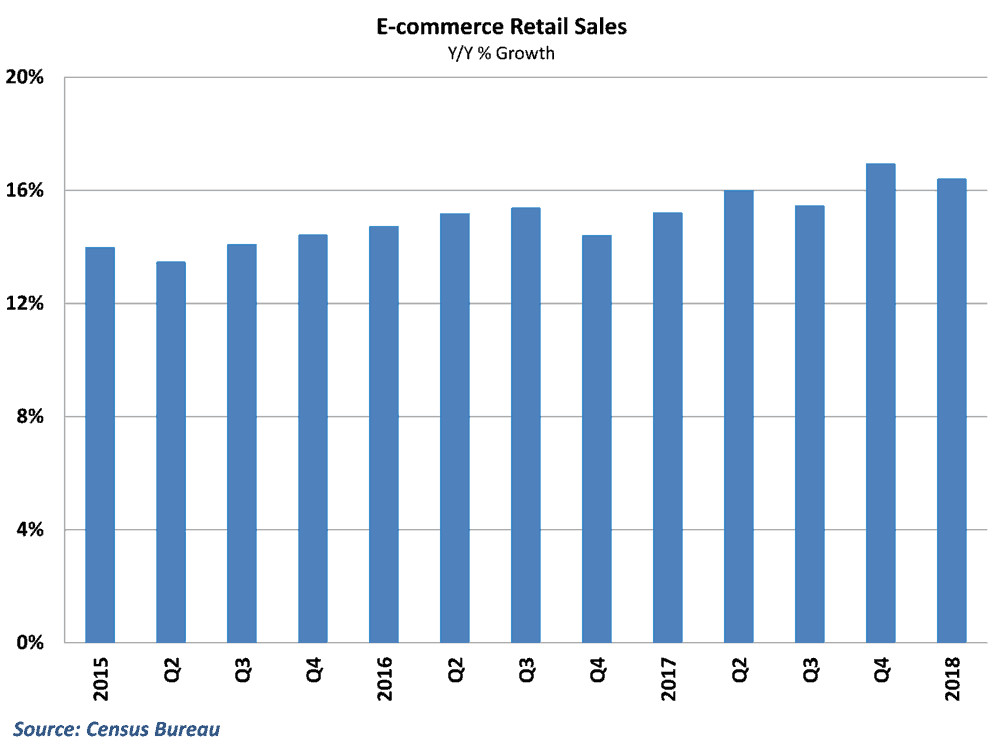
Despite the fluctuations in overall retail performance, e-commerce growth has been remarkably steady. The Census Bureau reported yesterday that e-commerce retail sales grew at a whopping 16.7% annualized pace during the 1st quarter, putting e-commerce sales at 16.4% higher than at this point last year. E-commerce now makes up 9.5% of total retail spending, and continues to make rapid share gains in the retail space.
Part of the reason for this resilience in e-commerce spending is that many of the factors that can derail total retail spending, such as major weather events, can actually push additional spending into online channels. Households may find themselves snowed-in during a massive winter storm, spending time purchasing what they can online even though. That certainly helps explain some of the results during the 1st quarter, as unusually harsh winter weather events occurred all the way until the end of the quarter.
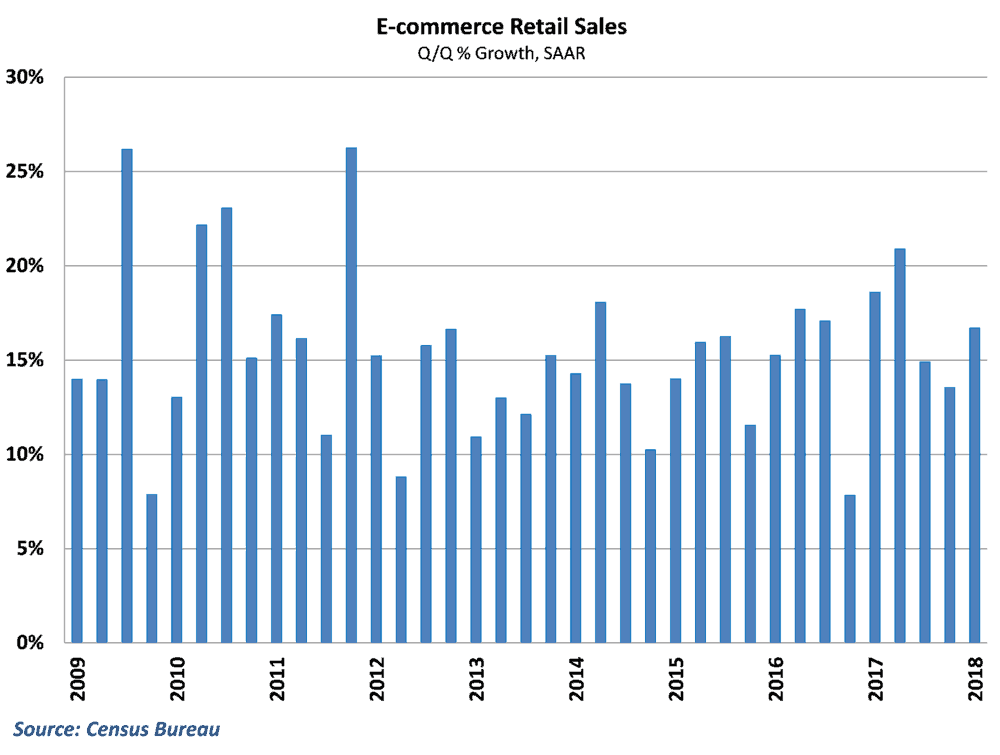
But the experience over the past couple of quarter is only part of a much broader trend. Consider that since the recession ended, e-commerce sales have yet to experience a single quarter of decline. The annualized pace of growth in e-commerce has only fallen below 10% three times. Through tax law changes, gas price surges, debt ceiling crises, government shutdowns, and strengthening and weakening currency, few things can be counted on more reliably that double-digit growth in e-commerce.
Driving transportation demand
Companies are always in search of markets and sectors of the economy that grow faster than the economy overall. For years, transportation companies benefitted from rising globalization in the world economy, as international trade growth consistently outpaced global economic growth. But trade growth has been far more erratic over the past couple of years, and protectionist rhetoric and policy moves have been on the rise, leaving no guarantee that international trade will be the driver of volume growth in the future that it had been in the past. E-commerce trends appear to be resistant to these fluctuations as well, as cross-border and international online shopping remains one of the strongest growth areas in global trade.
What this means is that businesses that utilize and develop useful e-commerce strategies can effectively find a source of revenue growth, even as conditions in the overall economy change from year to year. This fact is not lost on carriers and transportation companies in the economy. Parcel companies such as UPS and FedEx have long enjoyed healthy volume growth, as surging residential package growth has driven overall parcel demand well beyond the pace of economic growth. It is one of the reasons why DHL, who once essentially abandoned the US market, is pushing for new solutions for US residential deliveries, and why Maersk is looking to expand into the last-mile parcel delivery space.
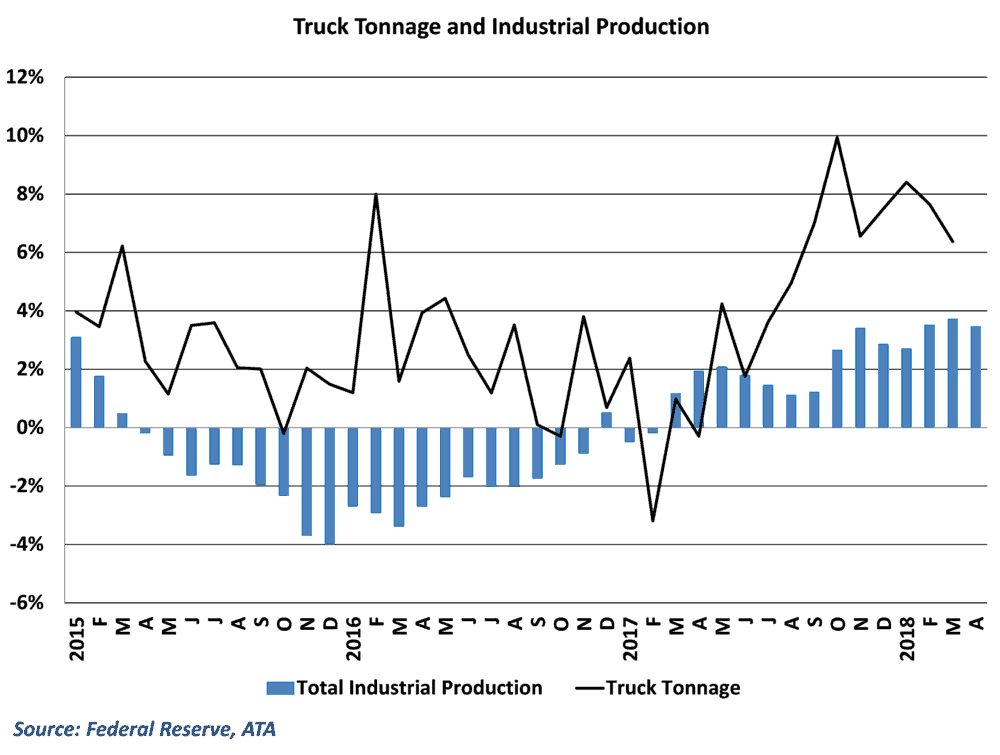
Trucking and LTL companies have also benefited from the surge in e-commerce demand. The desire for retailers to locate closer to end consumers has expanded distribution networks across the country, and increased the amount of freight movements in the economy. These kinds of movements helped sustain tonnage in the economy during 2015 and 2016, even as the industrial sector of the economy suffered significant losses, as carriers benefited from the spillover effects of e-commerce logistics.
In addition, trucking and LTL companies have increasingly gotten involved in last-mile delivery services. As e-commerce has grown, so have the categories of goods that get purchased through online channels. Large items such as furniture and appliances are now routinely ordered online, and LTL and freight companies have pushed to enhance their residential delivery capabilities. UPS is reportedly in talks to expand their services to include larger items, and it is a sure bet that its competitors will soon follow suit.
These kinds of developments are likely to continue going forward, as e-commerce growth continues to drive innovation in the transportation and logistics space. Results during the 1st quarter help illustrate that whether the economy is doing well or slowing down, e-commerce will make gains.
Ibrahiim Bayaan is FreightWaves’ Chief Economist. He writes regularly on all aspects of the economy and provides context with original research and analytics on freight market trends. Never miss his commentary by subscribing.
Brokerage Compliance Symposium
The day before F3. Every compliance issue you face - fraud exposure, carrier liability, FMCSA rules, cargo theft, insurance gaps - navigated by attorneys and operators defining best practices in a changing industry.
F3 Awards Dinner
The night before F3. FreightTech100 companies honored. FreightTech 25 and Shipper of Choice winners revealed live. Cocktail reception into dinner and live music - 300 industry leaders in one purpose-built room.
F3: Future of Freight Festival
Industry-defining keynotes, rapid-fire technology demos, and industry leaders networking in experiences across Chattanooga - plus the inaugural F3 Awards Dinner featuring the FreightTech and Shipper of Choice reveals.
The day before F3. Every compliance issue you face - fraud exposure, carrier liability, FMCSA rules, cargo theft, insurance gaps - navigated by attorneys and operators defining best practices in a changing industry.
The Signal at Chattanooga Choo Choo • Chattanooga, TN Register NowThe night before F3. FreightTech100 companies honored. FreightTech 25 and Shipper of Choice winners revealed live. Cocktail reception into dinner and live music - 300 industry leaders in one purpose-built room.
The Signal at Chattanooga Choo Choo • Chattanooga, TN Register NowIndustry-defining keynotes, rapid-fire technology demos, and industry leaders networking in experiences across Chattanooga - plus the inaugural F3 Awards Dinner featuring the FreightTech and Shipper of Choice reveals.
The Signal at Chattanooga Choo Choo • Chattanooga, TN Register Now