




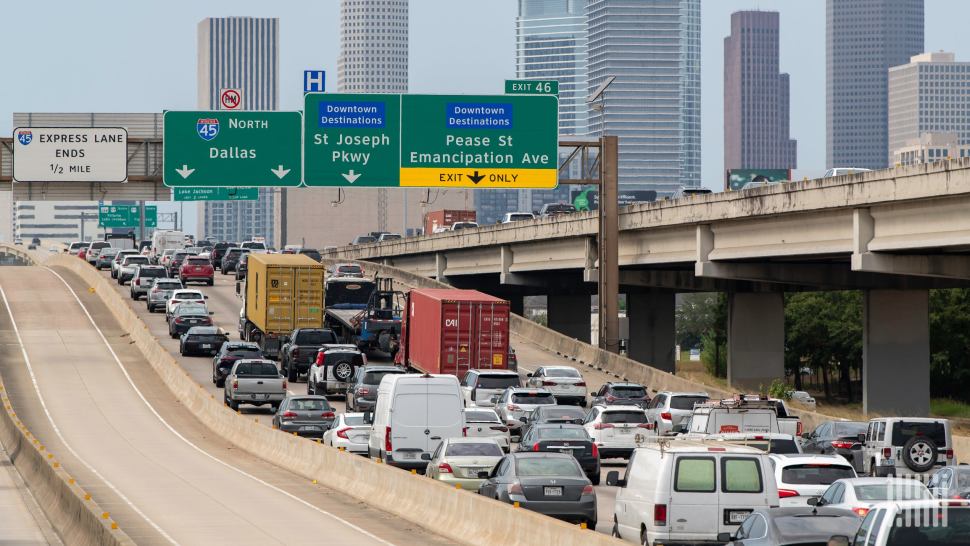
Highway congestion cost the trucking industry a record $108.8 billion in 2022, according to a survey released Wednesday by the American Transportation Research Institute.
ATRI’s survey, which measures congestion using average truck speeds, truck volumes and operational costs, found that total congestion hours in 2022 decreased slightly from 2021 due to the weakening freight market.
However, the cost to operate a truck increased at a greater rate in the same period, causing overall congestion costs to jump 15% from the previous high of $94.6 billion in the previous year as surveyed by ATRI, the research arm of the American Trucking Associations.
“This level of delay is equivalent to more than 430,000 commercial truck drivers sitting idle for one work year and an average cost of $7,588 for every registered combination truck,” ATRI estimated.
ATRI also estimated that the trucking industry wasted over 6.4 billion gallons of diesel fuel in 2022 due to congestion, resulting in $32.1 billion in added fuel costs, which released an additional 65.4 million metric tons of carbon dioxide.
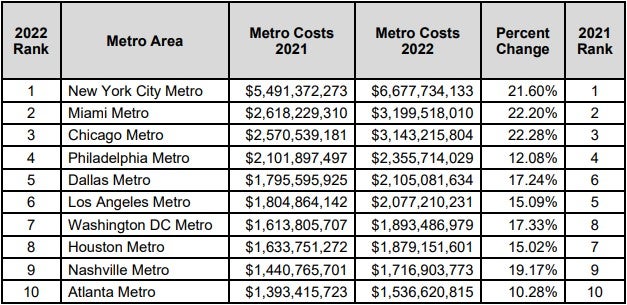
Congestion costs were highest in the New York City, Miami and Chicago metropolitan areas, but several smaller metro areas saw costs increase at a greater rate in 2022 compared with 2021, including New Orleans (37.1%), Buffalo, New York (28.6%) and El Paso, Texas (27.8%). “These cities contain ports [land- and sea-based] that experienced growth in international trade following the COVID-19 pandemic,” ATRI noted.
According to the survey, slight fluctuations in speeds and truck volume resulted in a 5.4% decrease in the total hours of congestion, to 1.2 billion hours in 2022 after hitting a high of 1.27 billion hours in 2021.
Higher truck operating costs – the most critical factor accounting for the record congestion costs – were driven by several factors, according to ATRI:
- The price of diesel rose sharply following a ban on new domestic drilling leases in early 2021 and later the Russian invasion of Ukraine in February 2022.
- Limited availability of new Class 7/8 truck tractors and components following the pandemic due to production backlogs and supply issues for parts continued to drive up prices for new and used trucks.
- Limited access to equipment caused fleets to run trucks longer than usual, resulting in significantly higher repair and maintenance costs, and a diesel technician shortage drove up the cost of technician labor.
- A highly competitive U.S. labor market and higher inflation also fueled a 12.3% increase in driver compensation (wages plus benefits).
The survey pointed out that the federal government spent $52 billion on highways in 2022 through various programs – several of which were established by the Infrastructure Investment and Jobs Act specifically to target congestion. State and local governments spent an additional $180 billion.
“However,” ATRI noted, “it is not clear whether all this infrastructure investment was adequately targeted to traffic congestion hotspots and bottlenecks, which is where strategic investments are most needed.”
Related articles:
Brokerage Compliance Symposium
The day before F3. Every compliance issue you face - fraud exposure, carrier liability, FMCSA rules, cargo theft, insurance gaps - navigated by attorneys and operators defining best practices in a changing industry.
F3 Awards Dinner
The night before F3. FreightTech100 companies honored. FreightTech 25 and Shipper of Choice winners revealed live. Cocktail reception into dinner and live music - 300 industry leaders in one purpose-built room.
F3: Future of Freight Festival
Industry-defining keynotes, rapid-fire technology demos, and industry leaders networking in experiences across Chattanooga - plus the inaugural F3 Awards Dinner featuring the FreightTech and Shipper of Choice reveals.
The day before F3. Every compliance issue you face - fraud exposure, carrier liability, FMCSA rules, cargo theft, insurance gaps - navigated by attorneys and operators defining best practices in a changing industry.
The Signal at Chattanooga Choo Choo • Chattanooga, TN Register NowThe night before F3. FreightTech100 companies honored. FreightTech 25 and Shipper of Choice winners revealed live. Cocktail reception into dinner and live music - 300 industry leaders in one purpose-built room.
The Signal at Chattanooga Choo Choo • Chattanooga, TN Register NowIndustry-defining keynotes, rapid-fire technology demos, and industry leaders networking in experiences across Chattanooga - plus the inaugural F3 Awards Dinner featuring the FreightTech and Shipper of Choice reveals.
The Signal at Chattanooga Choo Choo • Chattanooga, TN Register Now