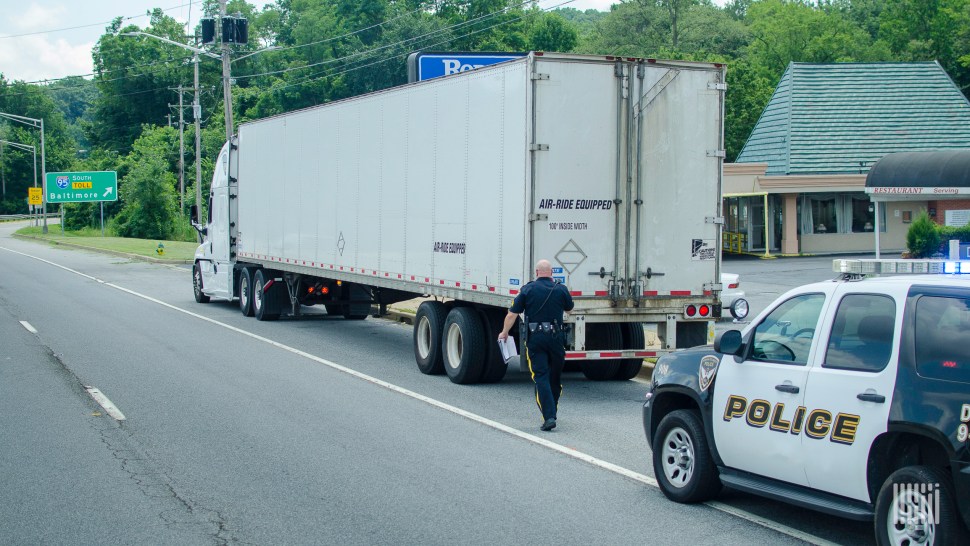
The Commercial Vehicle Safety Alliance has approved 17 changes to the 2026 North American Standard Out-of-Service Criteria that will take effect April 1, 2026, and while some updates are technical, several directly affect how drivers and small fleets will be inspected on licensing, ELDs, brakes, cargo securement, wheels and even hazardous materials placarding.
On December 5, 2025, CVSA formally notified its members of the approved updates following the fall issues ballot. According to the official letter, 51 of 70 Class I jurisdictions voted, and 17 changes were approved. These changes become enforceable across North America beginning April 1, 2026.
If you run one truck or ten, you need to understand what changed because knowledge protects your operation. Let’s break this down in plain language.
Licensing and CDL Restrictions – Clarification Matters
Several updates in Part I focus on licensing violations and how inspectors apply restriction codes.
One important clarification addresses CDL and non-CDL restrictions. Previously, confusion existed about whether a driver operating in violation of a restriction automatically invalidated the license. The update clarifies that a restriction violation does not invalidate the license itself. Instead, the driver would be placed out of service under applicable state law, not federal licensing statutes.
Another update addresses intrastate CDL “K” restrictions. The FMCSA clarified that the intent of the intrastate restriction is to keep drivers within their issuing state — not to prohibit them from operating the intrastate portion of an interstate trip. Under the updated criteria, drivers should only be declared out of service if they are operating outside their home state at the time of inspection.
For small carriers, this means two things: Know your drivers’ restriction codes. Understand when they actually apply.
This update removes some gray area, but it also puts responsibility on you to understand licensing nuances.
Alcohol Threshold Clarified
The intoxicating beverage section was amended to clarify alcohol content thresholds. Wine or beer with 0.5% alcohol content or more, and any distilled spirits, meet the threshold for an out-of-service violation if possessed while on duty or operating.
This aligns the criteria with federal regulations and removes ambiguity.
ELD Tampering and False Records – Major Update
This is one of the most important changes for 2026. The language around false records of duty status has been amended. Inspectors can now place drivers out of service when records are false and the inspector can determine driving or resting periods.
More importantly, a new out-of-service condition has been added for situations where ELD tampering makes it impossible to determine events.
That’s a big deal. If tampering — whether by driver or carrier — makes it impossible to identify what happened, an out-of-service condition now applies.
Small carriers need to hear this clearly:
If your ELD setup creates confusion, gaps or missing events, that’s no longer just a paperwork issue. It can become an out-of-service condition.
Automatic On-Board Recording Devices Removed
With the removal of AOBRD regulations, references to them were removed from the criteria. This reflects the full transition to ELD-only compliance.
Brake System Changes – Technical but Important
Several brake-related updates were approved.
One change moves the condition related to disconnected service air connections (formerly gladhands) under the 20% defective brakes rule. In simple terms, a trailer will not automatically be placed out of service for a disconnected service air connection unless the combination meets the 20% defective brake threshold.
Another change adjusts hydraulic and electric brake lining thickness measurements to align with federal regulations. The new standard reflects less than 1/16 inch (1.6 mm), aligning U.S. and Canadian standards.
Additionally, the term “parking brake” has been updated to “parking/emergency brake” to reflect that this system serves both functions. This may seem minor, but language clarity affects enforcement.
Cargo Securement – Logs and Wire Rope
Two cargo securement changes stand out.
First, a new hydraulic log securement system has been added to the criteria with defined out-of-service conditions.
Second, a wire rope damage chart will now be included to assist inspectors in determining when broken wires constitute a violation. This makes enforcement more standardized.
If you haul logs or use wire rope tiedowns, review these updates closely.
Coupling Devices – Countersunk Screws
The criteria now address countersunk screws specifically in upper couplers. Industry guidance clarified that all bolts present must be tight. Previously, there was ambiguity.
Wheels, Rims and Hubs – Significant Changes
This section includes practical changes small carriers need to understand.
Rims with missing pieces exceeding 3 inches (76.2 mm) at the bead area are now out-of-service conditions. This mirrors existing crack criteria and prevents small curb-strike damage from triggering OOS while addressing significant structural damage.
Cracks from center hole to stud hole have been removed as out-of-service conditions because they are not considered imminent hazards.
Additionally, the hub-related out-of-service condition regarding clear hubcaps has been removed. Inspectors discovered inconsistencies due to grease-packed versus oil-filled bearings. To prevent incorrect placements, the condition was removed.
This actually reduces the risk of improper OOS in that specific scenario.
Emergency Exit Markings – Passenger Vehicles
For passenger-carrying vehicles, exits marked as emergency exits must now have proper operating instructions — even if the exit is not required by regulation.
If it’s marked emergency, it must function and be labeled properly.
Hazardous Materials – Placarding Clarified
The placarding section was updated to clarify that if multiple divisions within the same class of material are missing placards, the vehicle is placed out of service.
For hazmat carriers, this is about completeness and accuracy.
Administrative Out-of-Service Orders – FMCSA Chart Added
A chart outlining the seven types of FMCSA out-of-service orders has been added to assist inspectors in properly applying Part IV administrative OOS orders.
For carriers under federal enforcement, this matters.
When Does This Take Effect?
All 17 changes go into effect April 1, 2026. According to the letter, the updated handbook will be available for purchase in February 2026 and will also be accessible through the CVSA OOSC app starting April 1. CVSA hosted a webinar on February 10, 2026 outlining the changes.
Brokerage Compliance Symposium
The day before F3. Every compliance issue you face - fraud exposure, carrier liability, FMCSA rules, cargo theft, insurance gaps - navigated by attorneys and operators defining best practices in a changing industry.
F3 Awards Dinner
The night before F3. FreightTech100 companies honored. FreightTech 25 and Shipper of Choice winners revealed live. Cocktail reception into dinner and live music - 300 industry leaders in one purpose-built room.
F3: Future of Freight Festival
Industry-defining keynotes, rapid-fire technology demos, and industry leaders networking in experiences across Chattanooga - plus the inaugural F3 Awards Dinner featuring the FreightTech and Shipper of Choice reveals.
The day before F3. Every compliance issue you face - fraud exposure, carrier liability, FMCSA rules, cargo theft, insurance gaps - navigated by attorneys and operators defining best practices in a changing industry.
The Signal at Chattanooga Choo Choo • Chattanooga, TN Register NowThe night before F3. FreightTech100 companies honored. FreightTech 25 and Shipper of Choice winners revealed live. Cocktail reception into dinner and live music - 300 industry leaders in one purpose-built room.
The Signal at Chattanooga Choo Choo • Chattanooga, TN Register NowIndustry-defining keynotes, rapid-fire technology demos, and industry leaders networking in experiences across Chattanooga - plus the inaugural F3 Awards Dinner featuring the FreightTech and Shipper of Choice reveals.
The Signal at Chattanooga Choo Choo • Chattanooga, TN Register Now