





A positive inflection in freight shipments now appears likely after 40 months of year-over-year declines, according to a monthly report from Cass Information Systems. A turn in demand would further bolster the supply-driven rate recovery that began late last year.
The multimodal shipments component of the Cass Freight Index dipped just 1.2% year over year in May, the smallest decline in 18 months. Shipments were up 3% from April but down 0.3% on a seasonally adjusted basis.
An increase in domestic intermodal volumes, while “many spot indicators suggest improving freight demand,” drove the change.
“These are positive signs that a volume recovery in the second half of the year remains likely,” the Monday report said. “While it may not be a consumer-led recovery, inventories are tight, tariffs are falling, and the U.S. dollar is soft, all of which support demand growth.”
A 5.2% volume decline on a two-year-stacked comparison was the smallest since February 2024.
Assuming historical seasonal volume trends throughout the remainder of the year, the index is projected to log a 1.8% y/y increase in the back half.
| May 2026 | y/y | 2-year | m/m | m/m (SA) |
| Shipments | -1.2% | -5.2% | 3.0% | -0.3% |
| Expenditures | 7.5% | 8.3% | 5.3% | 4.9% |
| TL Linehaul Index | 6.9% | 7.5% | 0.4% | NM |
Cass’ expenditures index, which measures total freight spend including fuel, jumped 7.5% y/y and was up 5.3% from April (4.9% higher seasonally adjusted). The y/y increase was the biggest since late 2022. A smaller decline in shipments, elevated fuel prices and higher freight rates were the catalysts for the increase.
Cass’ TL linehaul index, which tracks rates excluding fuel and accessorial surcharges, increased 6.9% y/y, the largest increase in nearly four years. The dataset, which includes for-hire spot and contract rates, has been up y/y in 17 consecutive months.
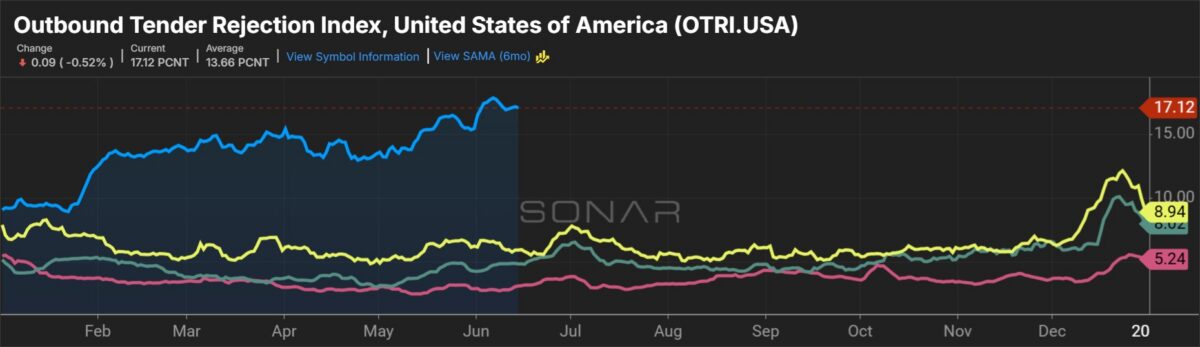
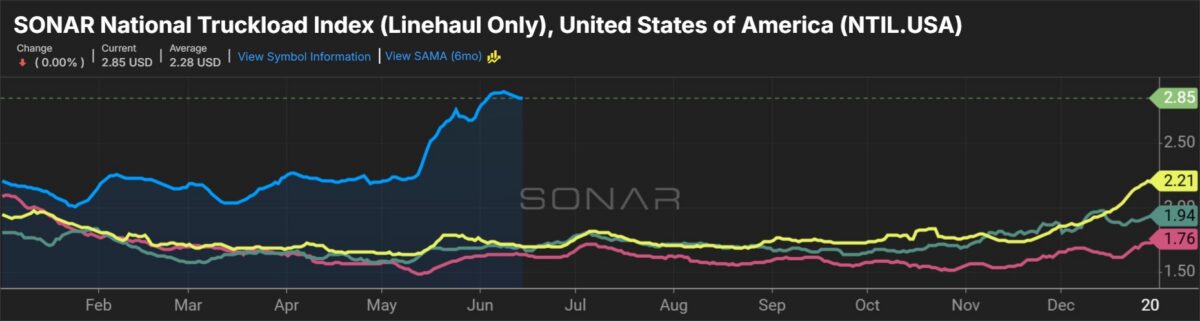
“Volumes are beginning to recover, but it is mainly supply constraints supporting higher rates, in our view, both for equipment capacity and drivers,” the report said.
Truckload capacity began to exit last year as authorities tightened enforcement of non-domiciled CDL and English proficiency rules, alongside crackdowns on questionable driver schools and ELD providers. Recent events (increased policing of cabotage rules and the Supreme Court’s broker liability ruling) are further purging noncompliant drivers from the industry.
Contract rates set earlier this year are proving too low as capacity continues to dwindle, according to publicly traded carriers appearing at an investor conference last week. The group sees the potential for double-digit rate hikes this year and next as routing guides crumble. That would be quite the turnaround after a nearly four-year downturn.
Data used in the indexes comes from freight bills paid by Cass (NASDAQ: CASS), a provider of payment management solutions. Cass processes $37 billion in freight payables annually on behalf of customers.
Brokerage Compliance Symposium
The day before F3. Every compliance issue you face - fraud exposure, carrier liability, FMCSA rules, cargo theft, insurance gaps - navigated by attorneys and operators defining best practices in a changing industry.
F3 Awards Dinner
The night before F3. FreightTech100 companies honored. FreightTech 25 and Shipper of Choice winners revealed live. Cocktail reception into dinner and live music - 300 industry leaders in one purpose-built room.
F3: Future of Freight Festival
Industry-defining keynotes, rapid-fire technology demos, and industry leaders networking in experiences across Chattanooga - plus the inaugural F3 Awards Dinner featuring the FreightTech and Shipper of Choice reveals.
The day before F3. Every compliance issue you face - fraud exposure, carrier liability, FMCSA rules, cargo theft, insurance gaps - navigated by attorneys and operators defining best practices in a changing industry.
The Signal at Chattanooga Choo Choo • Chattanooga, TN Register NowThe night before F3. FreightTech100 companies honored. FreightTech 25 and Shipper of Choice winners revealed live. Cocktail reception into dinner and live music - 300 industry leaders in one purpose-built room.
The Signal at Chattanooga Choo Choo • Chattanooga, TN Register NowIndustry-defining keynotes, rapid-fire technology demos, and industry leaders networking in experiences across Chattanooga - plus the inaugural F3 Awards Dinner featuring the FreightTech and Shipper of Choice reveals.
The Signal at Chattanooga Choo Choo • Chattanooga, TN Register Now