




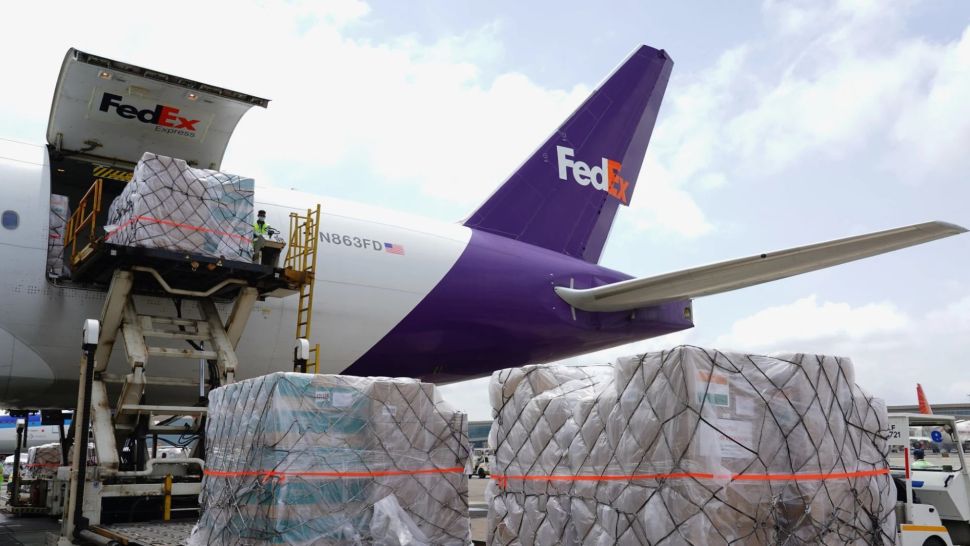
FedEx Corp. on Thursday made its second major commitment this year for air freight expansion in India, saying it will spend $150 million to equip a dedicated air cargo hub at Delhi international airport to support growing international trade in the northern part of the country.
The proposed facility would span about 230,000 square feet and include an advanced, high-speed conveyor belt with automated sorting capability and AI-enabled computer vision scanners to route packages. It will significantly increase FedEx’s (NYSE: FDX) processing capacity at the airport from 600 to 5,000 packages per hour, and bring scattered international pickup-and-delivery operations at the airport under one roof, enabling greater operational efficiency and faster shipment flow, the freight transportation company said in a news release. Flexible design elements will accommodate future expansion needs.
The new FedEx terminal will be part of a larger planned cargo campus. GMR Airports Ltd. is developing the site to house airlines, freight forwarders and service providers within the airport’s property to support India’s growing trade, e-commerce and express logistics requirements. Phase 1 of the project will comprise about 1 million square feet and construction is expected to begin soon. A second phase could add another 500,000 to 1 million square feet of developed space.
FedEx will lease the cargo warehouse, but is responsible for installing all systems, equipment and technology.
“India is a critical market in our global network, with North and East India playing an important role in the country’s growing trade and economic opportunity. Strengthening our presence in Delhi will enhance connectivity across these markets and support businesses as they grow and expand. It reflects our long-term confidence in India and our commitment to investing in the capacity and capabilities needed to support the country’s evolving trade needs,” said Kami Viswanathan, president FedEx Middle East, Indian Subcontinent and Africa, in a statement issued in conjunction with a ground breaking ceremony.
India is one of the fastest growing economies in the world and the United States’s tenth-largest trade partner. Last year, it had more than $1.2 trillion in merchandise exports and imports, according to the Ministry of Commerce and Industry.
In February, FedEx announced a $250 million investment for a custom air cargo facility at Navi Mumbai International Airport, a new airport that opened to passenger traffic in December and exists alongside the original Mumbai airport. FedEx shares a multi-user cargo terminal at the legacy Mumbai International Airport, with certain processing activities occurring off airport property. The Navi Mumbai facility is designed to enable on-airport parcel and freight processing. FedEx will continue to operate at the original Mumbai airport after it moves into the Navi Mumbai facility.
The Adani Group is developing an integrated cargo area at Navi Mumbai to serve as a trade gateway for western India, with capacity for 500,000 million metric tons per year in the first phase.
In December, FedEx opened a 60,000 square foot freight facility at Kempegowda International Airport in Bengaluru, southern India, consolidating import and export activities in one location. It handles parcels as well as industrial, pharmaceutical and manufacturing shipments. Throughput capacity is 4,000 packages per hour.
Click here for more FreightWaves/American Shipper articles by Eric Kulisch.
Write to Eric Kulisch at ekulisch@freightwaves.com.
RECOMMENDED READING:
FedEx invests $250M for dedicated parcel hub at new Mumbai airport
FedEx, China Southern Airlines explore to explore air cargo cooperation
