




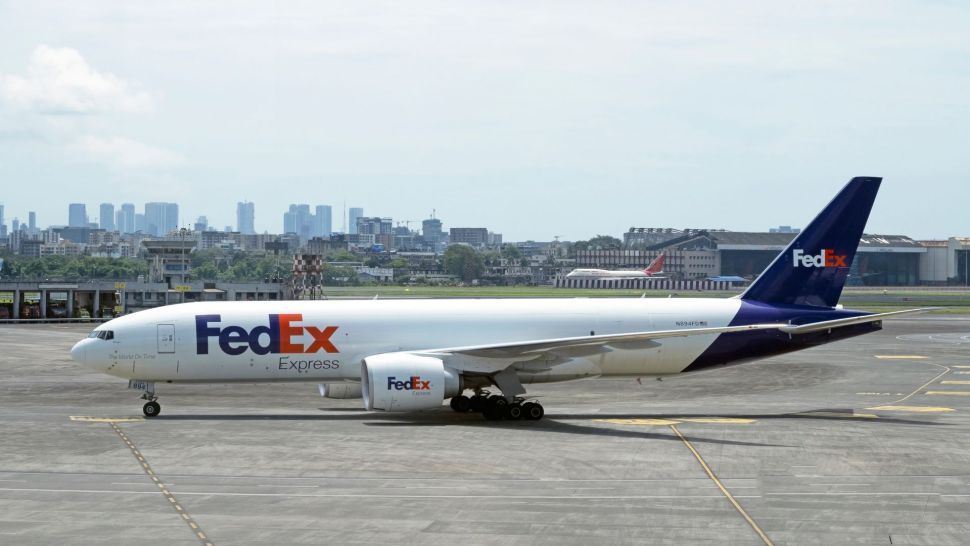
FedEx is investing about $250 million in the development of its own dedicated cargo processing facility at a new second airport in Mumbai, India.
Developers broke ground last week on a cargo campus that will include a dedicated terminal for FedEx (NYSE: FDX), which has made a series of airport investments during the past year to boost the reach and efficiency of its air cargo network, according to a joint news release.
The new facility at Navi Mumbai International Airport, which opened for domestic passenger travel on Dec. 25, will give FedEx greater control of its operations than the current arrangement at Mumbai’s main airport. FedEx shares a multi-user cargo terminal at the legacy Mumbai International Airport, with certain processing activities occurring off airport property. The Navi Mumbai facility is designed to enable on-airport parcel and freight processing within FedEx’s dedicated facility, subject to regulatory approval, a FedEx spokesman said.
FedEx will continue to operate at the original Mumbai airport after it moves into the Navi Mumbai facility.
Navi Mumbai airport is managed by Adani Group, a major infrastructure and logistics conglomerate in India. Adani Group announced it is constructing a new air hub for FedEx, which will invest $250 million of its own to equip the building with a high-speed conveyor system, dimensional scanning, security screening, automated package sorting technology and other features.
FedEx has signed a 20 year lease for the 300,00-square foot parcel consolidation center, which is expected to be ready for commercial operations in about 27 to 32 months, an Adani representative said in an e-mail exchange. The facility is designed with adjacent aircraft parking spaces for convenient loading and unloading.
The Adani Group commissioned an integrated cargo facility to serve as a trade gateway for western India, with capacity for 500,000 million metric tons per year in the first phase. At full build out the cargo area will have annual throughput capacity of 3.5 million tons.
The Navi Mumbai cargo complex benefits from its proximity to multimodal transport networks and industrial production, according to officials.
The new FedEx facility is designed to enhance network capacity and efficiency, particularly for high-value and time-sensitive verticals such as electronics, engineering products, pharmaceuticals and perishables, in western India.
“India’s competitiveness in global trade will increasingly depend on the reliability and speed of its logistics infrastructure. Establishing this hub at NMIA allows us to integrate global network strength with India’s fastest-growing trade corridor, providing greater certainty, speed and efficiency to customers,” said Kami Viswanathan, president of FedEx Middle East, Indian subcontinent and Africa, in the news release.
Capital expenditure strategy
Navi Mumbai is the latest example of FedEx efforts to expand its air network. In September, FedEx moved to a new cargo terminal at Istanbul International Airport in Turkey, a major crossroads between Asia, the Middle East and Europe after previously occupying a shared third-party facility. It also announced plans to build a regional air hub at King Salman International Airport, currently under development in Riyadh and scheduled for completion in 2030, to serve Saudi Arabia, Bahrain, Kuwait and Qatar.
FedEx last year also consolidated divided operations in a new facility at Detroit Metropolitan Wayne Country Airport.
During an Investory Day presentation earlier this month, management reiterated plans for lower capital expenditures as it strives to increase profitability and share price. In three years, FedEx expects the capital expenditure-to-revenue ratio to be approximately 4%, well below historical levels. By comparison the ratio was 8.6% in 2020 and 7% in fiscal year 2023, excluding FedEx Freight. And 90% of capital investments will be for maintaining the network, modernizing facilities and equipment, and other efficiency needs instead of expanding capacity.
(Correction: An earlier version of this story suggested FedEx will relocate from the original Mumbai airport to the new airport. It will actually operate at both locations.)
Click here for more FreightWaves/American Shipper stories by Eric Kulisch.
Write to Eric Kulisch at ekulisch@freightwaves.com.
RELATED STORIES:
FedEx expansion at Detroit airport boosts parcel, freight capacity
FedEx preparing major sort center expansion at Memphis air hub
Brokerage Compliance Symposium
The day before F3. Every compliance issue you face - fraud exposure, carrier liability, FMCSA rules, cargo theft, insurance gaps - navigated by attorneys and operators defining best practices in a changing industry.
F3 Awards Dinner
The night before F3. FreightTech100 companies honored. FreightTech 25 and Shipper of Choice winners revealed live. Cocktail reception into dinner and live music - 300 industry leaders in one purpose-built room.
F3: Future of Freight Festival
Industry-defining keynotes, rapid-fire technology demos, and industry leaders networking in experiences across Chattanooga - plus the inaugural F3 Awards Dinner featuring the FreightTech and Shipper of Choice reveals.
The day before F3. Every compliance issue you face - fraud exposure, carrier liability, FMCSA rules, cargo theft, insurance gaps - navigated by attorneys and operators defining best practices in a changing industry.
The Signal at Chattanooga Choo Choo • Chattanooga, TN Register NowThe night before F3. FreightTech100 companies honored. FreightTech 25 and Shipper of Choice winners revealed live. Cocktail reception into dinner and live music - 300 industry leaders in one purpose-built room.
The Signal at Chattanooga Choo Choo • Chattanooga, TN Register NowIndustry-defining keynotes, rapid-fire technology demos, and industry leaders networking in experiences across Chattanooga - plus the inaugural F3 Awards Dinner featuring the FreightTech and Shipper of Choice reveals.
The Signal at Chattanooga Choo Choo • Chattanooga, TN Register Now