




FedEx Corp. is strengthening its logistics capabilities in Saudi Arabia with new air connectivity from key markets in the West, full ownership of distribution facilities and investment in a new regional air hub in Riyadh to capitalize on the country’s trade growth.
Other logistics companies, including express delivery rival DHL, are similarly making strategic commitments in Saudi Arabia and neighboring Middle East states.
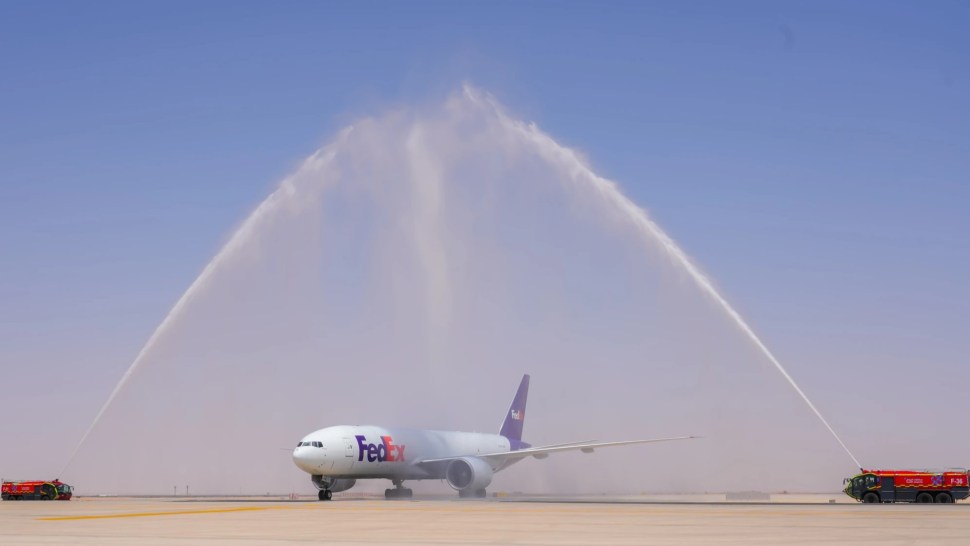
FedEx (NYSE: FDX) earlier this week announced the launch of its first dedicated all-cargo flight to Saudi Arabia from the United States and Europe, marking the first time an express delivery company has established a nonstop connection from the West to Saudi Arabia. The inaugural flight departed FedEx’s hub in Paris and landed at King Khaled International Airport late Tuesday morning local time.
The integrated parcel and logistics giant also plans to build a regional air hub at King Salman International Airport, currently under development in Riyadh and scheduled for completion in 2030, to serve Saudi Arabia, Bahrain, Kuwait and Qatar. A company spokesperson also confirmed that FedEx recently secured a license to operate as a foreign air carrier to regional destinations.
In further investments, FedEx has taken full ownership of its customs clearance and pickup-and-delivery operations in Saudi Arabia after previously being required to operate with local joint venture partners, according to a separate announcement. The company now directly manages those functions, supported by four gateway facilities and four delivery stations. Bloomberg reported that FedEx has also opened a regional office in Riyadh to oversee business in the region.
And the Memphis, Tennessee-based company has established a FedEx Logistics division in Saudi Arabia, offering freight forwarding services across all modes.
Company officials didn’t disclose how much money is being invested to build out services and infrastructure in Saudi Arabia.
FedEx’s expansion comes amid Saudi Arabian economic growth and implementation of the government’s ambitous economic development strategy aimed at diversifying the oil-based economy and expanding global trade opportunities. A growing manufacturing and logistics base is driving an increase in exports while the rise in online shopping, tourism and events, and infrastructure expansion have created a strong inbound market for business-to-consumer shipments.
Saudi Arabia, the United Arab Emirates and Qatar, because of their location and ability to build modern freight infrastructure, are increasingly becoming global logistics hubs, connecting Asia, Europe and Africa. Saudi Arabia’s logistics sector is projected to grow at a 6.5% annual rate and be valued at $199 billion by 2030.
Saudi Arabia’s real gross domestic product grew 3.4% in the first quarter and 3.9% in the second quarter. In 2024, GDP increased 1.3% largely due to a 4.3% increase in non-oil activities, according to government figures.
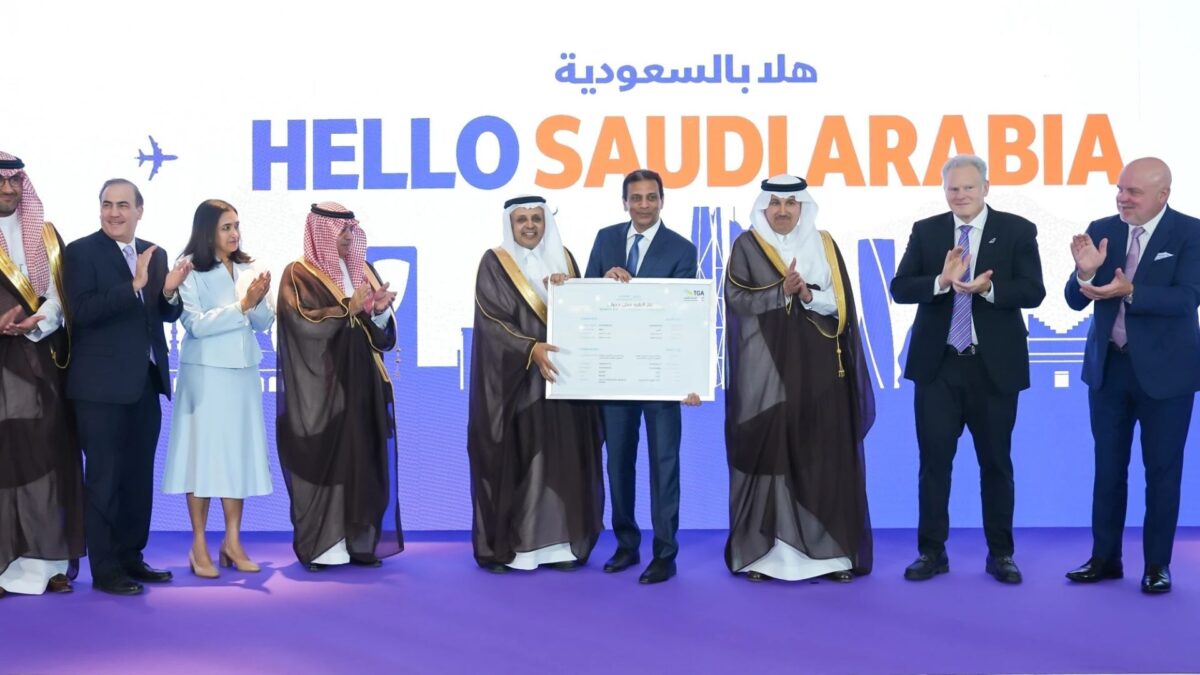
“Our recent investments underscore Saudi Arabia’s role as a vital link in our global network, connecting major economies across Asia, Europe, and the Americas,” said Richard Smith, chief operating officer for FedEx’s international business, and CEO of its airline, in a news release. “By expanding in the Kingdom, we are broadening our network’s reach and creating faster, more dependable trade routes. As global commerce evolves, Saudi Arabia’s strategic position ensures we can move goods with both speed and scale to connect more people and possibilities.”
Smith’s presence, along with that of CEO Raj Subramaniam and other FedEx leaders, at ceremonies with high-ranking Saudi Arabian officials signaled the level of importance FedEx is giving to its commitments in Saudi Arabia.
Air cargo upgrade
FedEx said the new flight will operate six times per week from Paris, fed by traffic from the United States, using a Boeing 777 cargo jet with onward connections to Guangzhou and Shanghai, China. Shipments destined for northern Gulf states will be distributed via FedEx’s Middle East road network or by regional air service. The direct connection means improved transit times for customers.
The dedicated freighter provides capacity for bulky, oversized, palletized, or heavy shipments, and is equipped to handle temperature-controlled and dangerous goods, FedEx said. The statement and morning flight schedule suggest the flights will operate as part of FedEx’s new Orange network, which is designed for the heavy airfreight market with a deferred schedule that allows the carrier time to maximize density on the aircraft and go to secondary hubs that aren’t as focused on express packages
Saudi Arabia’s air cargo sector is growing rapidly, with volumes reaching 920,000 tons in 2024 and projected to nearly triple to 2.45 million tons by 2033, according to Imarc.
DHL Group last month took a minority stake in a Saudi Arabian last-mile delivery company, part of a $570 million investment for its express delivery, e-commerce, contract logistics and freight forwarding units over the next five years in Gulf Arab states.
In 2024, Ceva Logistics expanded its presence in Saudi Arabia through a joint venture with a local logistics company. And in June, China-based JD Logistics launched parcel delivery operations in Saudi Arabia.
Click here for more FreightWaves/American Shipper stories by Eric Kulisch.
Write to Eric Kulisch at ekulisch@freightwaves.com.
RELATED READING:
FedEx sends specialists to streamline European operations
DHL eCommerce acquires share of Saudi Arabia courier
DHL steps up Middle East expansion with $570M in planned investments
FedEx and UPS cease parcel discounts, ‘weaponize’ fuel surcharges: report
Brokerage Compliance Symposium
The day before F3. Every compliance issue you face - fraud exposure, carrier liability, FMCSA rules, cargo theft, insurance gaps - navigated by attorneys and operators defining best practices in a changing industry.
F3 Awards Dinner
The night before F3. FreightTech100 companies honored. FreightTech 25 and Shipper of Choice winners revealed live. Cocktail reception into dinner and live music - 300 industry leaders in one purpose-built room.
F3: Future of Freight Festival
Industry-defining keynotes, rapid-fire technology demos, and industry leaders networking in experiences across Chattanooga - plus the inaugural F3 Awards Dinner featuring the FreightTech and Shipper of Choice reveals.
The day before F3. Every compliance issue you face - fraud exposure, carrier liability, FMCSA rules, cargo theft, insurance gaps - navigated by attorneys and operators defining best practices in a changing industry.
The Signal at Chattanooga Choo Choo • Chattanooga, TN Register NowThe night before F3. FreightTech100 companies honored. FreightTech 25 and Shipper of Choice winners revealed live. Cocktail reception into dinner and live music - 300 industry leaders in one purpose-built room.
The Signal at Chattanooga Choo Choo • Chattanooga, TN Register NowIndustry-defining keynotes, rapid-fire technology demos, and industry leaders networking in experiences across Chattanooga - plus the inaugural F3 Awards Dinner featuring the FreightTech and Shipper of Choice reveals.
The Signal at Chattanooga Choo Choo • Chattanooga, TN Register Now