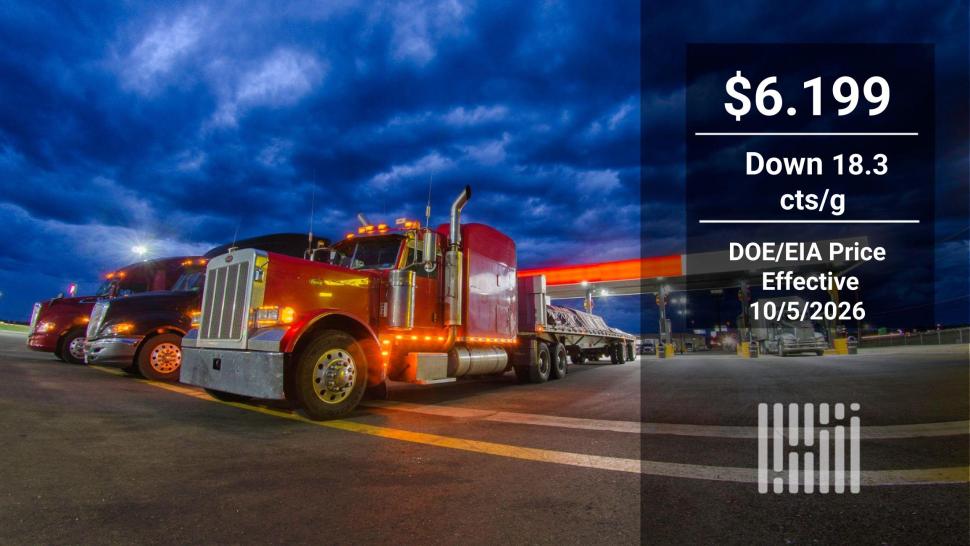
The benchmark price used as the basis for most fuel surcharges fell for the second week in a row, as the market awaits the impact of a change in federal regulation on a type of fuel that can now be consumed by over the road trucks.
The Department of Energy/Energy Information Administration average retail weekly diesel price declined for the second consecutive week, dropping 18.3 cents/gallon to $6.199/g. The price is effective Monday but published Tuesday.
Declines in the DOE/EIA price follow on weakness in the ultra low sulfur diesel price on the CME commodity exchange, especially viewed through the prism of the first month contract.
Measuring differences in futures months
ULSD settled Monday at $4.5452/g for the first month contract, which is November. On paper, that first month contract is down more than 40 cts/g from the settlement of last Wednesday, but that price was pushed higher by a heavy dose of shortcovering as the October ULSD contract prepared to roll off the board.
A better comparison is how the November contract has performed, both when it was the second month contract (through Wednesday) and the first month contract.
That contract is also showing a downward trend, but not as sharp as looking at the first month by itself, which straddles both October and November numbers. November ULSD settled at $4.6336/g on September 23. After several days of weakness, it settled Monday at $4.5452/g.
Downward movement in diesel also was spurred by the decision last week by member countries of the International Energy Agency to release 100 million barrels of crude, diesel and other product in storage both in Europe and the U.S.
The two latest declines in the DOE/EIA price come after a six-week stretch in which the price rose five times, with each of those increases in the double digits.
The latest price is now 33 cts/g less than the all-time high price in the DOE/EIA series of $6.529/g, recorded just two weeks ago.
What will be the impact?
Beyond the normal swings in futures and physical markets, retail diesel prices could be facing a major impact from a federal action. Or maybe not.
Late Monday, President Trump signed an executive order allowing what is known as red dye diesel to be used in over the road applications.
Red dye diesel gets its name from the red dye that is blended into the fuel to designate it as eligible to be used by off-road consumers for agricultural and other purposes. The red dye does not impact the chemical composition of the fuel, which can be swapped into a truck’s diesel engine without impact.
What the red dye does is mark the fuel as eligible to be sold into end uses but without paying the federal excise tax of 24.3 cts/g. Agriculture is the key consumer of red dye diesel.
The idea behind the executive order from the Trump administration is that by allowing red dye diesel to be sold into the trucking market, it could give those over the road users a tax break of that amount of the tax from the near-record prices they are paying to fill their vehicles.
The order says the administration will implement a deferral of excise tax payments for the on-road use of red dye diesel. But it also says the administration will study “pathways to eliminate the obligation to pay the deferred taxes,” suggesting those fees will never be incurred by any truck drivers.
It was Patrick DeHaan, the head of retail price information service GasBuddy, who pointed out a few aspects of red dye vs. no dye that might mean what gets passed on to drivers is far less than the size of the excise tax that is being yanked temporarily.
“Here’s the catch: states have their own dyed diesel laws, and an exec order can’t override them,” DeHaan wrote late Monday on X. He said Alabama, Louisiana, Nebraska, North Caroline, Oklahoma and Texas have changed their rules allowing red dye diesel on their respective highways, “but in most states running red on the road is still illegal.”
“Big fleets will likely sit this out,” DeHaan wrote. “Interstate trucking means a patchwork of state rules and tax headaches, and most major truck stops don’t sell dyed diesel.”
However, with the elimination of the distinction at least from a federal perspective, it’s possible those suppliers who don’t move dyed diesel into a truck stop now could change that policy.
The test of just how much the change in federal policy impacts the price on the road will come through in data from retail price services such as the AAA, the weekly DOE/EIA report and the DTS.USA price in SONAR, along with their respective subdivisions that break out average prices regionally.
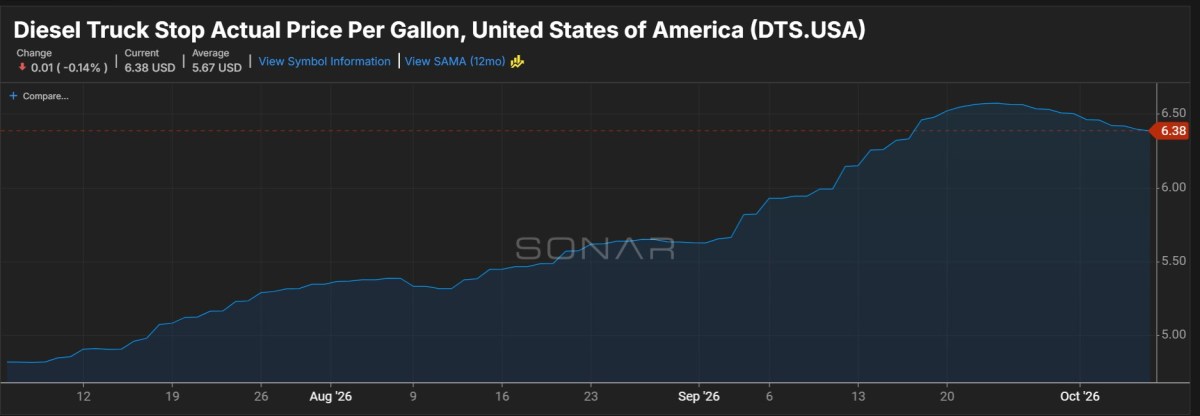
When new fuel taxes are imposed, such as an environmental tax, they inevitably show up in wholesale prices immediately. A reduction in such a tax does not necessarily make its way to the pump in a straight line or into the wholesale price either.
As DeHaan’s analysis notes, fuel distributors in some states may not choose to carry the excise tax-free red dyed fuel because of concern over conflicts with local laws. Wholesale distributors also may not immediately pass the savings on in their prices. And retailers are under no obligation to pass any lower wholesale costs on to consumers.
Sharp moves upward or downward in oil prices in general could mask the impact of the excise tax change. If the futures price of ULSD declines 20 cts/g, how much of a decline in retail prices alongside that can be attributed to the slide in futures and how much to the red dye waiver?
As DeHaan said in wrapping up his thread: “Bottom line: real change on paper, limited and uneven at the pump. A clean federal diesel tax suspension would need Congress, but it would hit every gallon in every state. Check your state’s rules before filling up with dyed diesel if available.”
More articles by John Kingston
FMCSA’s Elison: ‘weeks’ away from fixing Motus user experience
For transportation cybersecurity, AI isn’t helping fight..so far
C.H. Robinson acquisition of RXO may give a jolt to industry consolidation
Brokerage Compliance Symposium
The day before F3. Every compliance issue you face - fraud exposure, carrier liability, FMCSA rules, cargo theft, insurance gaps - navigated by attorneys and operators defining best practices in a changing industry.
F3 Awards Dinner
The night before F3. FreightTech100 companies honored. FreightTech 25 and Shipper of Choice winners revealed live. Cocktail reception into dinner and live music - 300 industry leaders in one purpose-built room.
F3: Future of Freight Festival
Industry-defining keynotes, rapid-fire technology demos, and industry leaders networking in experiences across Chattanooga - plus the inaugural F3 Awards Dinner featuring the FreightTech and Shipper of Choice reveals.
The day before F3. Every compliance issue you face - fraud exposure, carrier liability, FMCSA rules, cargo theft, insurance gaps - navigated by attorneys and operators defining best practices in a changing industry.
The Signal at Chattanooga Choo Choo • Chattanooga, TN Register NowThe night before F3. FreightTech100 companies honored. FreightTech 25 and Shipper of Choice winners revealed live. Cocktail reception into dinner and live music - 300 industry leaders in one purpose-built room.
The Signal at Chattanooga Choo Choo • Chattanooga, TN Register NowIndustry-defining keynotes, rapid-fire technology demos, and industry leaders networking in experiences across Chattanooga - plus the inaugural F3 Awards Dinner featuring the FreightTech and Shipper of Choice reveals.
The Signal at Chattanooga Choo Choo • Chattanooga, TN Register Now