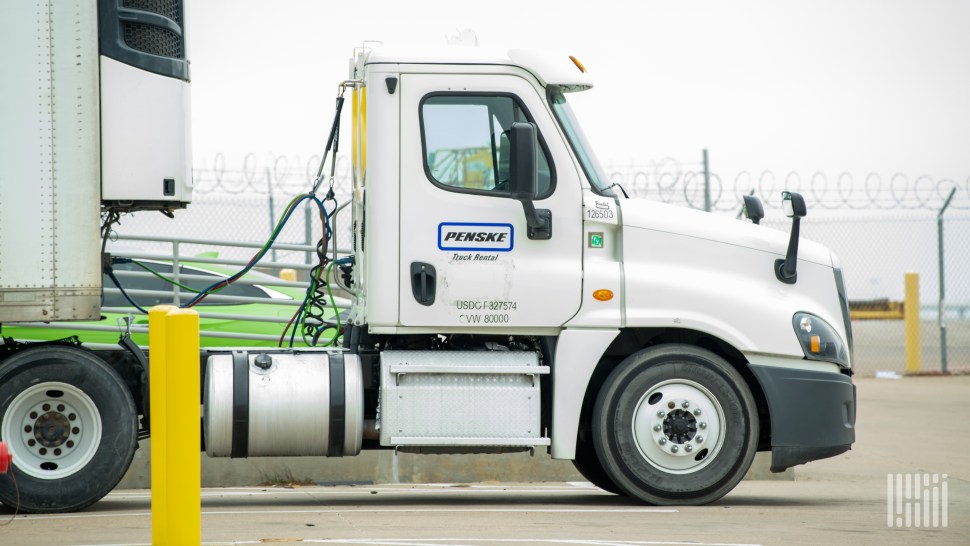
Both sides in the closely watched federal appellate case involving companies in the Penske network of companies now have made their case to the Fifth Circuit, as it considers whether to take up a larger hearing on an issue that has enormous disruptive potential for broker and carrier liability.
The plaintiffs in the case, all connected to the estate of Lyndon Dean Meyer who was killed in the accident at the heart of the legal dispute, last week submitted its brief arguing against the Fifth Circuit taking up an en banc hearing on the case that saw the Penske companies lose on the appellate level. That came after Penske companies had earlier won on the district court level in the Southern District of Texas on the question of liability.
But the district court decision was overturned by the Fifth Circuit. That led the Penske companies to seek an en banc hearing before the larger circuit.
Meyer was killed on impact the day after Christmas 2018 when a truck that was on the road through a process that began with a Penske company slammed into his vehicle on Highway 202 in Bee County, Texas. Bee County is roughly located between San Antonio and Corpus Christi.
Who was calling the shots?
At issue in the case is that of control.
The step-by-step history of the freight in question in the case known as Crane vs. Liberty Lane is that Penske Logistics was hired by car seat manufacturer Adient to ship their product; they gave the job to Penske Transportation Management (PTM), its brokerage affiliate; PTM brokered the freight to Liberty Lane, a carrier; that company in turn brokered it to OK Trans; and a driver for that company crashed into Meyer.
Penske has said it was not aware of the double brokering from Liberty Lane to OK Trans. But the fact of the double brokering is not a key issue in the case. It is cited more in passing by the Penske companies to establish it had nothing to do with the fatal accident, noting it had no idea the cargo was being transported by OK Trans.
With the Montgomery case taking any protection away from PTM that might have been been a legal argument before the Supreme Court decision in that case, the legal finding that has the trucking industry concerned is the appellate court’s ruling that Penske Logistics, the carrier at the start of the multi-step chain, was liable for the actions of Satnam Singh Lehal, the OK Trans driver who crashed into Meyer.
Big worries among the lawyers
That is being viewed in parts of trucking’s legal bar as a highly concerning precedent.
In its request for an en banc hearing, Penske Logistics and PTM said the initial agreement was with PTM, which then brokered the load out to Liberty Lane.
The Penske companies also cited the decision of the district court, which (quoting the lower court’s favorable finding) “found no cases where a court imposed statutory-employer liability absent an arrangement…between the motor carrier and the vehicle’s owner or driver.”
In that request, Penske said the appellate court’s decision holding it vicariously liable “as a statutory employer of the owner-operator of the truck whom it did not control, and with whom it had no arrangement, no communication and no knowledge of its existence” was a first in the annals of trucking law.
Different interpretation of the law
But the arguments put forth by the Meyer-related plaintiffs in opposing the en banc motion, not surprisingly, don’t see it that way.
“Penske (Logistics) did have ‘an arrangement’ with the operator of the truck, which it effectuated through its broker subsidiary and a relationship with another motor carrier,” the plaintiffs argued in their opposition to an en banc hearing. “The fact that this ‘arrangement’ was indirect, rather than direct, makes no difference under the unambiguous statutory text or the regulatory scheme.”
The plaintiffs argued that the “Control Statute and Regulations–49 U.S.C. § 14102 and 49 C.F.R. § 376.11-12 and 376.22–“(impose) vicarious liability (commonly known as ‘statutory employer’ liability) on a motor carrier that ‘uses motor vehicles not owned by it to transport property under an arrangement with another property,'” quoting the statute.
“Penske certainly could and should have complied with the statutory and regulatory requirements by obtaining a compliant lease of the truck and exercising the control and supervision over the truck and its driver that the (statute and regulations) require,” the plaintiffs’ brief argues. “If Penske didn’t know what a driver was doing on its behalf, it was only because Penske neglected all of its statutory and regulatory duties.”
The decision by the Fifth Circuit appellate court, the plaintiffs said, “was faithful to the text of the statute and regulations, which were adopted to eliminate the very abuses Penske…(seeks) to perpetuate. This case doesn’t warrant rehearing en banc.”
The core of the argument was revisited elsewhere in the en banc brief by the plaintiffs.
“The right of control imposed by the statute and regulations creates ‘statutory employment,’ making the motor carrier vicariously liable for the driver’s negligence, even when he is an independent contractor,” the plaintiffs wrote.
Penske has friends
The en banc petition has drawn amicus briefs from a joint submission by the American Trucking Associations and the Truckload Carriers Association, as well as a brief from the Trucking Industry Defense Association.
In its amicus brief, that petitioner described itself as “an international organization that includes over 1,900 members comprised of motor carriers, transportation logistics companies, insurers of motor carriers, third party claims administrators, and legal counsel.”
More articles by John Kingston
FMCSA’s Elison: ‘weeks’ away from fixing Motus user experience
Wall Street analysts positive on C.H. Robinson deal; S&P more cautious
FMCSA split sleeper berth pilot program moves closer to launch
Brokerage Compliance Symposium
The day before F3. Every compliance issue you face - fraud exposure, carrier liability, FMCSA rules, cargo theft, insurance gaps - navigated by attorneys and operators defining best practices in a changing industry.
F3 Awards Dinner
The night before F3. FreightTech100 companies honored. FreightTech 25 and Shipper of Choice winners revealed live. Cocktail reception into dinner and live music - 300 industry leaders in one purpose-built room.
F3: Future of Freight Festival
Industry-defining keynotes, rapid-fire technology demos, and industry leaders networking in experiences across Chattanooga - plus the inaugural F3 Awards Dinner featuring the FreightTech and Shipper of Choice reveals.
The day before F3. Every compliance issue you face - fraud exposure, carrier liability, FMCSA rules, cargo theft, insurance gaps - navigated by attorneys and operators defining best practices in a changing industry.
The Signal at Chattanooga Choo Choo • Chattanooga, TN Register NowThe night before F3. FreightTech100 companies honored. FreightTech 25 and Shipper of Choice winners revealed live. Cocktail reception into dinner and live music - 300 industry leaders in one purpose-built room.
The Signal at Chattanooga Choo Choo • Chattanooga, TN Register NowIndustry-defining keynotes, rapid-fire technology demos, and industry leaders networking in experiences across Chattanooga - plus the inaugural F3 Awards Dinner featuring the FreightTech and Shipper of Choice reveals.
The Signal at Chattanooga Choo Choo • Chattanooga, TN Register Now