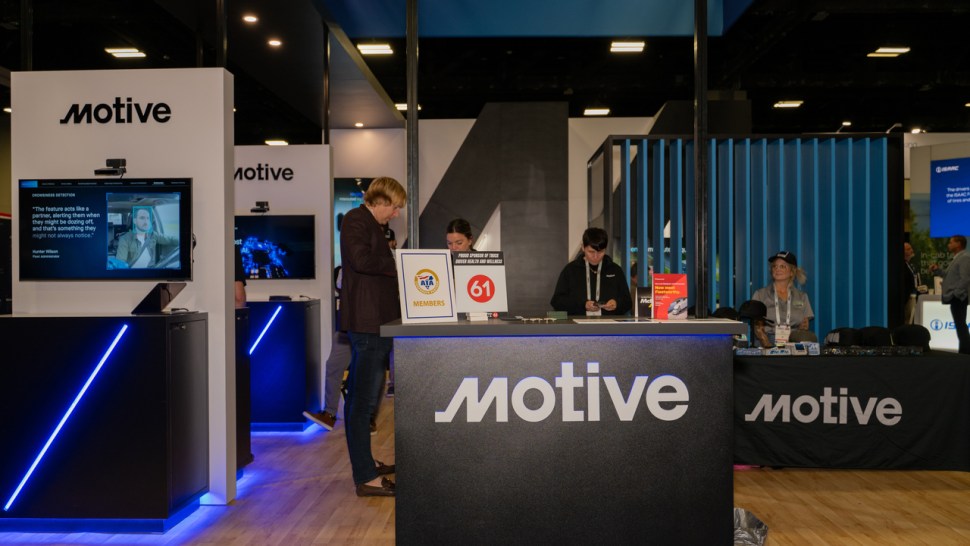
Motive, an AI platform for physical operations, launched Agents on Monday at the American Trucking Associations’ Management Conference & Exhibition (MCE) in Charlotte, North Carolina. These AI Agents act on safety and maintenance alerts under rules a fleet sets, including calling drivers, opening work orders, and bringing in managers so teams can scale without adding headcount. The company said Agents, AI that doesn’t just surface insights but acts on them, are available now to its customers. It previewed a similar rule-based tool, Automations, at its Vision 26 conference in May.
Operations teams have more visibility than ever, but they can’t act on it fast enough. The warning signs are often already in the data while acting on them still falls to managers, who chase alerts, call drivers, and check every fix by hand. That work eats hours every week and breaks down as operations grow.
For fleets, the decision rests on how much alert follow-up to hand over to software. Bennett Family of Companies, which began running Agents before the launch, started with Agents that notify its own staff and do not reach drivers.
“We did some things that did not communicate out to the drivers, and I think, for me, that was very intentional because I wanna build the trust,” Jared Whitson, senior director of safety and compliance at Bennett, said during a Motive fireside chat Sunday night at MCE. “I wanna build the trust in the product.”
Companies including Carvana, NovaSource Power, SPATCO Energy Services, Bennett Family of Companies, and Bulk Environmental & Industrial are already building and deploying Motive Agents across their operations.
What carriers already have to catch
Federal rules already make driver fatigue and vehicle condition parts of the carrier’s job. 49 CFR 392.3 bars a motor carrier from requiring or allowing a fatigued driver to operate, and 49 CFR 396.7 forbids running a truck in a condition likely to cause a crash or breakdown.
Failing to maintain that level of compliance has a direct impact on a carrier’s bottom line. Emily Parsons, a staff product manager for Agents at Motive, cited a Motive figure at the event: 47% of fleets have had delayed maintenance lead to a breakdown or an out-of-service event.
“A fault code fires, it sits in a dashboard, and by the time someone opens a ticket, a small issue oftentimes has already turned into a big one,” she said.
With Agents, a fleet picks a trigger and a response from guided workflows or ready-to-use templates in minutes, no technical expertise required, according to the release. The customer sets the threshold and the action; the Agent applies that rule continuously and consistently. Templates cover idling, fault codes, and fatigue, and one Agent can combine several triggers and actions, Motive said in a blog post.
When a fault code meets a fleet’s criteria, an Agent automatically opens a work order in Motive Maintenance and marks the vehicle out of service. Motive says each fault code comes with an AI-generated explanation, a severity level, and recommended actions.
Other agents flag driver fatigue, and idling Agents prompt drivers to shut off the engine and notify managers when idling passes a set threshold. Weather Agents can warn drivers about storms on active routes. Parsons said Motive data shows collision rates can rise as much as 40% in winter months. That is the promise of physical AI in fleet operations: connecting what hardware and software sees in the real world to what teams need done next.
“Our customers don’t need another alert. They need action,” Hemant Banavar, Motive’s chief product officer, said in the release. “The data that prevents collisions and breakdowns already lives in Motive. Agents put it to work the moment it matters, so teams can grow without adding headcount.”
Motive’s estimates and recent funding
Motive estimates organizations lose $46 billion to preventable issues such as downtime, compliance violations, and unproductive idling, and spend 860 million hours on tasks that could be automated. In the release, Motive said 42% of respondents to its 2026 ROI Report, an online survey of 351 of its North American customers, named operational inefficiencies, including excess administrative work, as a top concern.
The launch comes about six weeks after Motive raised more than $1.3 billion from General Catalyst and withdrew its IPO filing. The company said then that annual recurring revenue had passed $600 million, up 30% year over year, across nearly 100,000 customers — from small fleets to Fortune 500 enterprises — giving it one of the largest datasets in fleet management to train its AI.
Driver calls and goal setting come later
Some features are not live yet. Today, Agents alert managers by email, text, or app notification and reach drivers through in-cab voice messages, the blog post says. Calls to drivers from Atlas, Motive’s AI assistant, through AI Dashcam Plus arrive later this year.
Building an agent in plain language and setting a goal such as fewer collisions are slated for early next year. Motive also offers a library of pre-built Agents that require no setup and are available today. These Agents cover coaching and maintenance among others. Motive says Agents are included in existing Motive plans, while certain premium actions are available as add-ons. The release does not include pricing.
Bennett starts with alerts to its staff
Bennett has Motive’s AI Dashcam Plus in its vehicles but hasn’t yet enabled driver-facing Agent actions through the in-cab camera, Whitson said. Its first agent alerts asset management, the shop, and safety when a company truck with a critical fault code enters the geofence at its McDonough, Georgia, home office.
Whitson also set up an alert that notifies him when a driver logs three critical telematics events within 24 hours. Each agent is set up on a single screen: a user picks the conditions, then the action, he said. For now, Bennett’s agents report to people in the office.
Whitson noted that approach lets Bennett build confidence with back-office Agents before extending them to drivers. He said each company will decide how far to let Agents take action on its behalf. “I think it’s foolish not to make products earn that trust. But I do think that once it’s earned, then to keep up and to be competitive, then those are decisions that you’re going to have to make.”
“My team’s days are often spent running reports, cross-referencing them, and reacting to problems,” Whitson said in the press release. “Without Agents, safety management at scale is a massive challenge with inefficient, manual processes across nearly every team responsibility. Motive Agents allow us to handle that work the moment something happens — a one-time setup, and from that point forward the platform executes. Agents, and Motive’s vision for it, will let us reallocate resources toward things like field safety coordination, meaningful corrective actions, and training that ultimately lead to safer roads and money saved in collision costs.”
A scaled safety program across 15 Agents
Motive gave another customer use case example. A moving and storage company with roughly 230 vehicles is running 15 Motive Agents across its safety program. One flags patterns, including repeated speeding, unsafe lane changes, drowsiness over a rolling five-day window and auto-notifies the driver and coach when a threshold is hit. Others escalate crashes and near-misses to management by email, in-app, and SMS. The company estimates it’s saving 20 hours a week of manual event review.
HOS monitoring with a built-in buffer
A 35-vehicle fencing and guardrail contractor set up an HOS Agent that escalates as a driver nears their limit: an in-cab voice message at 60 minutes out, then a joint alert to driver and coach at 30. The 60-minute buffer gives drivers time to find safe parking and pull over legally. Most self-correct after the first message, so managers aren’t flooded with alerts. Monthly violations dropped from about 85 to 10 in September, approximately an 88% reduction.
Why it matters: A fault code that sits in a dashboard can turn into a breakdown or an out-of-service truck. Agents are built to act on those alerts automatically, closing the gap between spotting a problem and fixing it. It gives safety and maintenance teams more time for the decisions that require human judgment: field safety coordination, driver coaching, and more. Motive notes that puts them ahead of a broader industry shift from monitoring to automation.
Brokerage Compliance Symposium
The day before F3. Every compliance issue you face - fraud exposure, carrier liability, FMCSA rules, cargo theft, insurance gaps - navigated by attorneys and operators defining best practices in a changing industry.
F3 Awards Dinner
The night before F3. FreightTech100 companies honored. FreightTech 25 and Shipper of Choice winners revealed live. Cocktail reception into dinner and live music - 300 industry leaders in one purpose-built room.
F3: Future of Freight Festival
Industry-defining keynotes, rapid-fire technology demos, and industry leaders networking in experiences across Chattanooga - plus the inaugural F3 Awards Dinner featuring the FreightTech and Shipper of Choice reveals.
The day before F3. Every compliance issue you face - fraud exposure, carrier liability, FMCSA rules, cargo theft, insurance gaps - navigated by attorneys and operators defining best practices in a changing industry.
The Signal at Chattanooga Choo Choo • Chattanooga, TN Register NowThe night before F3. FreightTech100 companies honored. FreightTech 25 and Shipper of Choice winners revealed live. Cocktail reception into dinner and live music - 300 industry leaders in one purpose-built room.
The Signal at Chattanooga Choo Choo • Chattanooga, TN Register NowIndustry-defining keynotes, rapid-fire technology demos, and industry leaders networking in experiences across Chattanooga - plus the inaugural F3 Awards Dinner featuring the FreightTech and Shipper of Choice reveals.
The Signal at Chattanooga Choo Choo • Chattanooga, TN Register Now