




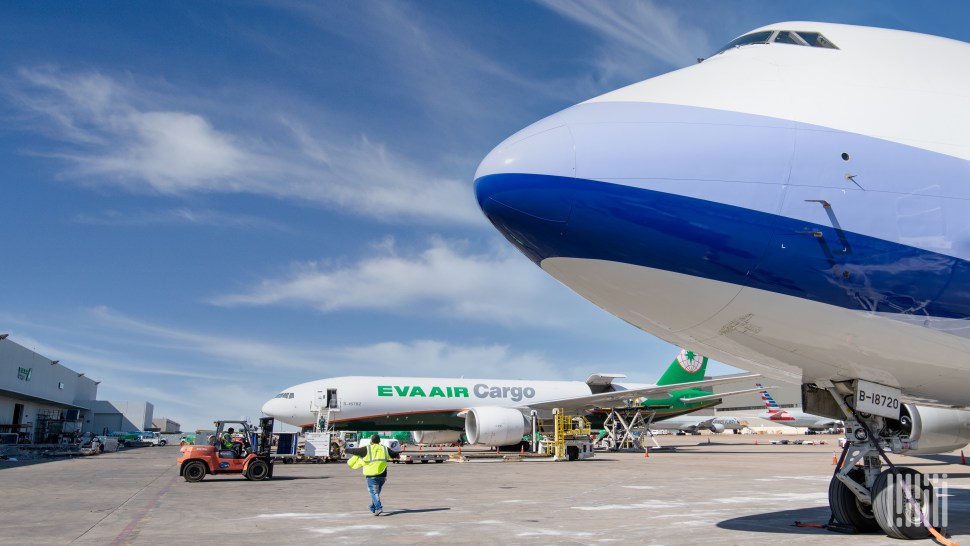
There wasn’t much change in Airbus’ latest 20-year forecast for air cargo. The manufacturer, which plans to begin delivering an all-new A350 freighter in about a year, estimated annual cargo traffic growth would tick down a tenth of a point compared to last year’s report, but that the industry would require a few more planes than previously thought.
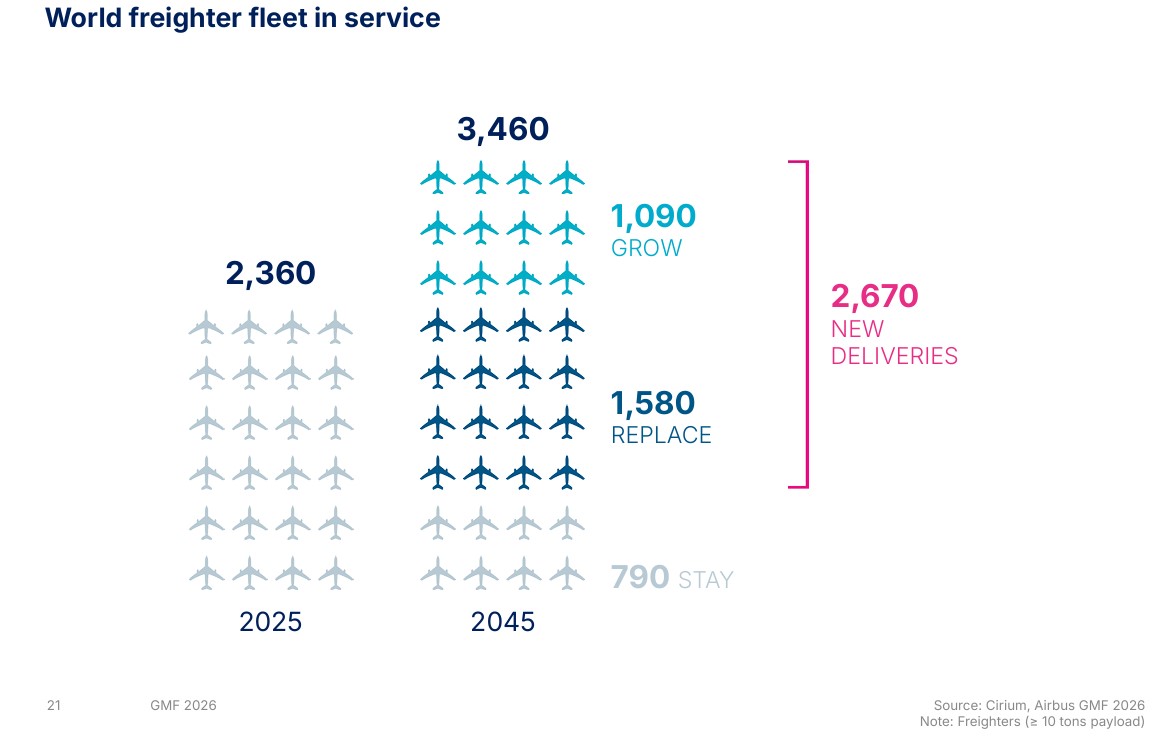
Airbus projected that the global fleet of cargo jets will grow 46% by 2045, requiring 2,670 new aircraft — 65 more than in last year’s report. The majority of new freighters will come in the form of replacements for older existing equipment, with nearly 1,100 for growth to accommodate an estimated 3.2% compound annual growth rate in air cargo volumes. Of the total influx, 970 airframes will be factory-built, with 1,700 aircraft entering the fleet as passenger-to-freighter conversions, according to the company’s market forecast released on Wednesday.
A year ago, Airbus said it expected 45% growth in the global freighter fleet, with 2,605 new aircraft combined with 815 existing aircraft. The total fleet estimate in the 2026 report is for 3,460 aircraft, a difference of 40 additional aircraft versus the prior forecast.
Fifty-seven percent of the demand for 2,670 aircraft will be in medium and large widebody freighters used in long-haul and transcontinental transportation.
Airbus based its estimate of 3.2% growth in air cargo demand on economists’ predictions for global trade to continue growing at a steady pace (2.9% per year). Air cargo growth has exceeded growth in global trade for many years, despite geopolitical, fuel and supply chain turbulence. Last year, Airbus estimated air cargo would develop at a rate of 3.3% per year.
The growth projection is better than the 2.3% compound annual growth of the past 20 years, which included two major global economic shocks. The outlook is better than some expected because the impact of tariffs on air cargo demand has been muted, with volumes shifting to different regions rather than declining.
Asia, a massive hub for industrial and high-tech production, is the fastest growth region for air cargo, at a projected pace of 4%.
Boeing said in its forecast last year that the market would see 2,900 total freighter additions, with the global freighter fleet growing by 67%, including 955 newbuilds, and air cargo traffic growing at 3.7%. Boeing is scheduled to issue its updated forecast next week.
In 2026, air cargo volumes through August were up 4.6% year over year, according to the International Air Transport Association and other market analysts. That’s an improvement from the solid 3.3% growth in 2025, when global trade faced a series of headwinds led by the United States unleashing a series of high tariffs on trading partners, especially China.
The U.S. tariffs on China, including on huge volumes of direct-to-consumer e-commerce packages that previously entered the country duty free, has shifted $750 billion worth of Chinese exports — and air cargo volumes — to other markets since last year. The U.S., in turn, has imported $375 billion from other parts of the world — notably Vietnam, Taiwan and Thailand — more than offsetting the reduction in imports from China. U.S. imports from the rest of the world are up 12% so far this year, according to global trade data compiled by Accenture..
Last year, North American air cargo demand dipped 1.1%. In 2026, Chinese exports to the United States are starting to pick up, influenced by tariff waivers and other factors, helping to push up North American air cargo volumes by 5.9% year over year.
Middle East air cargo volumes have fallen 6.5% year-to-date through August because of the U.S. war with Iran. Connecting cargo traffic through the Middle East is down to 31% versus 38% last year. Europe-Asia traffic is up 3% in that time span as more carriers bypass the Middle East and fly direct between the regions. Central Asia, with transit hubs in Baku, Azerbaijan, and Tashkent, Uzbekistan, has also seen increased growth in freighter traffic.
A big impetus for air cargo has been computers, semiconductors and electronic equipment, which has doubled to 15% of total value from two years ago primarily because of demand by AI hyperscalers to outfit data centers with servers. The equipment is relatively light considering that the high-tech weight share of air cargo is 6.2% and only increased 2.2 points even as demand sharply climbed.
The global freighter fleet has significantly increased to more than 2,350 freighter aircraft in service because the boom in air cargo during the Covid economic crisis led to a spike in passenger-to-freighter conversions and a sharp slowdown in aircraft retirements as carriers held onto assets to take advantage of big market opportunities. Two-thirds of those planes will be replaced in the next 20 years.
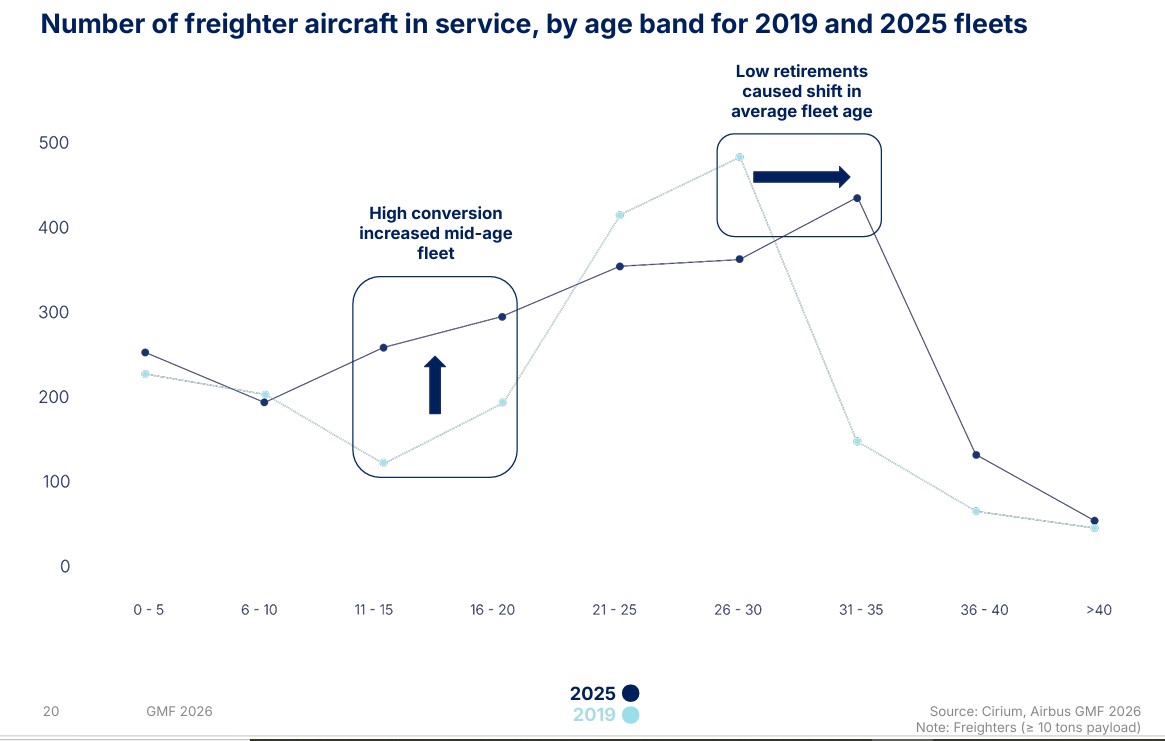
“On average, the fleet is a lot older than what it was just five or ten years ago. And that’s why there is a very strong demand for replacement aircraft, whenever they become available. Cargo airlines will decide to phase out their very old aircraft and then to phase in either new aircraft or converted aircraft,” said Francois Cabaret, head of market forecasts at Airbus, during a virtual briefing for reporters.
Freighter retirements increased in 2025 to about 75, according to Cirium.
Cabaret said that most of the demand for aircraft in the 80-ton category will be for new builds because widebody passenger aircraft are flown so many hours during their lifetimes that conversion may not make as much sense, especially with new aircraft that have better range and payload capacity.
Airbus does not have a conversion program for large jets and is incentivized to sell the new A350, based on the popular A350 passenger jet. Meanwhile, new Boeing 777 conversion forms from Israel Aerospace Industries and U.S.-based Mammoth Freighters have dozens of conversion orders as their first freighters roll out to customers.
Airbus does do aftermarket conversions of its A330-300 medium widebody jet and A321 standard airliner.
Crawford Hamilton, head of freighter marketing, was adamant that Airbus would make the first customer delivery of the A350F in late 2027, in line with previous company pronouncements. The A350F last month completed its first initial test flight and is scheduled to undergo nine months of additional flight testing, after which European civil aviation authorities are expected to certify the aircraft for commercial use.
In addition to flight testing, Airbus continuously practices loading and unloading the A350 with different types of equipment to develop optimal operating techniques for airlines to use.
Airbus has 115 orders for the A350 from 14 named customers and one unidentified. Boeing has 81 orders for its next-generation 777-8 freighter.
Click here for more FreightWaves/American Shipper stories by Eric Kulisch.
Write to Eric Kulisch at ekulisch@freightwaves.com.
RELATED STORIES:
AI gold rush transforms trans-Pacific trade and logistics
Airbus A350 freighter completes initial test flight
Boeing raises outlook for widebody freighters as 777-8 production begins
Brokerage Compliance Symposium
The day before F3. Every compliance issue you face - fraud exposure, carrier liability, FMCSA rules, cargo theft, insurance gaps - navigated by attorneys and operators defining best practices in a changing industry.
F3 Awards Dinner
The night before F3. FreightTech100 companies honored. FreightTech 25 and Shipper of Choice winners revealed live. Cocktail reception into dinner and live music - 300 industry leaders in one purpose-built room.
F3: Future of Freight Festival
Industry-defining keynotes, rapid-fire technology demos, and industry leaders networking in experiences across Chattanooga - plus the inaugural F3 Awards Dinner featuring the FreightTech and Shipper of Choice reveals.
The day before F3. Every compliance issue you face - fraud exposure, carrier liability, FMCSA rules, cargo theft, insurance gaps - navigated by attorneys and operators defining best practices in a changing industry.
The Signal at Chattanooga Choo Choo • Chattanooga, TN Register NowThe night before F3. FreightTech100 companies honored. FreightTech 25 and Shipper of Choice winners revealed live. Cocktail reception into dinner and live music - 300 industry leaders in one purpose-built room.
The Signal at Chattanooga Choo Choo • Chattanooga, TN Register NowIndustry-defining keynotes, rapid-fire technology demos, and industry leaders networking in experiences across Chattanooga - plus the inaugural F3 Awards Dinner featuring the FreightTech and Shipper of Choice reveals.
The Signal at Chattanooga Choo Choo • Chattanooga, TN Register Now