
The benchmark price used for most fuel surcharges fell this week, but the focus in oil markets is on the huge decline in futures market prices recorded Monday.
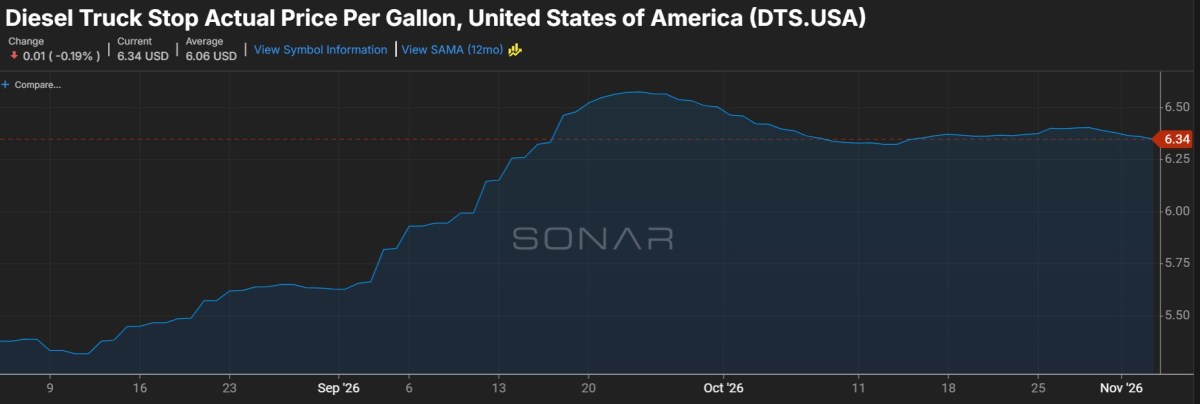
The Department of Energy/Energy Information Administration average weekly retail diesel price fell to $6.292/gallon, a decline of 6 cts/g, effective Monday, published Tuesday.
That price would not have been impacted by the stunning fall in prices Monday in futures markets, not just for ultra low sulfur diesel (ULSD) but also for crude and gasoline benchmarks.
But it would have reflected in part weakness that occurred late last month which took diesel futures prices down from more than $4.90/g to numbers closer to $4.80 or below.
Monday was the first day that the December ULSD contract was the first contract listed. The change in the ULSD price between Friday–when October was the first month–and Monday–when December was the first month–is gigantic, a decline of 36.89 cts/g.
But the more realistic decline is a comparison of the December contract over the two days, which is a still impressive 25.45 cts/g.
The outright numbers in that slide are that December ULSD settled Monday at $4.4216/g. It’s the lowest settlement since October 6 when ULSD settled at $4.4231/g.
Brent, the global crude benchmark, fell 10.94% on Monday. West Texas Intermediate, the U.S. benchmark, declined 7.36%.
Monday was the first day that the December ULSD contract was the first contract listed. The change in the ULSD price between Friday–when October was the first month–and Monday–when December was the first month–is gigantic, a decline of 36.89 cts/g.
But the more realistic decline is a comparison of the December contract over the two days, which is a still impressive 25.45 cts/g.
The outright numbers in that slide are that December ULSD settled Monday at $4.4216/g. It’s the lowest settlement since October 6 when ULSD settled at $4.4231/g.
Brent, the global crude benchmark, fell 10.94% on Monday. West Texas Intermediate, the U.S. benchmark, declined 7.36%.
As it has done so many times since the Iran war began, though to a greater degree than most prior declines, oil fell on hopeful news about negotiations between the U.S., Israel and Iran that could lead to some sort of cessation of hostilities.
Which means that things can quickly reverse if the prospect of peace turns out to be fleeting. On Tuesday, a report that Iran and the U.S. were “far from a deal” helped send the market back up. At approximately 11:30 a.m., ULSD was up 8.94 cts/g, or just over 1%, to $4.5110/g.
But Brent at that point was down 1.28%.
Trading on headlines
As oil analyst Rory Johnston said in his X feed, “The challenge remains that while any one diplomatic headline hope is very unlikely to amount to much, the market’s base case remains that this will end via some kind of deal.”
Even if the latest news does not mark a significant movement toward some sort of rapprochement, Johnson said “you gotta kind act accordingly so you don’t get run over as this latest episode runs its course.”
One irony is that the big decline came on a day when Goldman Sachs, whose oil prognostications have always been closely followed, raised its forecast for oil prices on “high supply disruption risks.”
One reason: the market will assume a high level of risk.
“We now expect markets to price in a higher risk premium, reflecting downside risks to Mideast supply, the length of past major oil supply shocks and many market participants’ view that a lasting diplomatic breakthrough will be difficult.”
Goldman Sachs gets bullish
The forecast for December at Goldman climbed to $105/b for Brent from $90. The market is near that $105 already, so what the Goldman move means is that if correct, its earlier forecast to see prices drop into the $90/b level will not come to pass and the price for next month will average a number close to where it stood Tuesday.
Jeffrey Currie is the former head of commodities research at Goldman. Since he left, and since the start of the Iran war, he has been one of the most consistent bullish voices on the price of oil.
On X Monday, he reiterated his view that commodities, including oil, are in a structural supercycle.
“The investment to support that regime has barely begun,” Currie wrote. “Oil is near $100 and drilling has hardly moved. Upstream investment is still well below its 2015 peak and refining investment sits at a decade low. Calendar 2027 Brent trades above every forecast on the Street: a long-term supply problem that nobody has yet been paid to fix.”
More articles by John Kingston
FMCSA’s Elison addresses Motus again, still no date on full repair
Waiting on EPA ‘27 rule, Rush says it might not be soon
TFI chief Bedard rips into its US LTL operations, promises change