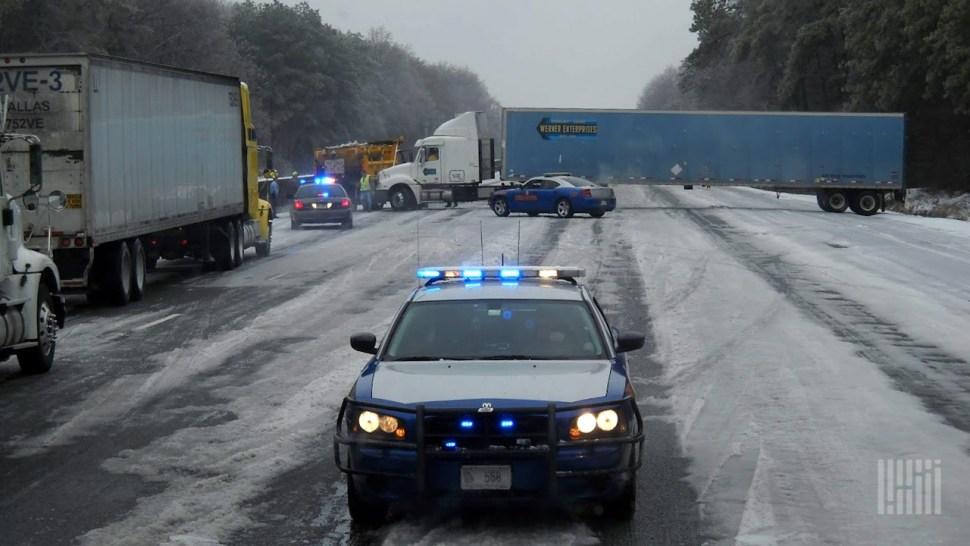
Summer’s winding down, and believe it or not, we’re less than a month away from Colorado’s annual chain law taking effect September 1. That means it’s time for another round of the trucking industry’s least favorite winter ritual: getting familiar with the patchwork of state chain laws that can make or break a driver’s day and wallet.
Chain law ignorance isn’t a defense. With some states now issuing fines approaching $900 for a single violation and penalties that can top $1,000 for blocking highways, understanding when to carry, when to install, and how to use chains properly has become a critical safety and financial issue for every driver running freight through snow country.
The big picture on chain requirements
Chain laws across the country generally fall into three categories: when you must carry chains, when you must use them, and when you absolutely cannot use them. But the devil’s in the details, and those details vary wildly from state to state.
The enforcement periods alone range from Colorado’s September 1 through May 31 mandate to more limited seasonal requirements in other states. Some states like Nevada don’t require drivers to carry chains during specific periods but mandate their use when conditions warrant and signs are posted.
Generally, only one set of snow chains is needed on any semi-trailer, regardless of the number of axles, to meet most state and local requirements; however, trucks in California may need up to eight chains in the wintertime to comply with their requirements.
For commercial drivers, the stakes are different than passenger vehicles. There is no exemption for heavy-duty commercial vehicles (over 6,500 pounds gross weight) equipped with snow tires. Chains must be installed on heavy-duty commercial vehicles whenever chain controls are posted.
States with the strictest laws
Colorado: The gold standard of chain enforcement
Colorado leads the pack with the most comprehensive and strictly enforced chain law in the country. Colorado’s commercial vehicle chain law applies to every state, federal and interstate highway within Colorado’s borders.
The key dates and requirements:
- Enforcement period: September 1 through May 31
- I-70 carry requirement: All trucks must carry sufficient chains between mile marker 259 (outside Golden) and mile marker 133 (Dotsero)
- Installation requirement: All four drive tires must be chained when conditions warrant
The penalty structure is equally serious:
- $50 plus $16 surcharge for not carrying chains when required
- $500 plus a $79 surcharge for not installing chains when required
- $1,000 plus a $156 surcharge for blocking the highway as a result of not installing chains
Colorado operates two levels of chain laws:
- Level 1/Code 17: Single-axle combination vehicles must chain up all four drive tires; other commercial vehicles need snow tires or chains
- Level 2/Code 18: All commercial vehicles with four drive tires must chain up
Oregon
The Oregon Department of Transportation (ODOT) says beginning Sept. 25, the fine for commercial vehicle drivers not using chains when required is a minimum of $880. That represents one of the steepest penalties in the country for chain violations.
Oregon’s law applies to all highways in the state. Signs will tell truckers when they are required to carry chains and when they are required to use them. Truckers will need to have six chains on hand to comply in Oregon.
California
California doesn’t require carriers to carry chains during specific periods, but when chain controls are in effect, compliance is mandatory and enforced through checkpoints.
Drivers must stop and put on chains when highway signs indicate chains are required. Drivers can be cited by the California Highway Patrol and fined if they don’t comply. Drivers will usually have about a mile between “chains required” signs and the checkpoint to install your chains.
When these screens are present, all heavy-duty trucks must stop and show Caltrans personnel that they have the required chains on board to proceed. Trucks without chains will be directed to return to a lower elevation until the weather improves.
California uses a three-tier system:
- R1: Chains required on drive axles except for 4WD vehicles
- R2: Chains required on all vehicles except 4WD with snow tires
- R3: Chains required on all vehicles, no exceptions
Washington
According to Washington’s chain law, “all vehicles with a gross vehicle weight of 10,000 pounds or more shall carry a minimum of two extra chains for use if road conditions require the use of more chains, or if chains in use are broken or otherwise made useless.”
Washington also mandates specific chain construction: chains must have at least two side chains with sufficient cross chains of hardened metal attached so that at least one cross chain touches the road surface at all times.
Nevada
Nevada doesn’t require commercial drivers to carry chains at any time of year. Truckers are required to chain up on any street or highway in the state during icy or snowy conditions, as indicated by roadside message signs.
The fine structure is more modest but still meaningful. The fee for not chaining up is usually $58, in addition to court fees, which vary from county to county.
State-by-state requirements snapshot
States with specific enforcement periods:
- Colorado: September 1 – May 31 (I-70 carry requirement)
- Idaho: November 15 – April 30 (chains permitted)
- Montana: October 15 – April 15 (chains permitted)
- Utah: October 1 – April 30 (restriction authority)
States requiring chains when conditions warrant:
- California, Nevada, Oregon, Washington, Wyoming, New Mexico, Arizona, and most other mountain states
States with seasonal restrictions:
- Alaska: Complex restrictions based on latitude and highway
- North Dakota: November 15 – April 30 only
- Wisconsin: November 15 – April 30 only
Fines and penalties by state:
- Oregon: $880 minimum
- Colorado: $50-$1,000+ depending on violation
- Utah: Up to $1,000 (Class B misdemeanor)
- Nevada: $58 plus court costs
- Washington: Up to $750 for highway closure violations
Chain types: What works and what doesn’t
Not all chains are created equal, and state laws often specify acceptable types.
Metal chains that consist of two circular metal loops, one on each side of the tire, connected by at least nine evenly spaced loops across the tread. Dual tire chains are acceptable.
Acceptable traction devices include:
- Traditional link chains: Most durable and widely accepted
- Cable chains: Lighter weight but may not meet all state requirements
- Automatic tire chains: Pneumatically deployed from the cab
- AutoSocks: Textile devices are accepted in some states like Colorado
- Wheel sanders: Systems that drop sand for traction
Tire traction devices are defined in the California Vehicle Code (VC) Section 605 as “devices or mechanisms having a composition and design capable of improving vehicle traction, braking, and cornering ability upon snow or ice-covered surfaces,” and include conventional link-type tire chains and cable chains, as well as other less conventional devices such as “Spikes Spyder.”
What doesn’t count:
- Studded tires (not considered traction devices in most states)
- Snow tires alone (insufficient for commercial vehicles in most chain law situations)
Installation basics
Snow chain laws are volatile, snow chain installation is quick and easy, only taking about 10 minutes. Doing it safely and correctly is crucial.
Basic installation steps:
- Find safe, level ground away from traffic before adverse conditions hit
- Lay chains flat with hooks and latches facing up
- Drape over the tire ensuring even distribution across the tread
- Secure inside connections first, ensuring proper tension
- Connect outside fasteners and adjust tensioners
- Drive forward a few feet and recheck all connections
Critical installation points:
- Chains must be installed on the drive axle. All-wheel drive vehicles and 4-wheel drive vehicles may have chains installed on either drive axle, but the rear axle is preferred
- Drive tires receive power from the engine and are typically located on the rear of the tractor
- You must have at least one axle chained if the trailer is equipped with brakes
Speed limitations:
Remember that all truck tire chains are designed for slower speeds, not normal highway speeds. It is recommended that you travel no faster than 30-35 mph after your chains are installed.
The business case against chaining
While chain laws exist for safety reasons, many carriers are taking a different approach to winter driving.
Some fleets don’t require drivers to use chains. If the roads are bad enough, they want their drivers to get off the roads and get to safety. If their drivers ever feel unsafe driving in the road conditions, they’re encouraged to report it to their driver managers and park until the road conditions improve. Not all fleets operate that way.
The reasoning is practical: Chains can damage your truck, your trailer, and the road. You can only go between 25 and 30 mph with them on, so you won’t make it far.
Driving with tire chains on is a rough ride. If they come loose, they can cause significant damage to your truck and tires. You can pop tires, tear up your truck, or lose mud flaps.
The operational costs add up:
- Drivers are not paid to apply tire chains. The process can take anywhere from 15 minutes to over an hour, depending on how the chains are used, how many are required and if the weather is slowing the application.
- A truck can take up to 6 chains, but those add a lot of weight. You could be looking at 1000 pounds added to your gross vehicle weight.
- Maximum speeds of 30 mph significantly extend transit times
Legal and safety consequences
Chain law violations can have long-term career implications.
Getting a ticket for violating chain laws is serious for truck drivers. Failing to pay a fine or show up in court on a predetermined date could lead to the suspension of your CDL. Beyond fines, the safety implications are real. Drivers who fail to chain up when required and subsequently cause accidents or block highways face additional liability beyond the initial fine.
Depending on how hard it was snowing when it came time to chain up, it can take about 45 minutes to an hour. The alternative might be a fatal crash.
Planning ahead
As we head into the 2025-26 winter season, preparation is key:
Before you roll:
- Check DOT websites for current chain law information in your route states
- Verify your equipment meets state-specific requirements
- Practice installation in good weather conditions
- Identify safe chain-up areas along your regular routes
Equipment considerations:
- Ensure you have the right size and type for your specific tires
- Carry extra chains for breakage situations (required in some states)
- Include tensioners and adjustment tools
- Consider alternatives like AutoSocks, which are accepted
Route planning:
- Monitor weather forecasts and road conditions
- Build extra time into schedules during chain season
- Identify alternative routes that may avoid chain requirements
- Plan for potential delays or parking situations
The bottom line is clear: chain laws are here to stay, penalties are getting stiffer, and the complexity isn’t decreasing. Whether your company policy is to chain up and keep rolling or park and wait it out, understanding the legal landscape is essential for every driver who operates in winter weather states.
As the saying goes in trucking, there are two types of drivers: those who know how to put on chains, and those who are about to learn. With September 1 just around the corner, now’s the time to make sure you’re in the first category.
Brokerage Compliance Symposium
The day before F3. Every compliance issue you face - fraud exposure, carrier liability, FMCSA rules, cargo theft, insurance gaps - navigated by attorneys and operators defining best practices in a changing industry.
F3 Awards Dinner
The night before F3. FreightTech100 companies honored. FreightTech 25 and Shipper of Choice winners revealed live. Cocktail reception into dinner and live music - 300 industry leaders in one purpose-built room.
F3: Future of Freight Festival
Industry-defining keynotes, rapid-fire technology demos, and industry leaders networking in experiences across Chattanooga - plus the inaugural F3 Awards Dinner featuring the FreightTech and Shipper of Choice reveals.
The day before F3. Every compliance issue you face - fraud exposure, carrier liability, FMCSA rules, cargo theft, insurance gaps - navigated by attorneys and operators defining best practices in a changing industry.
The Signal at Chattanooga Choo Choo • Chattanooga, TN Register NowThe night before F3. FreightTech100 companies honored. FreightTech 25 and Shipper of Choice winners revealed live. Cocktail reception into dinner and live music - 300 industry leaders in one purpose-built room.
The Signal at Chattanooga Choo Choo • Chattanooga, TN Register NowIndustry-defining keynotes, rapid-fire technology demos, and industry leaders networking in experiences across Chattanooga - plus the inaugural F3 Awards Dinner featuring the FreightTech and Shipper of Choice reveals.
The Signal at Chattanooga Choo Choo • Chattanooga, TN Register Now