




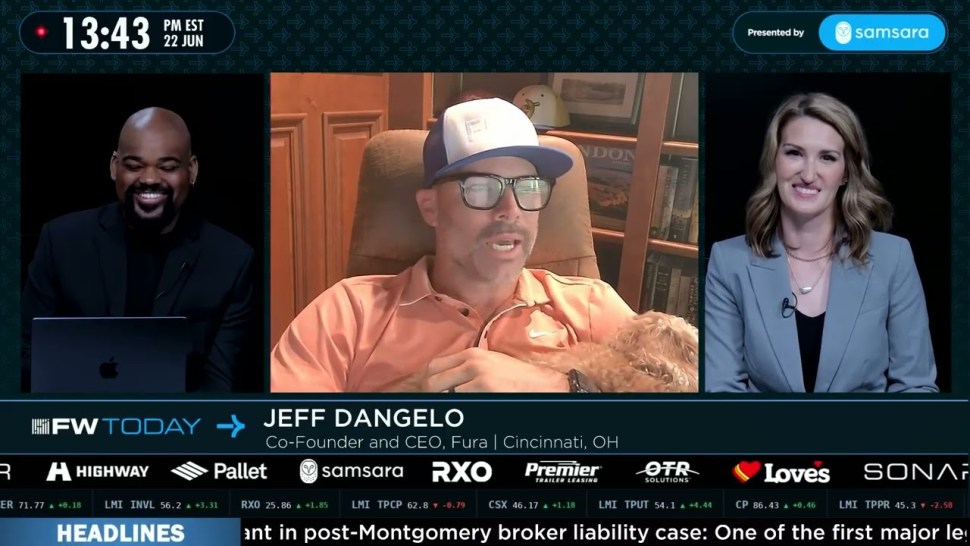
Fura's CEO Jeff D'Angelo sits down with FreightWaves to reveal how his AI-first brokerage achieved 800% growth in just three years, turning a $150K loss into $1M profit, all while operating in a challenging freight recession. Learn about their unique roll-up strategy,
Fura, an AI-first freight brokerage, grew from $10 million to $90 million in revenue over three years by combining organic growth with six acquisitions targeting brokerages in the $10 million to $30 million range. Co-founder and CEO Jeff D'Angelo attributes the expansion to a standardized operating model he likens to Chick-fil-A, offshore staffing, and process automation that holds SG&A expense to roughly 39% — well below the industry norm of 60% to 80%.
The Pinwheel acquisition illustrates the playbook: headcount dropped from 26 to 8 while the business swung from a $150,000 loss to $1 million in profit and GMV jumped from $12 million to $30 million. D'Angelo said most acquired brokerages plateau around $20 million to $30 million due to process gaps and limited technology access.
On carrier vetting, Fura uses AI-assisted compliance checks on every shipment — verifying driver, equipment, VIN, and trailer photos — with a human final review. D'Angelo said the Montgomery ruling will pressure smaller brokers without compliance infrastructure and called on large shippers to share liability risk through collaborative standard operating procedures.
- Fura targets $10Mu2013$30M brokerages, applies automation and offshore staffing to cut SG&A to 39%
- Pinwheel acquisition cut headcount from 26 to 8 and flipped a $150K loss into $1M profit
- AI-assisted compliance runs on every shipment, with human sign-off, to address post-Montgomery carrier vetting risk
Julie Van de Kamp [0:00] Welcome back. Jeff D'Angelo is the co-founder and chief executive officer of Fura, an AI-first brokerage that grew from $10 million to $90 million in 3 years. Wow. In the world'su2014 in the worst freight market he's ever seen. Jeff, welcome to FreightWaves Today. Thanks for being here.
Jeff DeAngelo [0:16] Thank you. And my dog's here too. I think I talked to your producer.
Julie Van de Kamp [0:20] Oh my goodness.
Jeff DeAngelo [0:22] She doesn't leave my lap throughout the day.
Malcolm Harris [0:25] Jeff, this isu2014
Julie Van de Kamp [0:26] So now we need to know her name and a little bit about her before we get into all the questions.
Jeff DeAngelo [0:30] So this is Birdie.
Julie Van de Kamp [0:33] So my puppy's name is Birdie.
Jeff DeAngelo [0:35] Oh, if we were going to have a female dog, which is great, she's amazing, I had to be able to name it. And I'm a big golf fan, so I had to name her something that, uh, I don't make a lot of lately.
Malcolm Harris [0:51] Hilarious. 10 out of 10. That's a great one. So, uh, well, we have Birdie in pocket, so So this is great. This is going to be a fantastic interview. Thanks again for being here, Jeff.
Jeff DeAngelo [1:00] No, thank you. I watched a little bit of the Provancha interview. He's great. He was one of our first customers at Turvo.
Malcolm Harris [1:09] Yeah, no, Jason is a phenomenal guy and great conversation. And talk to us aboutu2014 because you guys are an AI-first brokerage, $90 million run rate, built during a freight recession, may I add. Give us a 30-second version of what you're building and why specifically now, Jeff.
Jeff DeAngelo [1:26] Oh, that's a great question. So, um, not only we are an AI-based brokerage, it's really a bunch of tools, not just AI, but we're a roll-up. So we buy, you know, traditional brokerage companies. We digitize as much as we can. As a matter of fact, we focused on, you know, the perfect shipment. People call it what they will, but everything we think, uh, in the process of freight brokerage, most of it can be automated and you really have to hire for great people, like the best in the world. And for us, it's about growing inorganically, but we've grown a lot organically as well.
Julie Van de Kamp [2:09] Definitely. So tell us how, part of how you do that. So I think I read a stat that 39% SG&A expense is your number versus obviously other brokers have significant, I would say like 60 to 80% SGA expense. So how does that number define your model? How do you get there? What are you guys doing to make that possible?
Jeff DeAngelo [2:34] It's a lot of work. It's a heck of a lot of work. But, you know, we believe in, you know, what we call a zero-waste supply chain. So, you know, one of the first things we do is We offshore to amazing team members, and I think a lot of people offshore, but the folks that we offshore are, you know, they're just as good, in some ways better than our onshore, you know, folks that I've seen in the marketplace before. They're all company people, though, you know, they're not individuals. We standardized everything that we do. So, you know, one of theu2014 I was talking to someone earlier today and I said one of the things that we probably do different is we have almost like a Chick-fil-A model in that everyone answers the phone the same way. Everyone has the same sort of conversations with customers and carriers. And it makes it easier to drive costs down, not only because we get more customers that way, But, you know, we create a standard where it allows for automation and adoption of technology, which is one of the most challenging sort of things at bringing in AI or other tools. And once you do that, there's no limit to what you can automate.
Malcolm Harris [3:59] Jeff, I absolutely love that analogy about the Chick-fil-A model because it just shows kind of the continuity, right, within the organization. It also shows that everything looks and feels the same, which is definitely proceeded well, I'm sure, by your clients and customers. So I love that point that you made. I want to talk about the Pinwheel acquisition. 26 people down to 8, a swing from $150,000 loss to $1 million in profit, GMV from $12 million to $30 million. Walk us through, how does this happen?
Jeff DeAngelo [4:32] Well, you know, one of the most interesting parts about that deal is, in every deal that we do, we've done 6 deals, is a lot of the companies don't have the resources to support the folks that work with customers and work with carriers every day. So that's number 1. Number 2 is a lot of these companies, you know, they get to $20 or $30 million and it's almost like a glass ceiling. They can't grow beyond that. It becomes a plateau. Some of it has to do with process. A lot honestly has to do with technology. Um, our go-to-market strategy for organic, uh, sort of revenue is, uh, being the best in the world at literally one thing, and that's visibility. Everybody says they have visibility, but the way we roll it out is very different. So share of wallet with those folks increased significantly. Automation has allowed us to not spend as much money in those businesses. And it's really not as much about cost as it is growing that revenue and providing an amazing experience for the people, but also customers and care. Like, I'm a big believer in amazing experiences, like providing experience for everybody. Like I said, Chick-fil-A, so that you don't want to leave. You want to be a part of something that's very, very different.
Malcolm Harris [6:04] No, I'm sorry. Go, go, go right ahead.
Julie Van de Kamp [6:07] You mentioned that you guys have done 6 deals, so I imagine you have a robust M&A pipeline. What is it that you guys are looking for?
Jeff DeAngelo [6:14] It's a great question. So, um, we have done deals over, uh, we've talked about and been a part of deals over $30 million, uh, in this market. Think of like the Montgomery Rolling. The amount of impact that's going to have on our industry from those small to mid-sized brokers that can't afford to get to the next level, even if they invest, because they haven't sort of built the machine structurally from the ground up to be able to support that type of compliance. And so any, any brokerage that's usually in the range of $10 to $30 million, you know, we're targeting. And then we do a lot of research. I was watching your, uh, Craig's interview of Brad Jacobs. And he talked about research. We do a lot of research. We work with the CEOs on where the opportunities to grow revenue are, where the opportunities to have synergies, and I would say reverse synergies as well. If they have amazing people, those people would do really well in our environment to help them grow. And the first 3 months, honestly, is really about earning trust of the team. And assimilating them into the culture and then providing technology they've never had to allow them to grow the business. And, and to me, like, yeah, you're showing some of our stats, like, those kind of brokerages, you have great people wanting that kind of support and that tech that have never really had it.
Julie Van de Kamp [7:45] So you mentioned Montgomery, um, What is that doing to change how your organization works when it comes to vetting carriers? And then on the other side of that, how do you think it's reshaping what shippers are willing to pay and what they need from brokers?
Jeff DeAngelo [8:00] We could talk about this all day long. Yeah. I think if you ask different folks in different industry, they'll tell you, they'll give you a difference of opinion. I think number one, Like I said, if you don't build the infrastructure to support it on day one, you know, we have several technologies. We actually use AI to, to do compliance. There's still a human at the end saying, yep, and we do it on every shipment that corresponds with operationally and what we expect from the shippers to support having the right person, right driver, the right equipment, the right VIN number, the right pictures of all, you know, the trailer, the tractor. We do it on every shipment. And then the way we roll out visibility, it's a broad, broad thing, is we provide our toolset, not a customer portal, but an actual platform for not only the customer, but the shipper, the receiver, and what we call the constellation that surrounds that shipment. So everyone's sort of expected to collaborate around a single entity we call shipment. Not everybody does that. Not everybody has done it. So it's it puts a lot of pressure on the have-nots to do those sort of things. I kind of have a thought around what it's gonna do to shippers because a lot of the larger shippers especially, they don't care about the Carmack Law. They still force down the liability upon the brokers and we don't sign that. Like we, you know, it's hard on a broker with, you know, especially when we're acquiring companies to be able to support that. And I, I actually think shippers should take a larger role with less partners in having a common sort of goal together to either share in the, in the cost or have collaborative SOPs to ensure everybody minimizes the amount of liability across the board. Because they aren't just going to go after broker, right? If it's a shipper, they're going to go after the shipper as well.
Malcolm Harris [10:13] Now, Jeff, let's talk a little bit about growth because you've added, what, 85 new customers organically last year, but it's not necessarily 85 new salespeople. It's who salespeople only. Do I have that information correct?
Jeff DeAngelo [10:28] Yeah, um, I don't want to give everything away, but, um, it's, it's a different approach. Um, every, you know, person that we try to hire in either a senior role, um, and we don't go through everyone stays with us. Like, they loveu2014 it's a first idea wins culture or best idea wins culture. It's act like a CEO culture. And the, the sales folksu2014 sorry, I'm getting blown upu2014 but the sales folks that we have have lived in both worlds. They've lived on the tech side and they've lived on the logistics side. And when we built the sales machine, Ryan Morrow, who's an amazing CRO, uh, 12 years at TQL, but then he spent 3 years at Inception, which is a tech marketplace and platform. When we designed it, every customer goes through sort of a discovery process. It's very different than traditional brokerage going to market. That sales process identifies across customer service, finance, logistics, C-suite, and we really map out not only the organization, but the challenges. So thatu2014 and challenges could be, you know what, my customer calls our customer service people 10 times a day to say, where's my truck, or where's my document, or where that is. And so we put together a plan for everybody and we say, this is what we would do. You can try us out transactionally, but we're still going to give you the tools. And as you sort of grow with us, expect that your customers are going to get the same tools you are.. And it makes it really a differentiated process. Like I said, compared comparably, and we focus on one vertical at a time. So one of the challenges with this industry is you've got a lot of brokerages that are spraying across many different industries. And for us, it's about becoming very focused, which isu2014 you'll hear me say that a lotu2014 very focused on one vertical where everyone is close, everyone knows each other. So your reputation, if it's good, it spreads quickly. If it's not so good, it spreads quickly, probably quicker. So that's kind of been our focus. Um, and we do what's called a Constellation Sale, which I'm not going to share how it goes, but you can imagine based off of what we call it, um, how it works. And honestly, it made it very easy. This is organic, again, organic customers, not inorganic. Um, But the fastest way to grow customer base obviously is inorganic.
Julie Van de Kamp [13:05] So talk us through what you're using AI agents for. I think I read a stat that 80% of operations is automated at this point. What are the people doing versus what's automated and AI doing? And is that 20% just exceptions or are there specific roles that you keep humans doing repeatedly?
Jeff DeAngelo [13:23] So it's a great question. So we have, I would say, The AI agents and other tools, again, this isn't just about AI. AI is just a tool, right? We sort of use. And so in a lot of parts of our business, there's about 80 to 85% of automation, meaning like no human gets involved. So our AI agents, we build an algorithm, which is our toolset. It's not using a third party. To predict price and actually to bid until it wins or hits the floor. Once it sort of wins a shipment, then we automate shipment creation. And then that shipment gets shared out to our network programmatically where the carriers can book through an email or through the platform. So basically they can re-quote it, like meaning they can say, hey, instead of $500, I want $600. An AI can basically say, yep, that'll, that'll work. Then we have both an inbound and outbound, uh, agentic AI that makes calls or receives calls. Um, we were losing about 40% of our phone calls because we were so busy and we couldn't support it with people. Um, and so one of the biggest things I wanted to solve was, or we wanted to solve was number one, how do we answer every call? Like, you have to be able to manage every call. You have to be able to support every call. So right now, around 30% of our shipments are covered by some Agentic AI, usually a human, sometimes email. And the goal for me is to get to call it 90, 95% by the end of the year. Like I said, shipment creations there, document collection, track and trace. You know, we use several tools to do tracking. We have notifications set up for each person differently where it notifies them if there's an issue. Like I said, we still are a brokerage. Like, we still have to do the manual work, but it's not 100% automated. Our goal is to get there, right? Or at least, you know, have just people dealing with exceptions.
Julie Van de Kamp [15:42] So you've been around this industry, specifically freight tech, for a little while now and exposed to a lot. What do you think is sort of the biggest thing happening in this transportation landscape that we should be talking about and that people should know about?
Jeff DeAngelo [16:04] Theu2014 so I've been around for almost 25 years, so I was an earlyu2014 I'm aging myself, obviously. And the early days of, let's say, TQL or MegaCorp, again, they relied on people. And honestly, like logistics companiesu2014 sorry, I'm going to let her downu2014 logistics companies are really people-based. And what made them great historically make themu2014 I wouldn't say weak, like it's still relationships matter, but it makes it harder for them to compete in the future. When I was building Turvo, so I was a founder of Turvo, one of three, I got to be in the most interesting meetings at board level, you know, with the biggest companies in the world, with tech organizations that were building autonomous vehicles, like Volvo had some really interesting stuff. And obviously AI is gonna take over. So there are a few things that, long-winded here, but there are a few things that I think are really interesting. One is this idea of AI to AI. And so think about today how fast AI has evolved. And in the future when it's AI to AI booking, AI to AI creation, AI to AI negotiating, you think of what that impacts in our industry. It's really hard to say, but in terms of like, to people that there's not going to be as many people as there was. I'm sorry, like, I have that, that thought. Secondarily is the platforms that are built. Why would they have a user experience on top of them? There's no point because you don't have sort of humans interacting with those things. So I think that's going to happen. When I talked about Volvo, you know, you're going to haveu2014 so Volvo has a what they call Vera, like an autonomous skateboard that sits under the trailer and moves it around. You have, you know, all these testing around autonomous vehicles. I think there's justu2014 those are going to become nodes on the network that are booked, and they can be booked automatically by an AI agent. Are we there today? No. But I think in the next 5 years or so, it's, you know, it's going to evolve so quickly, faster than people would expect. Even though our industry historically has been behind in terms of innovation, It's a $1.4 trillion market in the United States. There's a lot of money going to be thrown at this from an AI perspective, and there already is.
Malcolm Harris [18:43] Jeff, I felt like, number one, I'm very, very impressed with you. But I will say Birdie is the MVP because of the behavior. I've not heard one bark. I've not heard anything. So I'm impressed with you, but Birdie is a little bit more impressive. I just have to say. To say.
Julie Van de Kamp [19:00] So, and that'su2014 she's the best.
Jeff DeAngelo [19:01] She's the best.
Malcolm Harris [19:02] Yeah, I'm a catu2014 I'm a cat dad too, so that's like really impressive for me to say that, uh, that she is the best for sure.
Jeff DeAngelo [19:08] Well, I, I couldn't put a cat up here because then I would look like Dr. Claw from like the old blade, and it would look a little weird. At least Birdie softens that, you know, that view.
Malcolm Harris [19:21] Yeah, no, I love that. I love that she softens for sure. Uh, my final question You've answered it a bit, but is there anything you can double down on in the next 5 years that people aren't necessarily paying attention to right now that you're just like, hey, you'd be an idiot not to do this. I have 25 years of experience. You should listen to me, probably.
Jeff DeAngelo [19:43] You know, I don't know if you should listen to me, but I would. All right. So one of the most interesting things that I think Iu2014 we were early on is business model innovation. So the, the market, and what I mean by that is how you make money. So the market is sort of, um, fraught with companies that make the spread between what they bill and what they pay. And some, some companies have a transparent model, but what I think is going to happen is sort of the, the hybrid between managed service in brokerage where the cost per transaction is going to go single digits. I believe that. And so, you know, the business models and how you make money can, can change. So think of, uh, you might make $25 a shipment, then you might make, you know, money on insurance, then you might make moneyu2014 like, there's, there's going to be different levels to monetize that business. But then the customers are going to have the same tools you have. So anyone that doesn't sort of transform their business, and it's really hard for people to do in companies, into sort of a new way to compete, you know, think of Charles Schwab and the $8 trade. Like, that stuff is going to happen and someone's going to step in and do it and be the first to the space.
Julie Van de Kamp [21:12] Grazie mille. All right, um, I feel like we are left with like a lot to ruminate on and I need to think about the future and my brain is gonna have to work on a little bit of this, um, but it's been great. Thank you so much for sharing all of your information, uh, and letting us hear more about your organization and we hope to talk more with you soon, uh, and again, thanks for being on.
Brokerage Compliance Symposium
The day before F3. Every compliance issue you face - fraud exposure, carrier liability, FMCSA rules, cargo theft, insurance gaps - navigated by attorneys and operators defining best practices in a changing industry.
F3 Awards Dinner
The night before F3. FreightTech100 companies honored. FreightTech 25 and Shipper of Choice winners revealed live. Cocktail reception into dinner and live music - 300 industry leaders in one purpose-built room.
F3: Future of Freight Festival
Industry-defining keynotes, rapid-fire technology demos, and industry leaders networking in experiences across Chattanooga - plus the inaugural F3 Awards Dinner featuring the FreightTech and Shipper of Choice reveals.
The day before F3. Every compliance issue you face - fraud exposure, carrier liability, FMCSA rules, cargo theft, insurance gaps - navigated by attorneys and operators defining best practices in a changing industry.
The Signal at Chattanooga Choo Choo • Chattanooga, TN Register NowThe night before F3. FreightTech100 companies honored. FreightTech 25 and Shipper of Choice winners revealed live. Cocktail reception into dinner and live music - 300 industry leaders in one purpose-built room.
The Signal at Chattanooga Choo Choo • Chattanooga, TN Register NowIndustry-defining keynotes, rapid-fire technology demos, and industry leaders networking in experiences across Chattanooga - plus the inaugural F3 Awards Dinner featuring the FreightTech and Shipper of Choice reveals.
The Signal at Chattanooga Choo Choo • Chattanooga, TN Register Now