




Businesses are rushing to secure alternative airlift for cargo shipments and bracing for higher freight rates and surcharges from airlines as continued airspace and airport closures in the Middle East due to the Iran war constrain aircraft availability and force lengthy detours, effectively reducing available capacity.
Even if the bombing were to end this weekend it would take several days to eliminate shipment backlogs at various hubs and for airlines to restore normal network activity, according to logistics experts.
“And on routes which actually have high load factors, the cargo that’s stranded will take several weeks to be cleared throughout the global network. If it’s perishable or time-sensitive cargo, it could be unsalvageable,” said Glyn Hughes, director general of The International Air Cargo Association during a media conference call on Wednesday.
The crisis could prove a boon for airlines and logistics companies as shippers look to avoid ocean shipping delays and shipping lines jettison Middle East-bound cargo in India, Sri Lanka and other locations.There could be a shift from ocean shipping to air to bypass ocean bottlenecks, which could benefit air freight pricing, said Kuehne+Nagel CEO Stefan Paul during an earnings presentation.
Air cargo volumes grew 4% year over year in 2025 and started strong this year, with demand up about 6% in the first two months and outpacing capacity growth of 4%, according to freight intelligence firm Xeneta.
Airports in Dubai, Abu Dhabi and Qatar, which are major freight transshipment hubs for trade moving between Europe and Asia, are closed to commercial traffic — with some emergency flights now allowed.
Global air cargo capacity has fallen 18% week-over-week, with 13% directly tied to large Middle East carriers like Emirates, Qatar Airways and Etihad Airways, according to air logistics consultancy Rotate.
Freighter and passenger-belly capacity has dropped nearly 40% on the Asia-Middle East/South Asia-Europe corridor, pulling global cargo capacity 21% below the pre-Chinese New Year level in mid-February, when airlines park some cargo jets because factories are closed and not exporting, said Aevean, an air logistics consulting firm.
Passenger and cargo airlines have paused service to Israel and other Middle East nations, or rerouted flights until hostilities calm down. FedEx has suspended all flights in, and around, the Arabian Gulf. Jumbo jet freighter operator Cargolux has cancelled all Middle East flights, with the exception of Muscat, Oman.
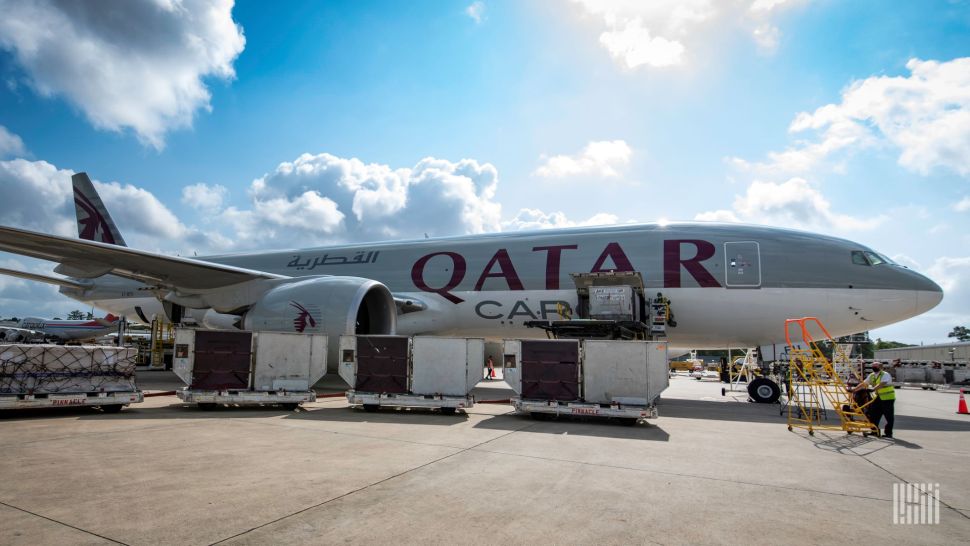
Qatar Airways Cargo, the largest non-express cargo airline in the world by traffic, said operations remain suspended because Qatari airspace remains closed. Some limited Qatar Airways Cargo freighters continue to operate on routes that don’t go through Doha. Emirates said it has begun operating sporadic passenger and freighter flights on select routes.
“About 80% of the India-Europe cargo goes through the Middle East, which means that a lot of vaccines and pharmaceuticals are not able to make their way through to Europe. If this lasts a few weeks we can anticipate drug shortages,” Hughes said.
The closure of major container shipping ports in the United Arab Emirates, Saudi Arabia and other Gulf countries could also contribute to extended lead times, particularly for sea-air shipments, integrated shipping giant Maersk said in a customer notice. Dubai, in particular, is a major connection point for shipments that move from Asia by vessel and are then transferred to aircraft for transport to destinations in Europe or the United States. The sea-air mode is used by companies looking to save money on air cargo, which can cost six-to-eight times more than ocean freight, but get faster transit times than shipping by sea.
Freight forwarders are already chartering flights to compensate for the lost capacity. Kuehne+Nagel, the world’s largest forwarder by volume, warned that backlogs of Europe and U.S.-bound cargo in Asia could begin building up by the beginning of next week.
Air cargo to the Gulf is mostly available via Riyadh, Saudi Arabia, and Oman with onward distribution via truck.
Other options for Asia exports to Europe are sea-air transload services via the Maldives, truck-air service with ground transport from Xi’an, China, to Tashkent, Uzbekistan, where shipments are reloaded on freighter aircraft, and sea-air service from China and Vietnam to Los Angeles.
Upward pressure on rates, fees
Meanwhile, air freight rates are rising sharply due to rerouting of aircraft, reduced payloads and rising fuel costs. And the effects extend far beyond the Middle East.
On the Asia-Europe trade lane there are only two routing options — north via Afghanistan then the Caucasus, or south via Oman, Saudi Arabia and Egypt — because the four-year-old Ukraine war has shut off Russian airspace for most airlines.
Long detours require aircraft to carry more fuel, limiting payload capacity and the amount of cargo that can be carried, or make time-consuming and costly refueling stops.

Carriers tend to prioritize humanitarian aid, military cargo, perishable produce, pharmaceuticals, premium shipments and contract customers over general cargo booked at the last minute, Seko Logistics reminded customers in a bulletin.
Southeast Asia-Europe shipping rates were up more than 6% to $3.82/kilogram since Friday, according to Freightos, a price benchmarking agency and freight marketplace. Freightos also showed South Asia rates to Europe up 3% and 5% to the United States; Middle East-Europe rates jumped 8% and China-U.S. rates were up 15%, although the transpacific increase more likely reflects the return of shipping demand following the two-week Lunar New Year holiday in China.
Airlines are introducing, or considering, war risk surcharges on shipments routed through or near the conflict zone, integrated shipping giant Maersk said in a customer notice. DHL Group said during its earnings call on Wednesday that its forwarding unit could impose emergency surcharges this week.
Airlines are also expected to hike fuel surcharges as the price of jet fuel goes up.
At a macro level, the war could also slow global economic growth and increase inflation, which could decrease demand for goods shipped by air.
Crude oil prices are surging, with tanker access through the Strait of Hormuz effectively cut off and Gulf energy facilities being struck by Iranian missiles raising worries of supply shortages. Brent oil, the international benchmark, rose to $88 on Thursday, up from $61 at the end of last year. Some experts are predicting oil prices to reach $100 per barrel or more. Economists say the impact of high oil prices on the economy could be short-lived if the war ends soon.
Global aviation fuel rose 3.6% last week to $99.40 per barrel, while U.S. jet fuel increased from $2.50 to $2.83 per gallon.
Investment bank Goldman Sachs estimates that each $10 per barrel increase in oil prices would reduce U.S. economic growth this year by about 0.1 points if prices stabilize at a higher level and weigh on households’ disposable income, limiting their spending. Goldman Sachs research finds that a sustained 10% increase in oil prices boosts U.S. headline inflation by 28 basis points (0.28%). If oil prices increase by $10 and remain elevated for three months, inflation would likely rise from 2.4% in January to 3% in May, according to the bank.
The U.S. Supreme Court’s ruling against President Donald Trump’s use of sweeping emergency tariffs was expected to slightly help increase consumption and imports this year, albeit at lower levels than in 2025, but the Middle East conflict is likely to weaken imports more than gain from lower tariffs, said Paul Bingham, director of transportation consulting, economics and country risk at S&P Global Market Intelligence, on the “Freight Buyers’ Club” podcast this week.
Click here for more FreightWaves/American Shipper stories by Eric Kulisch.
Write to Eric Kulisch at ekulisch@freightwaves.com.
RELATED STORIES:
DHL offers unusual truck-air transport between China and Europe
Air freight rates expected to rise as Iran war escalates
Kuehne+Nagel to lay off 2,000 workers amid weak demand, AI push
Brokerage Compliance Symposium
The day before F3. Every compliance issue you face - fraud exposure, carrier liability, FMCSA rules, cargo theft, insurance gaps - navigated by attorneys and operators defining best practices in a changing industry.
F3 Awards Dinner
The night before F3. FreightTech100 companies honored. FreightTech 25 and Shipper of Choice winners revealed live. Cocktail reception into dinner and live music - 300 industry leaders in one purpose-built room.
F3: Future of Freight Festival
Industry-defining keynotes, rapid-fire technology demos, and industry leaders networking in experiences across Chattanooga - plus the inaugural F3 Awards Dinner featuring the FreightTech and Shipper of Choice reveals.
The day before F3. Every compliance issue you face - fraud exposure, carrier liability, FMCSA rules, cargo theft, insurance gaps - navigated by attorneys and operators defining best practices in a changing industry.
The Signal at Chattanooga Choo Choo • Chattanooga, TN Register NowThe night before F3. FreightTech100 companies honored. FreightTech 25 and Shipper of Choice winners revealed live. Cocktail reception into dinner and live music - 300 industry leaders in one purpose-built room.
The Signal at Chattanooga Choo Choo • Chattanooga, TN Register NowIndustry-defining keynotes, rapid-fire technology demos, and industry leaders networking in experiences across Chattanooga - plus the inaugural F3 Awards Dinner featuring the FreightTech and Shipper of Choice reveals.
The Signal at Chattanooga Choo Choo • Chattanooga, TN Register Now