For the last 48 hours, a single inspection report has been blowing up timelines across trucking social media. Not because of a brake issue. Not because of a weight violation. Not even because of an ELD malfunction.
It’s blowing up because of one line buried inside the violation notes — a line many drivers never expected to see on official enforcement paperwork:
“FLOCK LPR HITS CONFIRM VEHICLE DRIVING…”
That’s right. The inspection cites Flock Safety, a camera system normally used by police departments, neighborhoods, and municipalities to identify vehicles by license plate. According to the report, the system spotted the truck traveling under a load while the driver’s log showed Off-Duty (or PC) status.
And that discovery triggered a falsified log violation.
Whether you agree with how the driver was logged or not, the shockwave wasn’t about the violation — it was about the tool used to detect it.
Folks weren’t asking, “Did the driver mess up?” They were asking, “Since when is DOT using outside cameras to check our logs?”
And that’s where this story gets bigger.
The Citation That Sparked the Conversation
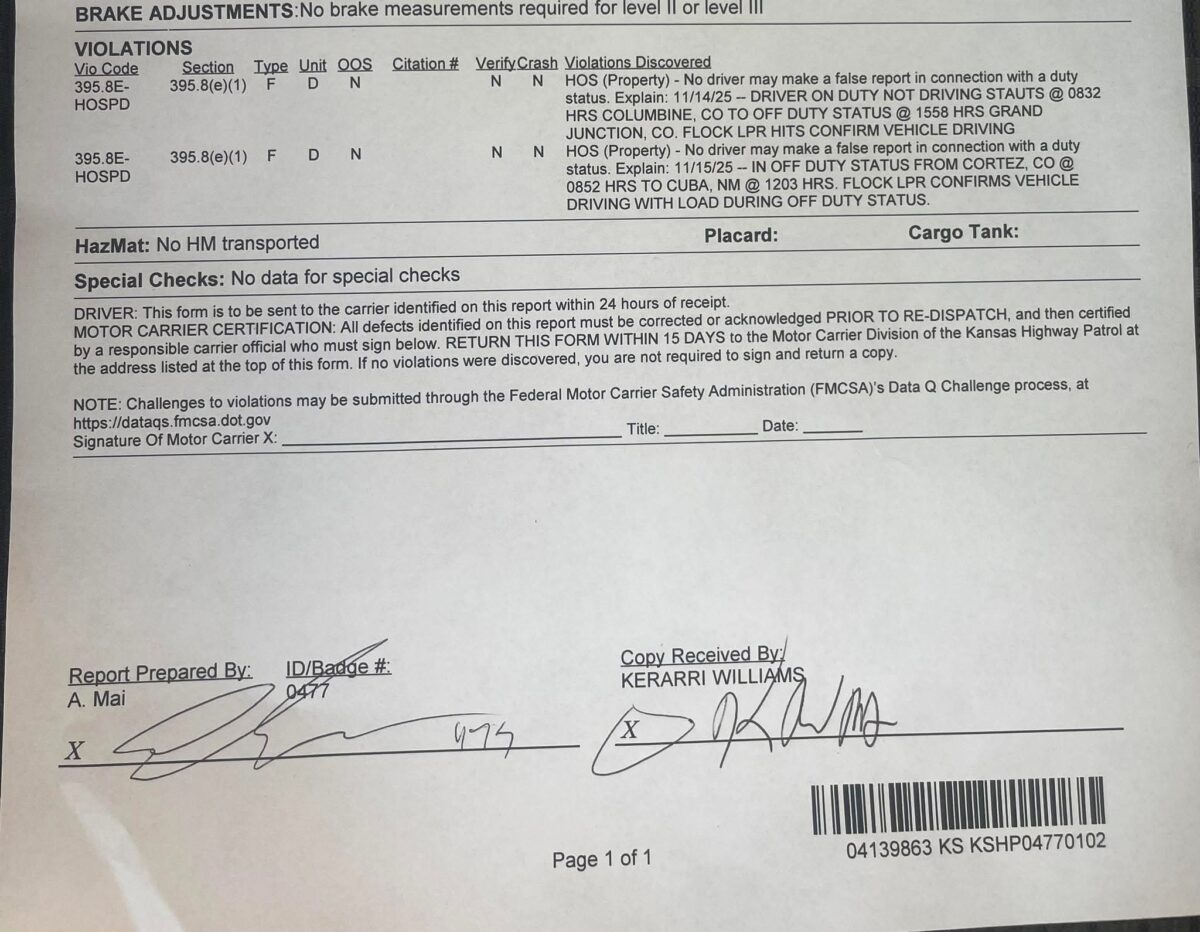
Here’s the issue at the center of the debate — the inspection report….
The officer listed two HOS falsification violations. What made it unusual was the language used to “confirm” the movement:
- “FLOCK LPR HITS CONFIRM VEHICLE DRIVING”
- “FLOCK LPR HITS CONFIRM VEHICLE DRIVING WITH LOAD DURING OFF DUTY STATUS”
For many drivers, this is the first time they’ve seen Flock Safety mentioned on federal enforcement paperwork. And that alone raises questions:
- Is DOT pulling commercial traffic data from Flock systems?
- Are third-party camera networks becoming tools for HOS enforcement?
- If a private system can be used to verify movement, what’s next?
No matter where you stand, this is no small shift.
Flock Safety openly markets its ability to help law enforcement reconstruct the movement of vehicles. Thousands of police departments use the system. Several state DOTs also partner with local agencies where these cameras are installed near commercial corridors.
But seeing that data show up directly in a log-falsification citation? That’s new.
Why Drivers Reacted So Strongly
When the citation surfaced online, it quickly crossed into X/Twitter.
It wasn’t just a joke — it was a change in expectation.
Drivers already feel a certain way about ELD monitoring. They are not big fans of telematics. They argue about AI dashcams. But this moment cut deeper because:
- The camera wasn’t inside the truck.
- The carrier didn’t install it.
- The driver didn’t consent to it.
- The system wasn’t designed for trucking compliance.
The system just happened to exist — and still ended up being used to validate an enforcement action.
That crosses into a much bigger question:
If DOT can use video evidence from an outside network… how much of the road is already being recorded?
A Trend We’ve Been Watching: Infrastructure Tech Is Getting Smart — and Trucking Is the Test Bed
Earlier this month, we covered another story about technology creeping into freight movement: a major truck-scale modernization project that could bring plate readers, automated weight checks, and real-time vehicle tracking into the inspection process.
That project wasn’t Flock. It wasn’t enforcement yet. But it hinted at the same direction:
Roadside enforcement could slowly be shifting toward digital verification.
Not simple random inspections. Not guessing. Not hoping the officer catches someone in the act.
Instead, the trend is moving toward automated triggers:
- License-plate captures
- Time-stamped movement logs
- Integrated weigh-station data
- Cameras tied to toll systems
- Sensors linked to infrastructure grants
The citation from Kansas suggests that trend may be accelerating faster than many expected.
When viewed in that context, a Flock hit showing up in an HOS violation isn’t an isolated moment — it’s part of a broader transformation of how highways are monitored.
Is DOT Actively Partnering With Flock? Here’s What We Know (and Don’t Know)
What we know:
- Nothing in FMCSA regulations prevents an officer from using publicly available or law-enforcement–shared information as evidence of movement.
- Many municipalities deploy Flock cameras near major roadways.
- If law enforcement has access to a traffic database, they can use it during an investigation or roadside stop.
- The citation clearly cites Flock as the confirming source.
What we do NOT know:
- Whether this was a one-off decision by a local officer
- Whether the state has a direct partnership with Flock
- Whether FMCSA endorses the use of this technology
- How widespread the practice is
- Whether this becomes standard across states
There is no public guidance — yet — that says DOT is officially integrating private-sector LPR data for HOS enforcement.
But enforcement patterns often evolve before the official memos catch up.
Why This Matters for Drivers — Even If You Run Legal
This isn’t about helping someone cheat logs. This is about what enforcement looks like going forward. The introduction of third-party camera verification creates a different landscape for every driver, including the ones who run compliant:
1. Off-Duty Personal Conveyance Could Face Scrutiny
If cameras can verify movement during off-duty time, you could expect officers to question PC more aggressively in the future.
2. Detention-heavy shippers or trailer swaps could trigger mismatches
If your log says one thing and the camera sees another, even innocent mistakes could cause problems.
3. Rural enforcement could tighten
Flock cameras could be placed on small-town intersections and local highways — the exact places truckers assume are “quiet.”
4. Carriers must prepare for more digital verification
If infrastructure modernization continues, log falsification won’t depend on an officer following you — it will depend on the combination of that and the network watching the corridor.
Is This the Beginning of AI-Assisted HOS Enforcement?
Not officially. But the path is clear: As more cities adopt new systems, more weigh stations add digital sensors, and more states experiment with automated pre-clearance and monitoring, enforcement becomes less about catching a moment — and more about reconstructing a narrative.
Think of it like this:
Five years ago: ELDs were one of the only digital sources of truth.
Today: Your movement can be verified by multiple independent systems. In five more years? It could be standard operating procedure.
So… Are Cameras Watching You Drive Off-Duty?
The honest answer:
Not directly intentionally, not universally — but the capability absolutely exists. And enforcement just proved it’s willing to use that information.
This isn’t a scare tactic. It isn’t a conspiracy. It’s simply a sign of where highway technology is evolving.
And the trucking community needs to understand that early — before the next wave of regulation arrives.
The Bottom Line
Whether you’re a one-truck owner-operator or running a small fleet, this moment is a reminder of a new reality:
Compliance isn’t just what your ELD says anymore. Compliance is what the road sees.
And as infrastructure upgrades continue — from smart scales to enhanced camera networks — the gap between real-world movement and logged movement will only get smaller.
For now, this one citation is just a spark. But sparks usually mark the beginning of a much bigger fire.
Brokerage Compliance Symposium
The day before F3. Every compliance issue you face - fraud exposure, carrier liability, FMCSA rules, cargo theft, insurance gaps - navigated by attorneys and operators defining best practices in a changing industry.
F3 Awards Dinner
The night before F3. FreightTech100 companies honored. FreightTech 25 and Shipper of Choice winners revealed live. Cocktail reception into dinner and live music - 300 industry leaders in one purpose-built room.
F3: Future of Freight Festival
Industry-defining keynotes, rapid-fire technology demos, and industry leaders networking in experiences across Chattanooga - plus the inaugural F3 Awards Dinner featuring the FreightTech and Shipper of Choice reveals.
The day before F3. Every compliance issue you face - fraud exposure, carrier liability, FMCSA rules, cargo theft, insurance gaps - navigated by attorneys and operators defining best practices in a changing industry.
The Signal at Chattanooga Choo Choo • Chattanooga, TN Register NowThe night before F3. FreightTech100 companies honored. FreightTech 25 and Shipper of Choice winners revealed live. Cocktail reception into dinner and live music - 300 industry leaders in one purpose-built room.
The Signal at Chattanooga Choo Choo • Chattanooga, TN Register NowIndustry-defining keynotes, rapid-fire technology demos, and industry leaders networking in experiences across Chattanooga - plus the inaugural F3 Awards Dinner featuring the FreightTech and Shipper of Choice reveals.
The Signal at Chattanooga Choo Choo • Chattanooga, TN Register Now