

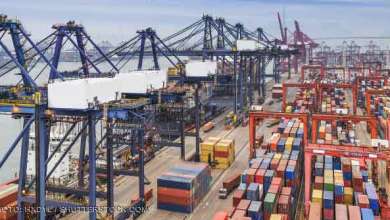
Port of Long Beach reports record January
The Southern California seaport handled 657,830 TEUs of containers in January, 12.9 percent more than in January 2017, and an all-time high for the month.

Chicago-based freight broker and third-party provider Echo Global Logistics posted a net income of $13.3 million in the fourth quarter of 2017 compared to a $3 million loss the previous year, according to the company’s most recent financial statements.
The containership owner recorded a net income of $22.8 million for the quarter, a sharp increase from a net loss of $446.6 million for the fourth quarter of 2016 when it had encountered headwinds from the aftermath of Hanjin’s insolvency.
Net orders for North American Class 8 trucks in January 2018 jumped 28 percent from the previous month and 116 percent compared with January 2017, according to preliminary data from freight forecaster FTR Transportation Intelligence.
MSC selects Terminal Investment Limited (TiL) CEO, Port of Redwood City executive director retires, the Suddath Companies appoints president of Global Logistics, and the Chartered Institute of Procurement & Supply (CIPS) names group CEO.
Uber CEO Dara Khosrowshahi said that although his company and Waymo parent Alphabet “won’t agree on everything going forward, we agree that Uber’s acquisition of Otto could and should have been handled differently.”
The Taiwanese shipping company revealed Monday that it has entered into an agreement with Shoei Kisen Kaisha to charter 12, 11,000-TEU containerships.
Upon completion of the merger of Japan’s NYK, “K” Line and MOL, the combined Ocean Network Express (ONE) will begin taking slots on three existing services between Asia and the west coast of Latin America.
The latest projection comes as ports covered by the National Retail Federation’s Global Port Tracker handled 1.72 million TEUs of imports in December and 20.5 million TEUs for 2017, year-over-year increases of 8.4 percent and 7.6 percent, respectively.
The South Korean shipbuilder posted a net loss of KRW 572.3 billion for the quarter, compared to a net loss of KRW 351.8 billion for the fourth quarter of 2016.
The United States exported $7.27 billion worth of beef and $6.49 billion worth of pork in 2017, up 15 percent and 9 percent year-over-year, respectively.
The third-party logistics and multi-modal transportation services provider recorded a net income attributable to common stockholders of $3.3 million for its fiscal year 2018 second quarter, which ended Dec. 31, 2017, a 58.6 percent year-over-year increase.
The non-vessel-operating common carrier entered into a partnership with Globelink Aeroceano in Costa Rica and Guatemala, and Sicarga in Panama.
The International Maritime Organization’s Subcommittee on Pollution Prevention and Response has proposed to move forward with banning the transport of non-compliant low-sulfur fuel on board ships when the 0.5 percent low sulfur limit takes effect in 2020.
While spot rates from Shanghai to Europe and the Mediterranean remained relatively unchanged since last week, rates from Shanghai to the U.S. trades had declined, according to the Shanghai Shipping Exchange’s Shanghai Containerized Freight Index.
The Thomasville, N.C.-based less-than-truckload carrier recorded a net income of $463.77 million on revenues of $3.36 billion in 2017, up 56.8 percent and 12.3 percent year-over-year, respectively.
The Southwestern Louisiana port will move forward with dredging its west barge basin after the port authority’s board approved a $1.3 million dredge contract with Coastal Dredging Co.
The cargo operation of Delta Air Lines expanded Pharma 4 to eight additional destinations, giving it 49 pharma stations worldwide, in addition to nine approved facilities in Europe that are operated with partner airlines.
Danish shipping giant A.P. Møller-Maersk narrowed its overall loss to $1.16 billion for 2017, a year in which it divested its energy businesses and acquired container carrier Hamburg Süd.
The U.S. goods and services deficit jumped 12.1 percent to $566 billion in 2017, its highest level since 2008, according to the most recent data from the Commerce Department’s Bureau of Economic Analysis (BEA).