Upstream pricing: Something has to give — Freightonomics
As consumer prices creep higher, Anthony Smith and Zach Strickland use this episode of Freightonomics to examine the upstream price increases driving inflation at the consumer level.

FreightWaves adds a new way to measure capacity changes in the domestic freight market to its SONAR platform.
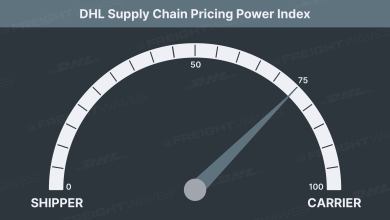
Shippers may have had a little more success with contracted carriers in May, but it came at a high cost.
Reefer rejection rates tumbled once again over the past week, and the national reefer rejection average is now below 40% for the first time since the second week of September.
On this episode of Freightonomics, Zach Strickland and Anthony Smith talk about OEMs’ supply chain issues and how they may keep the current transportation cycle tighter longer.
Unlike freight demand, the typical things we see play out on the capacity side of the equation prior to a holiday have not (at least to this point).
FreightWaves and Turvo announced that FreightWaves SONAR will be added to the Turvo collaborative logistics platform.
Shippers continue to struggle to find a reliable way to get freight into the U.S., which is causing major changes to surface transportation patterns.
Freight demand is not going to abate in the next few months, and there will not be any meaningful addition to fleet capacity in the meantime. This is a carriers’ market and will stay such throughout the summer.
In 2019 shippers crammed warehouses full of inventory coinciding with a stagnant freight market. As warehousing capacity tightens, could this contribute to the already tight transportation space?
Anthony Smith and Zach Strickland hit the ground running in their first hourlong episode of Freightonomics.
are pumping across the country, but it seems routing guides have finally shown signs of improvement. Pair the declining electronic tenders with declining tender rejections, fewer spot volumes, and both contract and spot rates headed lower, the picture of an improving environment can be visualized.
The industrial sector is trying to recover faster than transportation can react. There are numerous factors limiting the economic recovery, illustrating that it is harder to turn production back on than off.
On this episode of Freightonomics, Zach Strickland and Anthony Smith look at rising prices in commodities and continued shortages of products in the United States.
Many carriers expanded their fleets after the 2018 freight boom and were rewarded with an extremely challenging oversupplied market in 2019. The current pattern looks eerily similar to early 2018, but are they comparable?
Freight demand is not going to abate in the next few months, and there will not be any meaningful addition to fleet capacity in the meantime.
On this episode of Freightonomics, Anthony Smith and Zach Strickland spotlight the dramatic nature of the maritime world and look at how important timing is to shipping success.
Containers have been in short supply, exacerbated by gross trade imbalances between the U.S. and China. The surging flow of empties moving back to the West Coast implies the ships won’t be slowing anytime soon.
Imagine a world where companies have full visibility of their complete supply chains’ carbon emissions. FreightWaves Carbon Intelligence offers that insight to SONAR users.
Where can you find transportation options that fit your budget? On this episode of Freightonomics, Zach Strickland and Anthony Smith try to help you find what works.