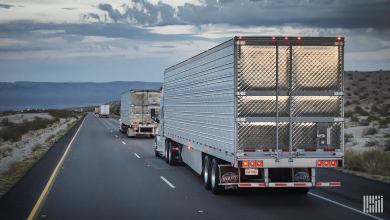
Climate pledges vs. climate action
United Nations Secretary-General António Guterres last week addressed the importance of doing more to decrease greenhouse gas emissions.
Freight Intel brings all shipping activities onto one platform, allowing shippers to access all their data in seconds.
Bob Bortner of IMI dives into the most effective fuel-saving strategies when combating exorbitant fuel prices.
Reliance Partners’ Robert Kaferle explains that you’ve got to do some digging to identify your safety risks.
DDC Sync allows drivers to use a mobile app with intuitive smart capture to instantly take high-quality images of bills of lading (BOLs) that are then processed with the driver’s terminal staff or operation staff of DDC.
Companies that have historically treated drayage and other inland transportation services as an afterthought will need to shift this mindset in order to survive in the current maritime environment.
While hydrogen fuel cells offer a promising alternative to ozone-threatening diesel engines, creating an electric-friendly infrastructure will require dedication from government regulators, equipment manufacturers and industry players alike.
The Securities Exchange Commission, in a 3-to-1 vote, has given initial approval of a rule that would require all public companies to report on the climate-related impact of their businesses.
In the market today, more and more companies in freight are turning to brokerage companies for help.
The average percentage of ocean carrier invoices with missing or wrong information jumped from a historical average of 18% to over 45% in 2021.
The former Mexican chief negotiator for the USMCA highlights the nation’s economic and trade advantages.
Optimal Dynamics aims to alleviate the uncertainty about freight movement today and in the future.
Tenstreet’s goal is to make processes easier for drivers and carriers alike. In 2022, that means making a driver’s smartphone a one-stop shop for as many tasks as possible.
In a highly regulated industry like transportation, technology is becoming increasingly paramount.
Carriers can become significantly more sustainable by simply focusing on solutions that make their fleets more efficient, reducing miles driven to move each load and cutting down on emissions.
Convoy has released its Q1 2022 Carrier Sustainability Survey in conjunction with this week’s Mid-America Trucking Show (MATS).
As farmers prepare for harvest, shippers should ready themselves for the seasonal rate increases and capacity shortages that accompany fresh fruits and veggies each year.
Developing a strategy to overcome the uncertainties in today’s economy, should be a key component of any company’s business plan, if they wish to remain in business.
Reliance Partners’ Brian Runnels and Robert Kaferle discuss ways to avoid unnecessary stresses with proper planning.
Consumers are becoming more aware of both the urgency of climate change and the complexities of the supply chain. Companies should be prepared for consumers to start calculating supply chain sustainability into their purchasing decisions.